Call or Text: +1 (208) 425-2990
Email: Sales@DroneSprayPro.com

5 Spray Drone Specs That Affect Daily Acres
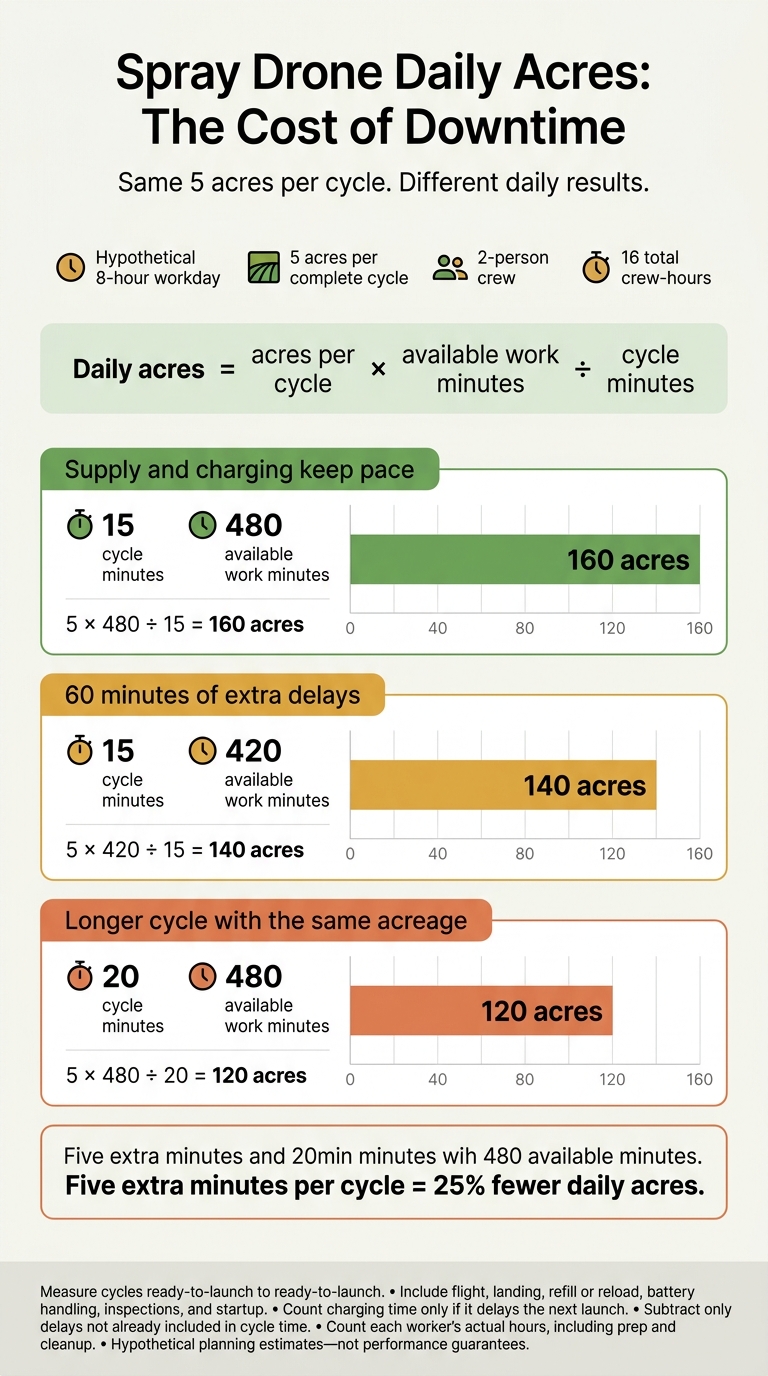
I compare spray drones by acres finished per day - not acres per hour. In a hypothetical 8-hour workday, covering 5 acres per cycle yields 160 acres with 15-minute cycles, but only 120 with 20-minute cycles. That’s 25% fewer acres from five extra minutes per cycle.
Here are the five specs I check together:
- Tank capacity: How many acres can I spray per load at the label-required gallons per acre (GPA)?
- Spray flow rate: Can the pump maintain that GPA at my planned speed and pass spacing?
- Effective spray swath: How much ground can each pass cover with even spray coverage?
- Loaded flight time: Will the battery last long enough to spray the load and land with a safe reserve?
- Battery charging time: Can charging and cooling keep pace with flights?
My starting point is <u>the label-required GPA and actual spray window (using a high-capacity ABZ L30 Agricultural Drone)</u>. Then I count refills, turns, battery swaps, charging waits, field moves, and each worker’s hours. The goal is a setup my crew can keep running safely - not the best single-flight result.
HUGE Spray Drones Do 400 Acres In One Day!
sbb-itb-3b7eef7
Set the Application Rate and Work Hours
Read the label’s Directions for Use. Record the product rate and required spray volume in gallons per acre (GPA).[4][5] Check that the label permits the crop, site, and application method. Never use a GPA below the label’s requirements.
Map field boundaries, terrain, obstacles, waterways, and no-spray buffers. Then divide the acreage into flight blocks and choose refill points to reduce turns and repositioning.
Before scheduling, check the water supply, filtration, truck access, charger capacity, battery count, and cooling time. Assign crew members to mixing, loading, and battery handling so everyone knows their role.
Schedule around the actual spray window - not just crew availability. Account for label restrictions, field access, breaks, checks, and cleanup. Mixing, loading, charging, and moves between fields also take time.
Charging and refilling can happen while a drone flies, but only when the power supply, equipment, and crew can support both tasks. These limits determine how the sprayer drone specs translate into acres per day.
With the work window set, start with tank capacity.
1. Tank Capacity
Acres per Load
Acres per load = usable tank gallons ÷ GPA. Calculate with usable volume, not the tank’s advertised maximum.
At 2 GPA, 10 usable gallons covers 5 acres before accounting for residual liquid, overlap, or calibration checks.[6]
For tanks measured in liters, 1 liter ≈ 0.264 U.S. gallons. A 50-liter tank holds about 13.2 gallons.[7]
Refill Downtime
At 2 GPA, a 100-acre job requires about 200 gallons of tank mix.[6] A 10-gallon usable tank would require roughly 20 loads, while a 50-liter tank - about 13.2 gallons - would require about 16 loads.[6][7]
Fewer loads mean fewer refill stops. But a slow transfer pump can wipe out that time savings. Match tank size to refill throughput, not just storage capacity.
Crew Workload
Larger loads reduce refill frequency, not the total spray volume needed. Solo operators need a tank they can refill safely with their available equipment. Two-person crews using a nurse tank and transfer pump can handle larger tanks more efficiently.
Compare total crew-hours, not just loads per day.
Payload and Field Limits
Water weighs about 8.34 pounds per gallon:
A 10-gallon load adds roughly 83 pounds, while 13.2 gallons adds about 110 pounds.
Check payload limits and the weight of the mix. Extra weight increases energy use and shortens loaded flight time, which can cancel out refill savings. Larger tanks offer less help in fragmented fields or those with many obstacles, where landing with unfinished loads costs coverage time.
With tank size set, spray flow rate determines how fast each load runs out.
2. Spray Flow Rate
Coverage Rate
GPA = 495 × flow in GPM ÷ (speed in mph × effective swath in feet). To calculate the flow you need, use GPM = GPA × mph × swath ÷ 495.
Higher flow lets you travel faster while keeping the same GPA. Higher GPA, on the other hand, means fewer acres per load. If the pump can’t maintain the target flow, slow down.
Flow must match speed and swath.
| Flow | Use case | Tradeoff |
|---|---|---|
| Low | Low-volume applications | May limit travel speed |
| Moderate | Routine work at the target GPA | May limit peak coverage speed |
| High | Faster travel at the same GPA | Adds no acres if field conditions limit speed |
Refill Downtime
Higher flow is not the same as higher GPA. Higher GPM empties the tank faster, shortening the time between landings. Higher GPA reduces acres per load and increases the number of loads needed. Compare acres per load - not just spray time.
Crew Workload
With less time between landings at higher flow, the crew must load and mix fast enough to keep up.
Field Limits
Calibrate with clean water rather than relying on the displayed setting alone. Pump capacity, filters, pressure, and nozzle or atomizer operating ranges all limit usable flow. Use higher-flow nozzles or atomizer settings instead of increasing pressure to force more output. Keep the label-required droplet size.
Check flow control during acceleration, deceleration, turns, and low-tank conditions. Terrain and wind may keep you from reaching the speed needed to make use of maximum flow.
Follow the current product label’s application-method, volume, and drift restrictions. More carrier does not permit more product per acre.
Once flow is set, swath width becomes the next limit on acres per day.
3. Effective Spray Swath
Coverage Rate
Once flow is fixed, swath width becomes the next limit on daily acres.
Effective swath is the verified width that delivers uniform deposition, not the rotor span or advertised maximum spray width. It determines how much ground each pass covers before accounting for downtime.
Theoretical acres per hour = mph × effective swath in feet ÷ 8.25. Use verified pass spacing, including any needed overlap. This calculation excludes turns, refills, battery changes, and other downtime.[9]
Crew Workload
Greater verified pass spacing means fewer passes and turns. Too much overlap wastes time and product, while skips require corrective passes. Set spacing based on tests of overlapping passes - not the outer edge of the card pattern.[9]
Field Limits
Place water-sensitive cards across the flight path. Test at the intended height, speed, nozzle or atomizer setting, spray volume, and droplet size. Verify performance with the intended product mixture, then check adjacent passes and different tank-fill levels. Repeat testing after changing settings or products. Test in the target crop, since bare-ground results may overstate usable width.[9][10]
Trees, power lines, waterways, and irregular boundaries require detours, shorter runs, and extra turns. Count boundary passes, turns, and detours as crew time that does not add acres. A broader spray pattern helps only when deposition stays uniform and drift stays within label limits.[9][10]
Next, flight duration determines how long the aircraft can maintain that swath before landing.
4. Loaded Flight Time
Tank size, flow, and swath set the pace. Loaded flight time determines how long you can keep that pace.
Use loaded spray time - not hover time or empty-tank flight time.[11] Check whether published endurance accounts for spray-on time, transit, takeoff, return, and landing reserve.
Acres per Cycle
Compare tank-limited acres with battery-limited acres. The lower number controls each cycle. A battery-limited flight ends with liquid still in the tank. A tank-limited flight ends before the battery reaches its landing reserve.
That lower number sets practical acres per sortie and helps estimate crew idle time. Confirm both figures with a timed field test.
Battery Downtime
Daily acres = acres per cycle × available work minutes ÷ minutes per cycle.
Measure each cycle from ready-to-launch to ready-to-launch. Include flight, landing, refill or reload, battery handling, inspections, and startup. Count charging time only if it delays the next launch.
Crew Workload
Shorter cycles mean more landings, refills, battery swaps, and safety checks per acre. Assign these tasks before estimating output.
When refill and battery work overlap, use the elapsed time to calculate cycle length. But count every worker’s time when calculating acres per crew-hour.
Field Limits
Payload, wind, temperature, elevation, battery age, and travel distance between fields reduce usable endurance.[12] Log spray-on time, total flight time, acres treated, refill time, battery temperature, wind, and state of charge.
Schedule acreage and labor using a conservative range from representative field runs - not your best flight.
Charging time is the next bottleneck.
5. Battery Charging Time
Daily Coverage
Count ready batteries, not total inventory. Daily output stalls when charging can’t keep up with flights. If aircraft return faster than batteries recharge, charger throughput limits how many acres you can cover each day.
Charging Downtime
Fast-charge claims depend on the model and charging conditions. Check the charge range, input power, temperature, and number of charging slots used to support the claim. Ask whether the stated time includes cooling. A multiport charger may slow down when charging several packs at once.
Use recharge time, pack count, and simultaneous charging slots to size your battery pool and charger capacity. Together, these factors determine whether charging will hold up the day’s work.
Actual recharge time varies with battery state, temperature, charger settings, and power supply.[13][14][15]
Crew Workload
Assign one ground worker to remove, inspect, label, and monitor packs. Use the approved charger in a ventilated area.[16]
Field Limits
Add batteries only when pack rotation - not charger speed - is holding up flights. Include charging rate, pack count, and cooling delay in the daily-acre and crew-hours calculation that follows.
Calculate Daily Acres and Crew-Hours
Spray Drone Daily Acres: The Cost of Downtime
Once tank capacity, flow, swath, flight time, and charging time are set, use them to estimate daily acres and crew-hours.
Base the estimate on the full work cycle - not flight time alone. Track labeled GPA, usable gallons, acres per tank, flow at the planned speed and swath, loaded endurance, turns, transit, refills, battery swaps, charging waits, weather delays, operating window, and crew needs. Set the operating window using FAA limits and label requirements.[8][2] Use the lowest acres-per-cycle limit imposed by tank capacity, flow, swath, and loaded endurance.
Calculate acres per tank = usable gallons ÷ GPA.[8] Then check GPM = GPA × mph × swath width in feet ÷ 495.[9] If flight time runs out before the tank does, use the flight-limited acreage per cycle. Time several consecutive cycles, including ground handling, rather than using the fastest flight as your estimate.[8]
Daily acres = acres per cycle × available work minutes ÷ cycle minutes. Subtract only delays that aren't already included in cycle time. Here's how extra delays and longer cycles reduce daily output:
Hypothetical scenario Acres per complete cycle Cycle minutes Available work minutes Daily acres Crew size Total crew-hours Supply and charging keep pace 5 15 480 160 2 16 60 minutes of extra delays 5 15 420 140 2 16 Longer cycle with the same acreage 5 20 480 120 2 16
Count each person's actual work hours, not just drone time. Total crew-hours include prep, field work, refills, battery handling, cleanup, and closeout. Assign those tasks before assuming a second worker will shorten the cycle. If one person must stop flying to handle them, include that time in the measured cycle.
Conclusion: Match the 5 Specs to Your Fields and Crew
Use the cycle math above to compare models by daily acres, not brochure acreage. Choose the system that can repeat the most productive, safe, calibrated spray cycle throughout your workday. Its specs need to fit your water supply, power, batteries, and crew.
Before buying, check the numbers behind the claims. Request spec sheets for the exact configuration, including rated tank capacity, usable payload, charger output, and batteries included in the package. Ask for field results at your planned GPA under similar crop, weather, and terrain conditions. Treat acreage figures as planning estimates, not guarantees.
For a local purchase, use the same checklist when talking with Drone Spray Pro. The company offers agricultural spray drones, batteries, chargers, training, FAA licensing support, and farm-ready packages in Idaho.[1][3] Bring your field maps, water and power details, and crew size so the recommendation fits your whole operation - not just the drone.
FAQs
How do I identify my biggest daily-acre bottleneck?
Track where your drone spends the most time idle. Ground tasks - not flight time - are usually the main bottleneck. Look for delays caused by mixing, refilling, and waiting for batteries to charge.
Check your application rate, field shape and terrain, and how the operator handles each task. More gallons per acre means more refills. Irregular or hilly fields call for more turns and slower speeds. A two-person crew can help cut delays on the ground.
When would a second worker increase my daily coverage?
A second worker can increase daily coverage when ground logistics - not flight time - limit your output. While the pilot flies, a second person can refill tanks, swap batteries, and mix chemicals. That means less downtime and more time in the air, helping models like the DJI Agras T50 work toward their daily capacity of 400 to 450 acres.
How can I test a drone’s capacity before buying?
Start with the manufacturer’s specifications to estimate coverage:
Tank volume ÷ spray volume per acre = area covered per flight.
Wind, terrain, and battery efficiency can affect actual coverage. Check the drone’s manual for standardized performance data. Drone Spray Pro offers agricultural drones and training to help you assess and fine-tune these metrics for your farm’s needs and operating conditions.
