

Call or Text: +1 (208) 425-2990
Email: Sales@DroneSprayPro.com

Drone Fungicide Settings for Wheat Head Coverage
I start with flowering stage and the product label - not a drone preset. For Fusarium head blight, I check for early flowering at Feekes 10.5.1, follow the label’s timing, and test with clean water before mixing fungicide.
My checklist covers four steps:
- Check the rules: Confirm aerial use, carrier volume, droplet requirements, and FAA and state requirements.
- Test delivery: Check flow accuracy, pass spacing, and spray deposition at wheat-head height across adjacent passes.
- Adjust and retest: Change one setting at a time - height, speed, spacing, or spray setup - within label limits.
- Monitor and record: Watch wind, drift, and delivered gallons per acre. Stop if delivery looks wrong, and save the settings and weather details.
<u>Spray cards show where droplets land - not whether disease is controlled.</u> I use them to check delivery, but coverage cannot make up for missed timing.
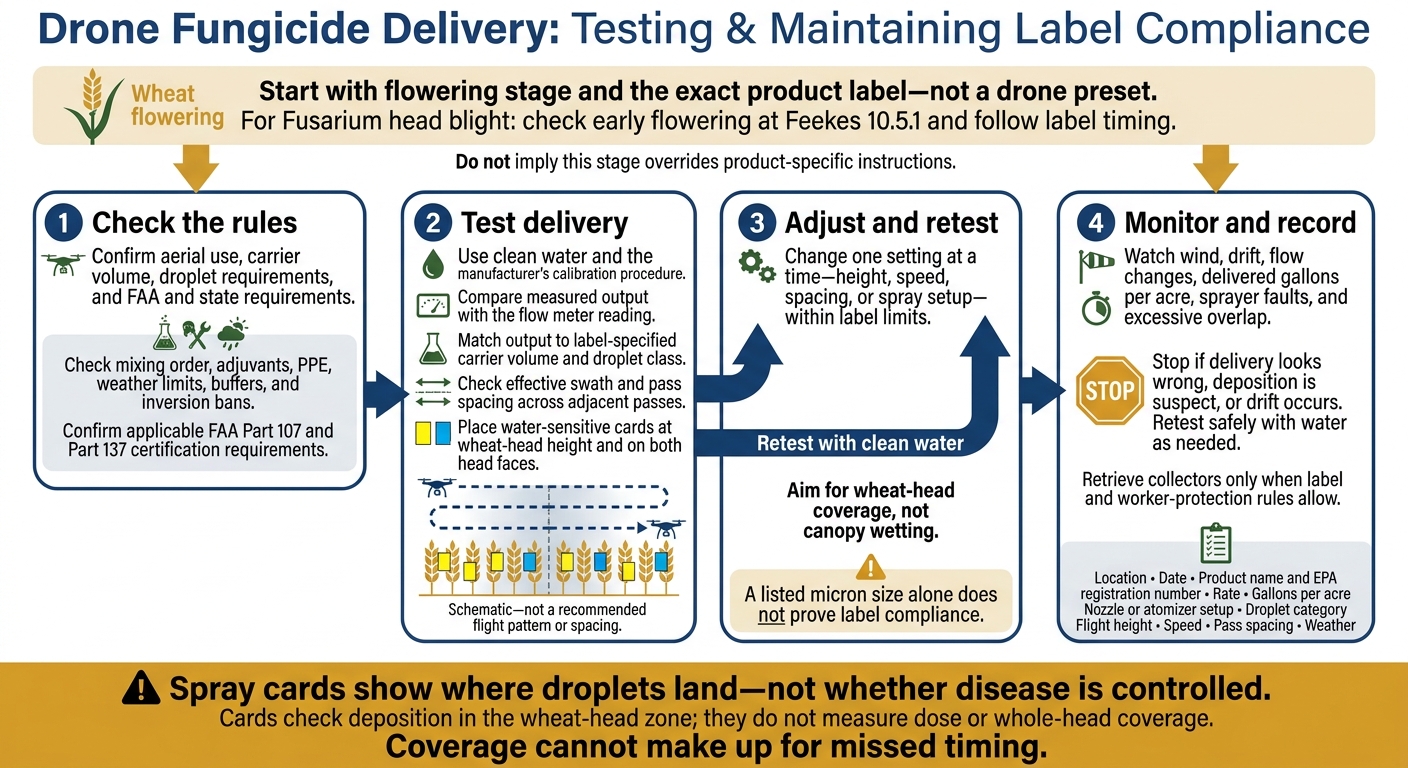
Drone Fungicide Settings: Wheat Head Coverage Checklist
Best Practices for Drone Fungicide Applications: Expert Tips and Testing Results
sbb-itb-3b7eef7
2. Calibrate Spray Delivery With Clean Water
Use clean water and follow the aircraft manufacturer’s calibration procedure. After setting the label rate, check that the drone delivers it evenly across the swath.
Check Flow Meter Accuracy and Spray Output
Run the manufacturer’s measured-volume calibration test to compare actual water output with the flow meter reading. Match the output to the label-specified carrier volume and droplet class.[1]
Once output is correct, check whether the spray reaches the wheat-head zone evenly.
Measure Effective Swath and Deposition at Head Height
Place collectors across repeated passes to check swath width and pass spacing.
Set water-sensitive cards at wheat-head height and on both head faces. These cards check deposition only in the wheat-head zone; they do not measure dose, whole-head coverage, or disease control.[1]
3. Adjust Flight and Spray Settings
If the water test shows uneven wheat-head coverage, adjust flight settings within label limits. Aim for wheat-head coverage, not canopy wetting. Change one variable at a time, then retest.
Set Height, Speed, and Route Spacing
Use the test results to guide changes to height, speed, and route spacing. Adjust each setting separately and retest until coverage is even across wheat heads.
Choose Label-Compliant Droplets and Carrier Volume
Use manufacturer droplet data to choose the label-required droplet category for head coverage and drift control. A listed micron size alone does not prove label compliance. Check the exact product label for droplet and carrier-volume limits; don't assume all wheat fungicides have the same requirements.[1]
Plan Pass Direction and Control Drift
Record wind speed and direction before spraying and throughout the application. Follow label weather limits, buffers, and inversion bans. Plan pass direction and the field-edge spraying sequence to reduce drift. Stop spraying if gusts or shifting winds cause uneven coverage or off-target drift.[1]
4. Verify Delivery Before and During Spraying
After calibrating with clean water, check wheat-head coverage in the field with a representative water-only pass at the planned T3 timing. Compare actual flow, swath width, and deposition on wheat heads with your planned setup. Check collectors across adjacent passes - not just beneath the flight path. If they show gaps or too much overlap, adjust the setup before spraying the full field.[1]
Check Mixing Instructions and Legal Requirements
Before mixing or flying, check the label and legal requirements for the application. Read the exact label for mixing order, adjuvants, PPE, carrier volume, and weather limits. Keep the applicable label available during mixing and application.[1]
Check the federal and state requirements where you spray. Confirm that the operation is covered by an FAA licensing support for Part 107 and Part 137 certificates.[1]
Monitor Delivery and Record Settings
During spraying, watch for drift or flow changes that reduce head coverage. Track delivered gallons against treated acres, and monitor sprayer faults and excessive overlap. Stop if you suspect poor deposition rather than finishing the load. Retest safely with water as needed. Retrieve collectors only when label and worker-protection rules allow; don't enter the crop just to inspect cards.
Record the location, date, product name and EPA registration number, rate, gallons per acre, nozzle or atomizer setup, droplet category, flight height, speed, pass spacing, and weather. Save these details so you can repeat the same head-coverage setup in the next field.[1]
5. Conclusion: Use Tested, Label-Compliant Settings
Apply at the target flowering stage. Before proceeding, check the exact product label’s aerial limits, measure carrier volume, and verify deposition at wheat-head level. Monitor wind and coverage throughout the application, accounting for prop wash effects on deposition, and use spray cards to check that spray reaches the wheat heads.
Spray cards show where spray landed; they do not prove disease control. Good coverage cannot make up for spraying outside the target flowering window. Before mixing, match the nozzle setup to the label’s carrier-volume and droplet-size limits [1].
FAQs
What if my wheat flowers unevenly?
When wheat flowers unevenly, time your application for when most heads are susceptible, typically at full head emergence (Feekes 10.5). The spray window for head diseases is short. Spray too early, and scab control drops. Spray after full bloom, and you get less DON mycotoxin suppression and a lower yield response.
Check with your local extension office to pinpoint the peak susceptibility window in your area.
How do I spot spray gaps between drone passes?
Place water-sensitive paper or white paper tape perpendicular to your flight path across multiple passes. After a test flight, check for uneven deposits or spots with no coverage. These gaps may point to poor overlap, misalignment, or uneven delivery.
Check the nozzles first for blockages or damage. If the equipment works correctly, verify your effective swath width - usually 65% to 75% of the advertised maximum - and reduce the spacing between passes to get proper overlap.
Can I reuse calibrated settings with a different fungicide?
Don’t assume your previous settings will work with a different fungicide. Changes in formulation can affect spray deposition and effectiveness [1].
Recheck the spray pattern and verify deposits within the target crop canopy using the new product or a technically justified substitute [1]. Use past records as a starting point, but run new single-pass tests to confirm the flow rate, droplet spectrum, and swath spacing for that fungicide [1].
