Call or Text: +1 (208) 425-2990
Email: Sales@DroneSprayPro.com

Spray Drone Guide for Vineyards: Row Spacing, Drift Control, and Which Drones Actually Work
Spray drones are transforming vineyard management by reducing chemical use, improving efficiency, and offering precise coverage even on challenging terrains. Compared to traditional sprayers, drones use 96% less pesticide solution per hectare and achieve better leaf coverage with finer droplets. They’re faster, covering 2.2 acres per hour versus manual sprayers at 0.3 acres per hour, and are equipped with advanced tech like Variable Rate Spraying to apply chemicals only where needed.
Here’s what you’ll learn:
- Row Spacing: How to optimize vineyard layouts for drone navigation.
- Drift Control: Tips on minimizing chemical drift with proper nozzles, flight settings, and weather management.
- Top Drones for Vineyards: Models like DJI Agras T100, Talos T60X, and XAG P150 excel in different vineyard conditions, from steep slopes to dense canopies.
- FAA Compliance: Key regulations for operating spray drones, including certifications and safety practices.
Drones like the DJI Agras T30 can treat up to 40 acres per hour, making them ideal for vineyards of all sizes. They also reduce environmental impact by cutting chemical waste and avoiding soil compaction. Whether you manage flat fields or steep, terraced vineyards, spray drones offer a precise, efficient solution.
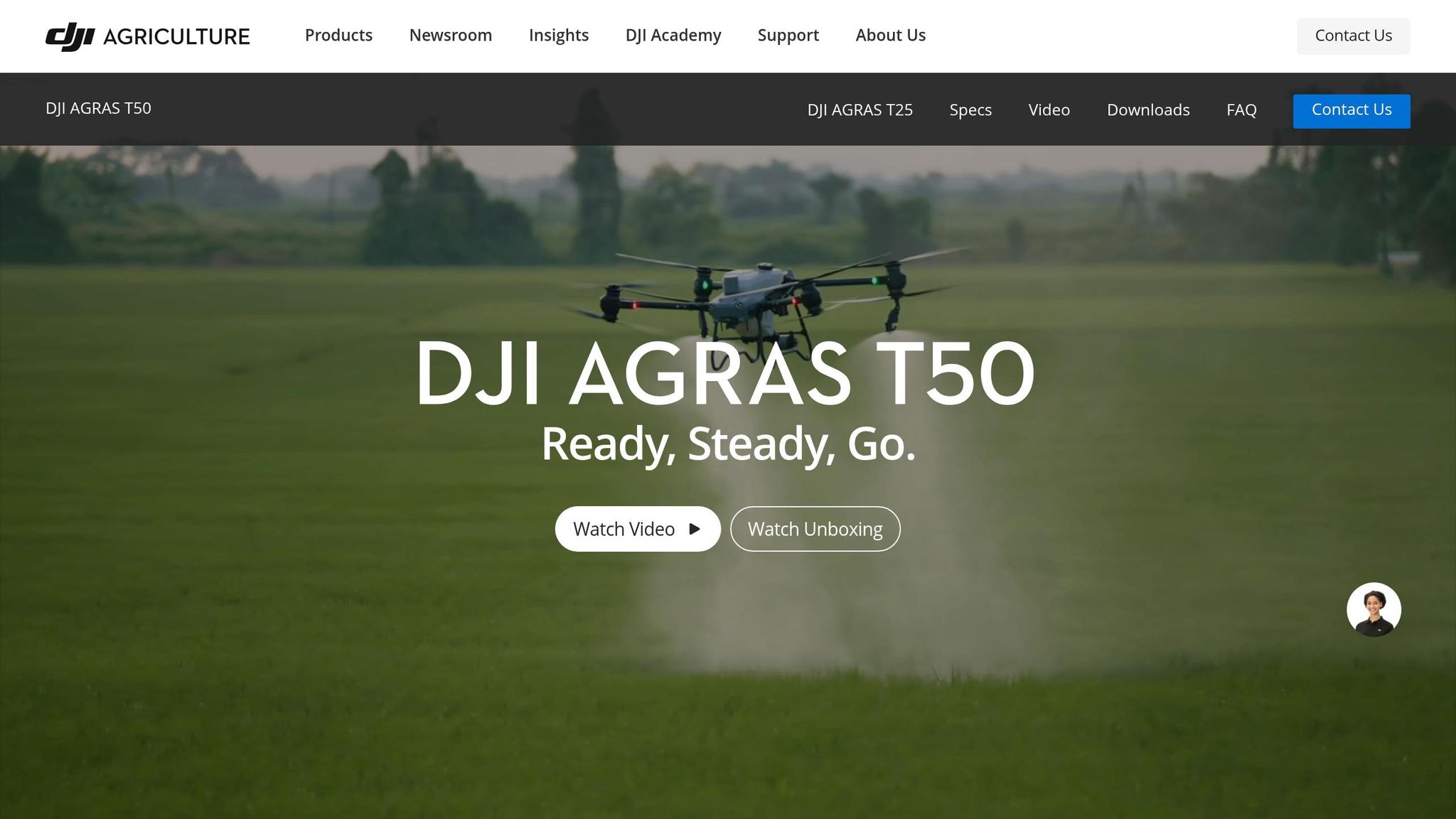
Vineyard Spray Trials With The DJI Agras T50
sbb-itb-3b7eef7
Row Spacing for Drone Navigation
Navigating vineyards with drones is no small feat. Unlike flat fields, vineyards come with their own set of challenges - sloped rows, uneven terrain, and varying canopy heights. To ensure drones operate efficiently and deliver consistent spray coverage, careful attention to row spacing and terrain mapping is essential [1].
Standard Vineyard Row Widths
Vineyard rows typically range from 6 to 10 feet (1.8–3 meters) apart. This spacing influences which drones are suitable and how flight paths should be planned. For instance, drones like the DJI Agras T40/T50 operate best with route spacing between 13 and 20 feet, while the T30 performs well with a narrower range of 10 to 16 feet [3]. These configurations allow a single flight path to cover multiple rows, with the drone's powerful downwash ensuring spray reaches both sides of the grapevine and even the underside of leaves [2][3].
For vineyards with tighter rows or dense canopies, adjustments to flight paths are necessary. Drones equipped with Dual Phased Array Radar excel in such conditions, as they can maintain a steady altitude over steep slopes [3]. This is particularly useful in regions like California, where hillside vineyards demand precision over sheer tank capacity [1].
Drone Wingspan and Flight Path Planning
The size and agility of a drone play a big role in its suitability for vineyard work. Larger drones designed for flat fields may struggle in vineyards, where smaller, more maneuverable models are often a better choice [1]. For example, the DJI Agras T70P, with its 70-liter tank, offers a balanced option. Its compact design allows for easy navigation between rows while still providing ample spray capacity. On the other hand, the T100, with its 100-liter tank, is better suited for large-scale crops like corn but may be too bulky for the intricate layouts of vineyards [1].
When planning flight paths, it’s important to stick to the recommended parameters. For the T40/T50 models, maintain a flight height of 8 to 11.5 feet (2.5 to 3.5 meters) above the crop, while the T30 requires a slightly lower height of 6.5 to 8 feet (2 to 2.5 meters) [3]. Flight speeds should range from 11 to 14 mph (18–22 km/h) for larger models and 8 to 11 mph (13–18 km/h) for the T30. Advanced drones can even pause spraying in areas without vines, conserving chemicals and improving efficiency [2].
Mapping Vineyard Terrain with Drones
To navigate vineyards effectively, drones rely on terrain mapping. High-precision tools like RTK (Real-Time Kinematic) positioning and terrain-following radar help maintain centimeter-level accuracy and consistent height above the canopy [1]. This is especially crucial in hilly or terraced vineyards, where elevation changes can lead to uneven spray coverage.
Mapping technologies, including LiDAR and multispectral sensors, allow operators to create detailed 3D models of the vineyard. These models can highlight terrain changes, crop stress, and other factors, enabling customized spray routes [1]. For example, the Trinity Pro mapping drone can survey up to 700 hectares (around 1,730 acres) in one flight, while the WingtraOne Gen II performs well even in windy conditions, maintaining centimeter-level accuracy [1].
These 3D maps enable drones to adapt to their environment, adjusting for terraces, headlands, and irregular margins [1]. High-resolution imagery, such as NDVI or canopy density maps, helps pinpoint areas with dense growth. This allows operators to slow down or tighten lane spacing in specific zones to ensure thorough spray coverage [4]. For especially dense rows, splitting the vineyard into two missions - spraying in opposite directions - can help achieve even coverage on both sides of the canopy [4].
| Drone Model | Recommended Route Spacing | Flight Height Above Crop | Recommended Flight Speed |
|---|---|---|---|
| DJI Agras T40 / T50 | 13–20 ft (4–6 m) | 8–11.5 ft (2.5–3.5 m) | 11–14 mph (18–22 km/h) |
| DJI Agras T30 | 10–16 ft (3–5 m) | 6.5–8 ft (2.0–2.5 m) | 8–11 mph (13–18 km/h) |
With a solid understanding of terrain mapping, the next step is to explore how to manage spray drift effectively.
Drift Control in Vineyard Spraying
Spray drift is a big issue for vineyard managers using drones. When chemicals drift off-target, they can harm nearby crops, damage the environment, and lead to expensive legal troubles. The good news? With the right nozzles, flight settings, and attention to weather, drift can be minimized.
Droplet Size and Nozzle Selection
Droplets smaller than 100 µm are highly prone to drifting, even in light winds. To combat this, opt for nozzles that produce "Coarse" (C) or "Very Coarse" (VC) droplets. Droplet size is measured using DV50, which represents the diameter where half the spray volume consists of smaller droplets and the other half of larger ones [5].
Air-induction nozzles (AIN) are a solid choice. These nozzles, like the TeeJet AI, AIXR, TTI, or Agrotop Airmix, mix air into the spray to form larger, heavier droplets. For example, a DJI Agras T30 equipped with Agrotop Airmix 110-015 nozzles produced "Very Coarse" droplets with a DV50 of 462 µm during tests by the Julius Kuehn Institute in Germany [5].
Rotary atomizers (RAT), such as those on the DJI Agras T25, use centrifugal force to create uniform droplets. While they provide excellent coverage, they’re more sensitive to flight speed and altitude. In the same study, rotary atomizers running at 3,600 rpm produced "Coarse" droplets with a DV50 of 291 µm. However, wind tunnel tests showed that at wind speeds of 3.5 m/s, rotary atomizers had a significantly higher cumulative drift percentage (90.1% at 2 meters) compared to hydraulic nozzles (40.6%) [5].
| Atomizer Type | Setting | Droplet Class | DV50 (µm) | % Volume < 100 µm |
|---|---|---|---|---|
| Airmix 110-015 (AIN) | 2.6 Bar | Very Coarse (VC) | 462 | 1.44% |
| Airmix 110-02 (AIN) | 2.9 Bar | Very Coarse (VC) | 493 | 1.23% |
| LX8060SZ (RAT) | 3,000 RPM | Coarse (C) | 298 | 1.50% |
| LX8060SZ (RAT) | 3,600 RPM | Coarse (C) | 291 | 3.06% |
For vineyards near sensitive areas, air-induction nozzles are generally the safer choice. If you prefer rotary atomizers, ensure they’re operated within recommended settings. Once the nozzle type is sorted, focus on fine-tuning flight settings to further manage drift.
Adjusting Flight Speed and Altitude
Keep your drone flying at about 2.0 meters (6.5 feet) above the canopy and maintain a speed of around 2.5 m/s (5.6 mph) [5].
Rotary atomizers can be tricky - they’re sensitive to speed changes. While air-induction nozzles perform consistently at speeds between 2.5 and 3.5 m/s, rotary atomizers experience increased drift at higher speeds. Staying closer to 2.5 m/s helps reduce this risk. Speeds above 10 mph (about 4.5 m/s) can create spray vortexes, lifting droplets into the air [7]. Meanwhile, the rotor downwash at lower altitudes helps direct droplets into the canopy, so staying between 1.5 and 2.0 meters is critical [5].
With flight settings optimized, the next step is to monitor environmental factors that affect drift.
Managing Wind and Weather Conditions
Wind speed and direction are the main environmental factors influencing spray drift. The ideal spraying conditions occur when wind speeds range from 3 to 10 mph. Spraying below 3 mph can lead to lateral drift caused by temperature inversions [7].
Temperature also plays a big role. Many vineyard herbicides, such as 2,4-D, become more volatile as temperatures rise, especially above 60°F, with volatility peaking at over 90°F. To reduce vapor drift risks, avoid spraying when temperatures exceed 85°F or when relative humidity is below 50% [7].
"The price of a wind meter is usually less than one-third the hourly fee a lawyer can charge a client sued for drift-related damages." - Erdal Ozkan, Professor and Extension Pesticide Application Technology Specialist, Ohio State University [6]
Plan your spraying for early mornings or late afternoons when temperatures are cooler and winds are steadier. Always monitor real-time weather and be ready to stop if conditions change. Also, maintain a buffer zone of 250–300 feet from sensitive crops [7].
Which Spray Drones Work for Vineyards
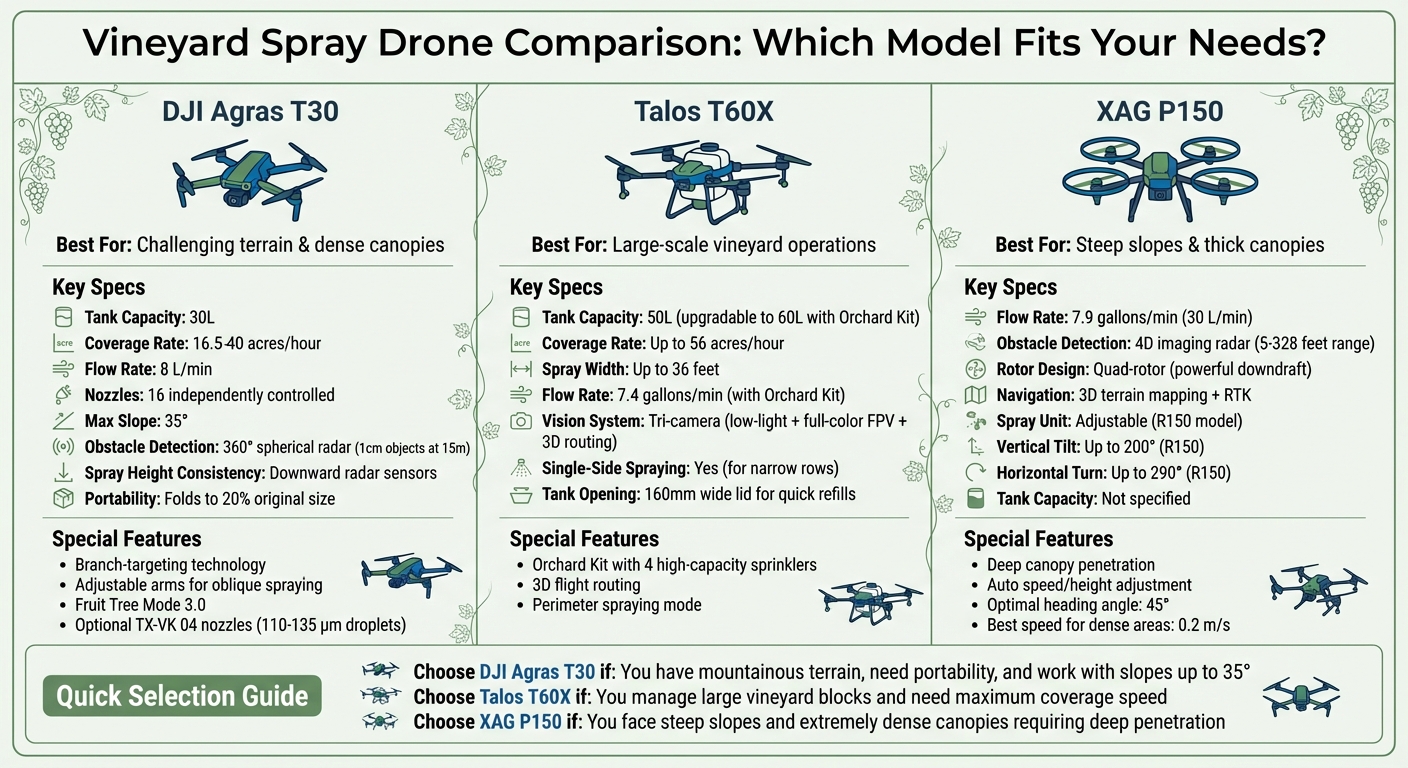
Spray Drone Comparison Guide for Vineyards: DJI Agras T30 vs Talos T60X vs XAG P150
Taking care of vineyards can be tricky, especially when dealing with uneven terrain and closely packed rows. To boost efficiency and save money compared to traditional crop dusters, here are some spray drones that are well-suited for vineyard operations.
DJI Agras Series: T30
The DJI Agras T30 is a great fit for vineyards with challenging layouts. Its branch-targeting tech and adjustable arms allow for oblique spraying, ensuring even dense canopies get coverage on both sides [8][9].
This drone is built for tough environments. Its Fruit Tree Mode 3.0 enables fully automated spraying on slopes up to 35°, making it perfect for mountainous vineyards [9][11]. A spherical radar system offers 360° obstacle detection, spotting objects as small as 1 cm from 15 meters away and rerouting at about 6 meters. Plus, downward radar sensors keep the spray height consistent over uneven ground [9].
With a 30 L tank and 16 independently controlled nozzles, the T30 can cover 16.5 acres per hour (using 4.8 L/acre). In some cases, it can even reach up to 40 acres per hour [9][10]. Its plunger pump delivers 8 L/min, a 66% boost compared to earlier models [9][10]. For vineyards needing finer spray, optional TX-VK 04 nozzles create smaller droplets (110–135 μm) for better canopy penetration [9][11]. And when it’s time to move, the drone folds down to just 20% of its original size, making transport between rows a breeze [9].
For those managing larger vineyard blocks, the Talos T60X offers even more capacity.
Talos T60X: High-Capacity Precision Spraying
The Talos T60X is built for large-scale operations. Its standard 50 L tank can be upgraded to 60 L with the Orchard Kit, allowing it to cover an impressive 56 acres per hour. Its spray width can stretch up to 36 feet, making it a powerhouse for bigger vineyards [13].
Designed with vineyards in mind, the T60X features a single-side spraying mode tailored for narrow rows and perimeter areas [13]. Its tri-camera vision system combines low-light, full-color first-person view with 3D flight routing, ensuring accurate coverage even on uneven terrain [13]. The Orchard Kit upgrade adds four high-capacity sprinklers capable of delivering 7.4 gallons per minute. The 60 L orchard tank also comes with a wide 160 mm lid for quick and easy refills [14].
When using multiple drones, it’s important to have visual observers for each one to comply with FAA Part 137 regulations [12].
For vineyards with steep slopes or dense canopies, XAG models bring a unique advantage.
XAG Models: Performance on Challenging Terrain
XAG drones, like the P150, shine in vineyards with steep slopes and thick canopies. Thanks to their quad-rotor design, they generate a powerful downdraft that pushes chemicals deep into the foliage [16]. Their integrated 4D imaging radar detects obstacles from 5 to 328 feet (1.5 to 100 meters), allowing them to navigate around power lines and uneven terrain with ease [16].
The P150 delivers a maximum flow rate of 7.9 gallons per minute (30 L/min) and uses 3D terrain mapping to adjust speed and height as needed [16]. Curtis Schramm from Texas Agridrone Services shared his experience using the P150 to treat 682 acres of dense brush between August and December 2025. He noted its ability to penetrate thick canopies, which helped him retain all his clients [16].
"What good would a wide swath do me if it didn't have the force to push the chemical all the way down through the canopy?" - Curtis Schramm, Owner, Texas Agridrone Services [16]
The XAG R150 offers even more flexibility with RTK navigation and an adjustable spray unit. Its vertical tilt (up to 200°) and horizontal turn (up to 290°) make it ideal for vineyards with varying row spacing [17]. Tests showed that setting the heading angle to 45° improved grapevine coverage, while operating at lower speeds (0.2 m/s) boosted spray effectiveness in dense areas [17].
FAA Compliance and Best Practices
After tackling the technical aspects, ensuring compliance with FAA regulations is key to conducting safe and legal drone spraying operations.
Key FAA Regulations for Agricultural Drones
Operating spray drones requires adherence to specific FAA rules. Drones weighing under 55 lbs must comply with 14 CFR Part 107, while those used for applying agrochemicals must also meet Part 137 requirements [18][20]. For professional drones exceeding 55 lbs - common in agricultural settings - you’ll need to secure a Section 44807 exemption and register the drone with an N-number [20].
Drone pilots must hold a Remote Pilot Certificate, which requires being at least 16 years old, passing with a minimum score of 70%, and clearing TSA vetting [19][20]. For drones over 55 lbs, an FAA Medical Certificate is also mandatory [20]. Beyond federal rules, additional steps include obtaining a State Pesticide Applicator License and carrying liability insurance, which typically costs between $45 and $136 per month [20].
FAA regulations limit drone altitude to 400 feet above ground level and require pilots to maintain a visual line of sight, unless a waiver is granted [19]. Night operations are allowed if the drone has anti-collision lights visible for at least three statute miles [19][20]. Drone registration costs $5 and lasts for three years [19][20].
Adhering to these regulations not only ensures safety but also strengthens the reliability of your drone-based spraying strategy.
Best Practices for Safe and Effective Spraying
Safety is paramount. Always yield to manned aircraft, avoiding flying over, under, or ahead of them unless a safe distance can be guaranteed [20]. Before each flight, inspect your drone thoroughly and ensure at least three statute miles of visibility [19].
As of September 16, 2023, all registered drones must broadcast Remote ID information, unless operated within an FAA-Recognized Identification Area [20]. While standard rules allow one drone per pilot, exemptions can enable the operation of up to three drones simultaneously [20]. Additionally, any accident causing serious injury or property damage exceeding $500 must be reported within 10 days [19].
For a smoother Part 137 certification process, email FAA Form 8710-3 with your exemption number to UAS137Certificates@faa.gov. Submit exemption petitions at least 120 days before your planned operation date [18].
FAA Standards Comparison Across Drone Models
| Requirement | Drones Under 55 lbs | Drones Over 55 lbs |
|---|---|---|
| Primary Regulation | Part 107 | Part 91 & Section 44807 |
| Registration Type | FA-number (DroneZone) | N-number (Aircraft Registry) |
| Pilot Certificate | Remote Pilot Certificate | Remote Pilot + Medical Certificate |
| Max Altitude | 400 ft AGL | 400 ft AGL (typically) |
| Remote ID | Required | Required |
| Agricultural Rule | Part 137 | Part 137 |
For heavier drones like the DJI Agras T30, Talos T60X, and XAG models, Section 44807 exemptions and medical certifications are necessary [20]. Additionally, appoint a Chief Supervisor of Operations to act as the primary FAA contact for vineyard spraying operations [18].
Following these guidelines ensures your spraying practices align with both technical and regulatory standards, promoting safe and efficient operations.
Conclusion
Spray drones are reshaping vineyard management by improving navigation, minimizing chemical drift, and offering tailored solutions for different terrains. Understanding row spacing is crucial for maneuvering through narrow vineyard corridors, while controlling drift - through careful nozzle selection, proper altitude, and weather awareness - ensures crops and surrounding areas stay protected from overspray. Choosing the right drone model, whether it’s the DJI Agras T30, Talos T60X, or XAG, depends on your vineyard's specific needs and challenges.
These drones bring impressive efficiency to the table. Advanced models can treat up to 100 acres in under an hour, avoid soil compaction caused by heavy ground equipment, and allow spraying immediately after rain - something traditional machinery often can’t manage [1][21]. For vineyards in hilly or mountainous areas, drones equipped with LiDAR-based terrain following and RTK positioning achieve centimeter-level precision, even on uneven slopes [1].
Beyond speed, spray drones help reduce environmental impact by applying chemicals with precision, cutting waste significantly. Studies show UAV sprayers can reduce pesticide use by about 33% compared to constant-flow systems [21]. Economically, they’re a smart choice for smaller vineyards too, becoming cost-effective at just 2.27 hectares (around 5.6 acres), a fraction of the acreage needed for traditional ground-based Variable Rate Technology sprayers [21].
When paired with strict FAA compliance and licensing and established best practices, spray drones not only address current operational needs but also prepare vineyards for future challenges. They offer immediate advantages while supporting long-term sustainability in an era of rising labor costs and growing environmental concerns.
FAQs
Will a spray drone work in my row spacing?
Spray drones are generally effective in vineyards with row spacing of 6 to 8 feet (1.8 to 2.4 meters) - the same spacing often used for narrow tractors. For rows with wider spacing, adjustments like altering flight altitude and modifying spray techniques can help maintain efficiency. It's crucial to implement proper drift control to ensure thorough coverage and minimize off-target spraying. Always evaluate your vineyard's specific row spacing and conditions to confirm compatibility with drone spraying.
How do I prove drift control to neighbors or regulators?
To ensure effective drift control, stick to well-documented practices backed by scientific evaluations. Keep thorough records of your spray parameters, environmental factors, and calibration tests. Opt for the right nozzle types, adjust spray altitudes as needed, and use established spray techniques. Keeping detailed documentation highlights your dedication to reducing drift and applying products responsibly.
What’s the real cost to start spraying legally in the U.S.?
To legally operate a spray drone in the U.S., you'll need to secure a few key certifications. First, the FAA Part 107 Remote Pilot Certificate is required. Additionally, you'll need an Agricultural Aircraft Operator Certificate (AAOC), and in some cases, a Section 44807 exemption if your drone weighs less than 55 pounds.
When it comes to costs, high-quality spray drones usually fall in the range of $30,000 to $40,000, though some models are priced as low as $19,999. These expenses include both the equipment and the necessary compliance measures to ensure legal operations.