
Call or Text: +1 (208) 425-2990
Email: Sales@DroneSprayPro.com

How Solar-Powered Drone Charging Stations Work
Solar-powered drone charging stations are changing how agricultural drones operate in remote areas. These stations use solar panels, batteries, and advanced charging systems to provide a reliable power source without relying on the grid. Here's how they work:
- Solar Panels: Convert sunlight into electricity. Efficiency ranges from 20–25%, but real-world factors like weather and temperature can affect output.
- Charge Controllers: Regulate electricity flow to match drone battery requirements. MPPT controllers optimize energy delivery for maximum efficiency.
- Batteries: Store energy for use during low sunlight or at night. Advanced systems include dual-battery setups to keep drones operational continuously.
- Inverters (Optional): Convert stored DC power into AC for other farm equipment. Many drone stations skip this step to avoid energy loss.
- Wireless Charging: Some systems offer contact-free charging, reducing maintenance but with slightly lower efficiency.
Modern stations can charge drone batteries in 7–10 minutes for high-capacity models like the DJI Agras T40, and support up to 1,000 charge cycles, reducing costs and increasing uptime. They also help cut energy expenses by up to 30% and reduce CO2 emissions by 30–80%.
These systems are ideal for farmers, enabling longer drone operations, reducing reliance on fuel generators, and offering a cleaner energy solution for precision agriculture tasks.
( BEST YET ) DJI ALTERNATOR CHARGER | 1.8KW Solar / Car Super Fast Charger Review
sbb-itb-3b7eef7
Main Components of Solar-Powered Drone Charging Stations
A solar-powered charging station for agricultural drones depends on five key components working together. Each element plays a role in capturing sunlight, storing energy, and delivering power to drone batteries. Knowing how these components function can help you select the best setup for your farm.
Solar Panels
Solar panels are the backbone of the system, converting sunlight into DC electricity for immediate use or storage. Commercial panels generally achieve 20–25% efficiency under ideal conditions [1], but real-world performance often falls to 70–85% due to environmental factors [6].
For agricultural drones, you’ll typically see two types of panels:
- Rigid panels: Ideal for permanent ground stations.
- Portable folding panels: Common for mobile operations, often in the 100W–200W range [6].
The panels must align with the "Max Solar Input" rating of the charging station's controller. Undersized panels waste potential energy, while oversized ones risk damaging the system [6].
Weather plays a huge role in output. Thin clouds can reduce power by 20–40%, while heavy clouds drop it by 60–80% [6]. Heat also impacts performance - at 113°F (45°C), panels can lose 10–15% efficiency [6]. To counter these challenges, many operators use overpaneling, adding 10–30% more panel wattage than the station's maximum rating to maintain peak performance in less-than-ideal conditions [6].
Positioning matters, too. Panels laid flat can lose 10–15% efficiency compared to those angled toward the sun [6]. Adjustable kickstands and sun-tracking adjustments can recover 10–20% of lost output [6]. For high-powered drones like the DJI Agras T10, which requires a 3,600W charging capacity, larger solar arrays or additional storage batteries are essential [5].
Once energy is captured, charge controllers ensure it’s safely regulated for storage and use.
Charge Controllers (MPPT vs. PWM)
Charge controllers manage the flow of electricity from solar panels to batteries or directly to drones. They ensure voltage compatibility with the drone’s electrical system and optimize power delivery by monitoring solar output, environmental conditions, and energy demand [1].
"The power conditioning system... operates the solar cells within a desired power range and provides compatible voltage to the UAV's electrical system." - MicroLink Devices Inc [1]
In 2022, researchers at Zhejiang University introduced an energy management system for solar drones. It dynamically adjusted power delivery based on real-time demand, improving overall efficiency [1].
Some stations use relay controls that activate or cut off the 12V power supply when drones land, preventing energy waste and overcharging [7]. Meanwhile, wireless inductive charging is gaining traction for its ability to charge multiple drones simultaneously and withstand harsh weather. However, it currently has higher energy losses compared to contact-based systems [7].
Once regulated, the energy is stored for continuous use.
Batteries and Storage
Storage batteries keep the station running day and night, even when solar panels aren’t producing power. They store DC electricity for drone charging and power autonomous functions like robotic battery swaps and landing platform adjustments [1].
"The system incorporates a power management system that dynamically controls charging and discharging of the battery pack based on solar array output and flight conditions." - AeroVironment Inc [1]
Advanced setups may use dual-battery systems, separating high-power components like motors from low-power ones like sensors, to extend battery life [1]. Researchers are also exploring capacitor-based systems as an alternative to traditional batteries, reducing the need for frequent replacements [1].
Thermal management is crucial, especially in areas with extreme temperature swings, like Idaho. Some systems include heating or cooling mechanisms to protect battery health and maintain performance.
Inverters for AC Output
Inverters convert stored DC power into AC, making it compatible with other farm equipment [8]. While most modern drones use DC charging, inverters add flexibility for farms with mixed equipment needs.
However, the conversion process introduces some efficiency loss. For this reason, many dedicated drone charging stations skip inverters entirely and deliver DC power directly. If you’re running a mix of equipment - like DJI Agras drones alongside other tools - an inverter allows one station to handle everything.
Bifacial panels, which collect sunlight on both sides, are particularly useful for ground-mounted stations in sandy or snowy environments. Additionally, bypass diodes in the junction box ensure batteries keep charging even if part of the array is shaded [8].
Wireless Charging Coils
Wireless charging makes the process simpler by eliminating physical contact points that can corrode or fail in tough agricultural conditions. Instead, inductive charging coils embedded in landing pads transfer power when drones land [7].
This method is more weather-resistant and can charge multiple drones at once, which is especially helpful during busy seasons [7]. However, it’s less efficient than contact-based systems, losing more energy during transfer [7].
Proper alignment is critical. Misaligned drones can see significant drops in charging efficiency. Sensors guide drones to precise landing spots, and some systems even use adjustable platforms to ensure alignment. As technology develops, wireless charging is becoming a more practical option for those prioritizing ease of use and durability over maximum efficiency.
| Component | Primary Function | Key Consideration |
|---|---|---|
| Solar Panels | Energy Capture (DC) | Efficiency: 20–25% [1]; Real-world: 70–85% [6] |
| Charge Controllers | Power Regulation | MPPT vs. PWM; voltage compatibility [1] |
| Batteries | Energy Storage (DC) | Energy Density: 150–200 Wh/kg [1] |
| Inverters | DC to AC Conversion | Efficiency loss during conversion [8] |
| Wireless Coils | Contactless Charging | Higher losses but better weather resistance [7] |
How Solar-Powered Charging Works Step-by-Step
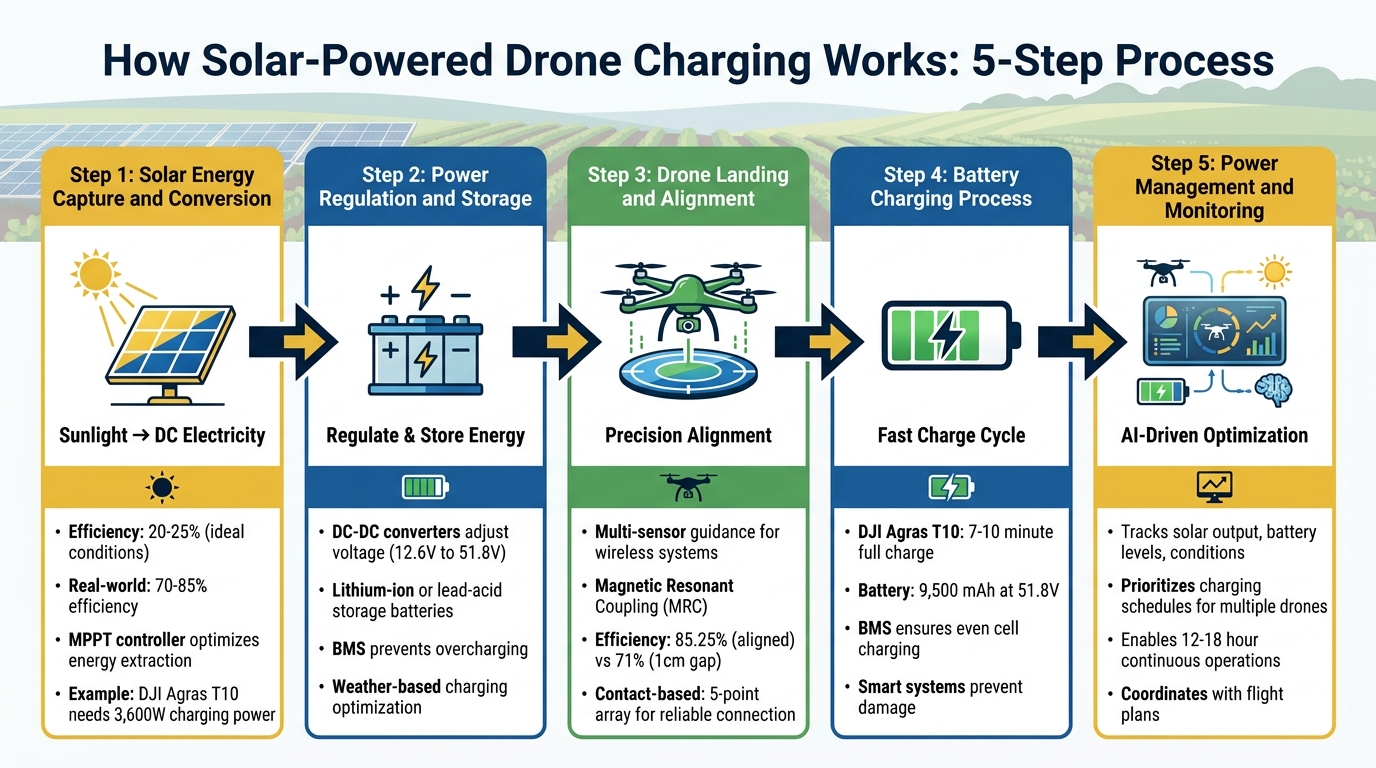
How Solar-Powered Drone Charging Stations Work: 5-Step Process
The process of using solar energy to power drones involves five key phases, from capturing sunlight to getting the drone ready for takeoff.
Solar Energy Capture and Conversion
Solar panels are the first step, capturing sunlight and converting it into DC electricity [4]. When sunlight hits the photovoltaic (PV) cells, it dislodges electrons, generating an electrical current. However, the amount of energy produced varies due to factors like cloud cover, temperature changes, and the angle of the sun. That’s where an MPPT (Maximum Power Point Tracking) controller steps in, constantly adjusting to ensure the system pulls the maximum possible energy [9].
Currently, commercial solar cells operate at an efficiency of 20–25% under ideal conditions [1]. For drones like the DJI Agras T10, which needs 3,600 W of charging power and a 50 A current [5], sizing the solar array is crucial. You can calculate the required array size by dividing the total power needed (voltage × average current) by the output per cell (watts × efficiency) [9].
Once the sunlight is converted into DC power, it moves to the next phase: regulation.
Power Regulation and Storage
The raw energy from the solar panels is regulated to match the drone battery’s specific requirements. Whether it’s 12.6 V for lightweight batteries or 51.8 V for heavy-duty agricultural drones [9][5], DC-DC converters adjust the voltage dynamically to meet real-time needs.
This regulated power is stored in large stationary batteries, often lithium-ion or lead-acid, which act as a buffer. These batteries ensure a steady energy supply for quick recharges, even during cloudy periods or peak operational hours [4][1].
Advanced setups go a step further by using weather data to plan charging sessions during optimal sunlight [1]. A Battery Management System (BMS) oversees charging cycles, preventing overcharging and reducing wear on the batteries. It also monitors temperature, which is particularly important in hot climates where summer temperatures can exceed 100°F.
Drone Landing and Alignment
For efficient charging, the drone must align perfectly with the charging station. This is especially challenging for wireless systems, as drones often struggle with precise landings.
"Misalignment is the dominant case in WPT specific for a drone application because often in this case, the landing accuracy of a drone is found to be very low." - IEEE Access [10]
To address this, wireless systems use multi-sensor guidance for precise alignment [1]. Some stations feature adjustable platforms or telescoping landing gear to position the drone’s receiver pad correctly. Proximity sensors detect when the drone’s receiver coil is close enough, switching from low-power detection to high-power charging [1].
Magnetic Resonant Coupling (MRC) technology helps transfer power even if the coils aren’t perfectly aligned, though efficiency drops from 85.25% to 71% with just a 1 cm gap [10].
On the other hand, contact-based systems use multiple conductive strips and galvanic contacts to ensure a reliable connection. These systems often include a five-contact array (four corners and one center) to guarantee at least two points of contact, regardless of landing orientation. Onboard circuits automatically direct power to the battery [11].
Once alignment is verified, charging begins seamlessly.
Battery Charging Process
Once power reaches the drone’s battery pack, the charging system takes over. For drones like the DJI Agras T10, which uses 9,500 mAh batteries at 51.8 V, smart charging systems can fully recharge in just 7 to 10 minutes [5].
The BMS ensures each battery cell charges evenly, preventing damage and extending the battery’s lifespan. While wireless charging systems may lose some efficiency compared to contact-based ones, they avoid issues like corrosion, which can occur in harsh outdoor environments [10]. Choosing between the two depends on the specific conditions and maintenance capabilities of your operation.
Power Management and Monitoring
Modern charging stations use AI-driven systems to optimize charging based on battery capacity and flight schedules [1]. These stations track solar output, battery levels, environmental conditions, and power demand, adjusting voltage and current as needed [1].
For farms using multiple drones, integrated power management systems can prioritize charging schedules, ensuring the most critical drones are ready first. This approach can extend operations to 12–18 hours, enabling continuous work during key agricultural windows. By coordinating power delivery with flight plans, these systems maximize efficiency and field coverage.
Setup Process for Agricultural Spray Drones
Setting up a charging station for agricultural spray drones involves carefully combining advanced technology with practical considerations to ensure smooth operations and energy efficiency in the field.
Site Selection and Installation
Choose a flat, open area with clear skies and strong GNSS or RTK signals. These factors are critical for precise drone landings and to maximize solar energy capture. Poor positioning can lead to drones missing their charging terminals, disrupting operations.
In regions with frequent cloud cover or located at higher latitudes, solar energy capture can drop by 30% to 40% [1]. To counter this, consider using solar panels with prismatic covers. These covers improve light collection during times when the sun is lower in the sky, such as early mornings or late evenings [1].
To protect your setup, install canopies and use elevated platforms to reduce exposure to heat and dust [12][15]. Ensure the landing zone is free from overhead obstructions so the drone's radar and vision systems can function correctly [15]. For locations exposed to harsh conditions, use components rated at least IPX6K to protect against water and dust [15].
Component Integration
Once you've chosen the right spot, focus on integrating the components for efficient operation. Use air-cooled heat sinks to keep batteries below 95°F (35°C) [13]. While high-performance batteries, like those in the DJI Agras T30, can handle internal temperatures as high as 149°F to 158°F (65°C to 70°C) during intensive use [3], keeping them cooler helps extend their lifespan.
Position batteries away from heat sources by using longer charging cables (up to 1.5 meters), which reduces thermal stress and improves charging efficiency [13]. For added reliability, consider using multiple smaller power units. This setup ensures redundancy, so operations can continue even if one unit fails [12]. Modern intelligent charging stations can further enhance efficiency by automatically adjusting voltage to prevent overloading, boosting performance by up to 20% [3].
These steps help create a durable and efficient charging station that aligns seamlessly with your drone operations.
Compatibility with DJI Agras, Talos T60X, XAG Drones

Each drone model requires specific battery and charger combinations. For instance, the DJI Agras T50 uses the DB1560 battery paired with the C10000 charger, while the T25 relies on the DB800 battery and C8000 charger [13]. The DJI Agras T30 has its own dedicated battery station capable of delivering 7,200W of charging power [3].
| Drone Model | Compatible Battery | Compatible Charger |
|---|---|---|
| DJI Agras T50 | DB1560 Intelligent Flight Battery | C10000 Intelligent Charger |
| DJI Agras T25 | DB800 Intelligent Flight Battery | C8000 Intelligent Charger |
| DJI Agras T30 | T30 Intelligent Flight Battery | T30 Intelligent Battery Station |
If you're working with a mixed fleet, such as combining DJI drones with models like the Talos T60X, you'll need separate charging equipment for each brand. While mission planning tools like DroneDeploy or Pix4Dfields can help manage field boundaries across different drones, the charging hardware must be specific to each brand [14].
Properly pairing drones with their designated charging systems ensures uninterrupted operations. Additionally, modern DJI batteries now last up to 1,000 charge cycles - an improvement from the earlier 600 cycles - making them a more economical choice over time [3].
Benefits and Efficiency Considerations for Farming
Solar-powered stations bring practical advantages to farming operations by combining energy efficiency with cost-effectiveness.
Energy Independence
By switching to solar-powered charging stations, farmers can eliminate recurring fossil fuel costs, saving an estimated $0.67–$0.84 per battery charge [2]. Beyond the financial savings, these stations offer a reliable energy source in remote areas where grid power might not be an option. Plus, they help reduce the environmental footprint of agricultural operations.
Modern Intelligent Battery Management Systems (BMS) play a crucial role here. These systems monitor battery cells 24/7, protecting them from damage caused by temperature, current, or voltage fluctuations. This not only extends the lifespan of equipment but also reduces the need for frequent replacements [2]. On top of that, advanced battery algorithms improve performance by increasing discharge depth by 5%, enabling drones to fly an additional 200 meters per charge compared to older models [2].
Charging Speed
The speed of charging depends on factors like panel wattage, battery capacity, and how well thermal management is handled. When systems are optimized, charging efficiency can improve significantly, cutting costs by up to 20% compared to less efficient setups [2][13].
Simple adjustments, like positioning charging equipment in shaded areas or away from heat sources, can make a big difference. Combined with modern heat dissipation technologies, these measures ensure faster charge cycles while maintaining battery health.
Continuous Operation
Solar-powered systems enable around-the-clock drone use when paired with effective battery storage and dual-battery cycling. This setup allows one battery to charge while another powers a drone, ensuring uninterrupted operations as outlined in power management protocols [2].
"With a rapid charging system, the battery you're charging is ready to deploy as soon as the drone returns for a tank refill, thus maximizing productivity and operational continuity for farmers" - DJI Agriculture [2]
Excess energy collected during peak sunlight hours is stored for later use, ensuring drones remain operational even during cloudy periods or at night. This setup guarantees that your drone fleet is always ready to support precision agriculture tasks without delays.
Integration with Drone Accessories like Batteries and Chargers
When it comes to boosting the performance of your solar charging station, the right accessories can make all the difference. One smart strategy is dual-battery cycling - while one battery powers a drone, the other charges. This method keeps operations running smoothly, especially when managing multiple drones, and aligns perfectly with the power management protocols mentioned earlier.
Cross-brand compatibility is another key factor to consider. Take the DJI C12000 Intelligent Charger, for example. It supports batteries from both DJI (T-100, T-70) and Talos (T60x) drones. However, your solar setup must meet its power needs. For peak performance of 12,000W, the charger requires 380V/480V three-phase power, though it can also operate at 3,000W using single-phase power (200–264V). Pairing such chargers with effective heat management systems ensures faster, safer charging for advanced batteries.
Temperature management plays a crucial role in keeping batteries in top condition. After a flight, let batteries cool before recharging to avoid damaging the cells. In hot conditions (above 95°F), use an air-cooled heat sink to maintain optimal temperatures. For long-term storage (over 10 days), keep batteries charged at 40–60% to minimize cell stress[16][17][18].
Modern intelligent chargers simplify the process by automatically adjusting their output to prevent overloading. When combined with robotic swapping systems, they eliminate the need for manual battery changes, streamlining operations even further[3][1].
Finally, regular maintenance is essential for extending the lifespan of both batteries and chargers. Clean terminals with a dry cloth or compressed air, and every 2–3 months (or after 50 cycles), perform a full charge and discharge to 15–20%. This recalibration ensures accurate readings and preserves battery health[16][18]. These small steps can significantly enhance the efficiency of your power management system and protect your investment in drone technology.
Conclusion
Solar-powered drone charging stations offer farmers the ability to operate independently of the grid while ensuring uninterrupted field operations. By utilizing solar panels, advanced charge controllers, and battery storage, these systems provide a practical solution for remote agricultural areas.
The benefits extend beyond technical specifications. Dual-battery setups streamline workflows by keeping one battery in use while the other charges, minimizing downtime effectively [2]. Modern intelligent batteries, like the DB1560, can endure up to 1,500 charge cycles, making them a cost-efficient choice over time [19]. For those using drones such as the DJI Agras T50 or Talos T60X, optimized charging systems can lower charging expenses by as much as 20% [2].
These stations are designed to handle tough agricultural conditions, offering the durability required for demanding environments. Features like autonomous battery swapping and wireless power transfer reduce the need for manual handling [1]. Additionally, integrating weather forecasting and predictive energy management allows for smarter charging schedules based on available sunlight [1]. Such advancements not only improve efficiency today but also set the stage for greater autonomy in the future.
For farmers aiming to cut fuel costs and reduce reliance on traditional energy sources, solar-powered charging stations provide a reliable and scalable solution. By combining renewable energy with intelligent battery systems, these stations ensure prolonged and efficient operations for Drone Spray Pro users.
FAQs
How big should my solar array and battery bank be for my drone fleet?
The size of your solar array and battery bank hinges on a few key factors: your drones' energy requirements, payload weight, flight duration, and the amount of sunlight available in your area. Your solar array needs to produce enough energy to fully recharge the batteries within your planned operational window. Meanwhile, the battery bank should be large enough to handle the maximum flight time under a full payload, with some extra capacity to account for inefficiencies and allow for multiple flights. To get the sizing just right, calculate the energy used per flight and incorporate your flight schedule into the equation.
Will it still charge fast on cloudy days or in winter?
Charging tends to slow down on cloudy days or during the winter months. This happens because solar panels depend on sunlight intensity to generate energy, and both overcast skies and shorter daylight hours reduce the amount of sunlight available. As a result, less energy is captured, which directly impacts how quickly devices or systems can charge.
Is wireless charging worth it compared to contact charging?
Wireless charging brings ease to agricultural drones by allowing them to recharge automatically without the need for manual intervention - perfect for large-scale farming operations. That said, its efficiency is lower, averaging about 56.6%, and its power transfer speed is slower when compared to contact charging. On the other hand, contact charging delivers faster and more efficient energy transfer but relies on physical connections. The decision between these methods hinges on what matters most for your farm, whether that's seamless automation or quicker charging times.