Call or Text: +1 (208) 425-2990
Email: Sales@DroneSprayPro.com

Hemp Spraying with Drones: Regulations, Application Rates, and Equipment Guide
Using drones for hemp spraying can save time, reduce costs, and improve precision - but it requires meeting strict regulations and using the right equipment. Here's what you need to know:
- Regulations: You need an FAA Remote Pilot Certificate and drone registration. For pesticide application, a Part 137 Agricultural Aircraft Operator Certificate is mandatory. State-specific licenses may also apply.
- Application Rates: Most drones operate with ultra-low volumes (under 4 GPA), but always follow pesticide label instructions. Flight height, droplet size, and wind conditions significantly affect results.
- Equipment: Top drones like the Talos T60X offer high capacity (50L tanks, upgradeable to 60L) and efficiency (56–70 acres/hour). Accessories like extra batteries, fast chargers, and mapping software improve operations.
- Cost Savings: Drones use up to 30% less chemicals and can deliver higher returns per acre compared to ground rigs or helicopters.
To get started, ensure compliance with FAA and state regulations, calibrate your drone for precise application, and select equipment tailored to your farm's needs. This guide breaks it all down.
Why Farmers Love Spraydrones for Pasture Spraying
sbb-itb-3b7eef7
FAA Regulations and Legal Requirements for Drone Spraying
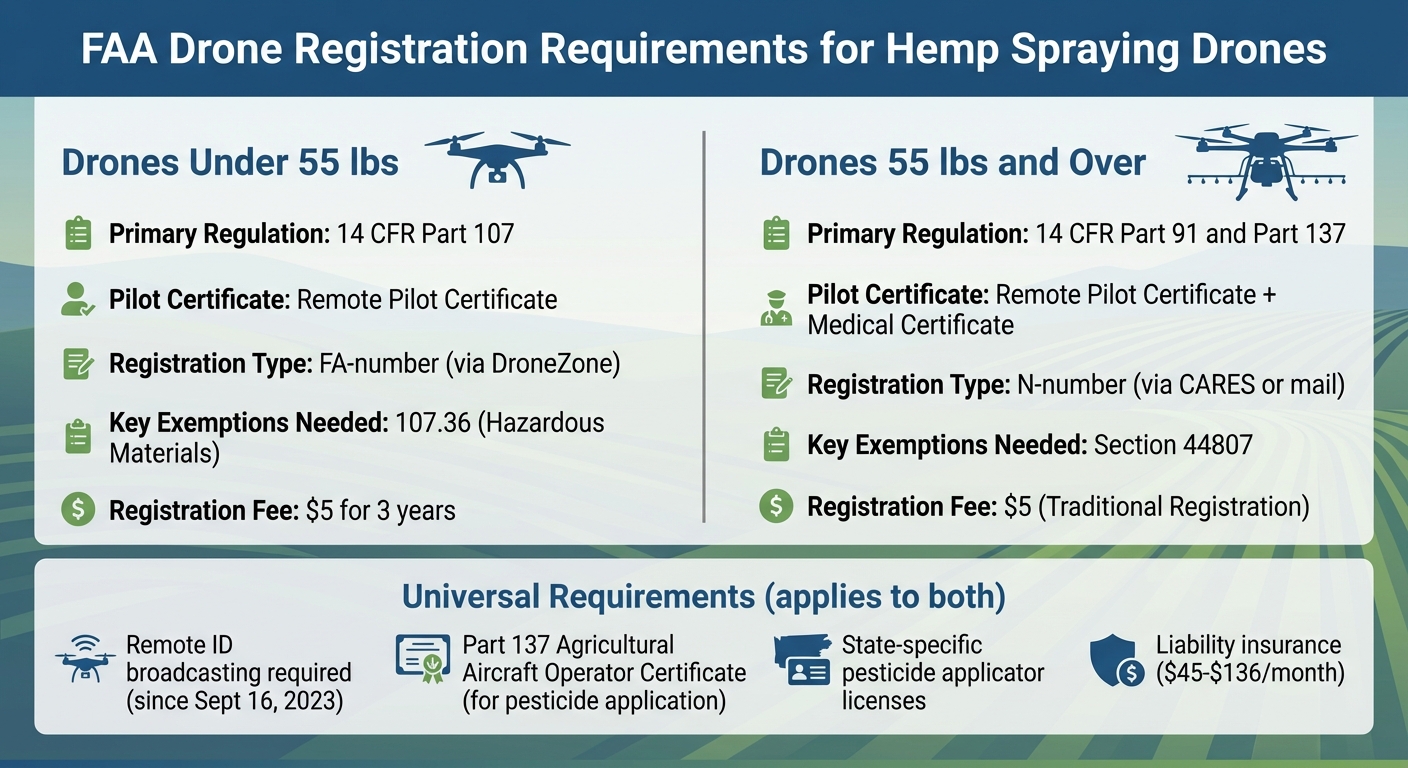
FAA Drone Registration Requirements: Under vs Over 55 lbs Comparison
Hemp spray drone operations must align with federal aviation rules that govern agricultural aircraft. These regulations are especially important in hemp cultivation, where precision and compliance are crucial. The requirements vary depending on your drone's weight and whether you're applying pesticides or other crop treatments.
Remote Pilot Certification and Drone Registration
To get started, every operator needs a Remote Pilot Certificate under 14 CFR Part 107. The qualifications include being at least 16 years old, passing an aeronautical knowledge test with a score of 70% or higher, and clearing a TSA security background check [1].
Drone registration depends on the weight of the aircraft:
- Drones under 55 lbs: Register through FAA DroneZone for $5. This provides an "FA" registration number valid for three years.
- Drones 55 lbs and over: These require traditional aircraft registration using FAA Form 8050-1 to obtain an "N" number, processed through the Civil Aviation Registry Electronic Services (CARES) or by mail [4][1].
| Requirement | Drones Under 55 lbs | Drones 55 lbs and Over |
|---|---|---|
| Primary Regulation | 14 CFR Part 107 [4] | 14 CFR Part 91 and Part 137 [4] |
| Pilot Certificate | Remote Pilot Certificate [4] | Remote Pilot Certificate + Medical Certificate [1] |
| Registration Type | FA-number (via DroneZone) [4] | N-number (via CARES or mail) [4] |
| Key Exemptions Needed | 107.36 (Hazardous Materials) [4] | Section 44807 [4] |
| Registration Fee | $5 for 3 years [1] | $5 (Traditional Registration) [1] |
Since September 16, 2023, all registered drones must broadcast Remote ID information during flight [1]. Once pilot certification and registration are complete, operators can move forward with obtaining the Part 137 certification required for pesticide application.
Part 137 Certification for Agricultural Aircraft Operations
Using drones to apply pesticides, herbicides, or fertilizers to hemp requires a Part 137 Agricultural Aircraft Operator Certificate. This certification regulates the application of "economic poisons" and plant treatments, regardless of the type of aircraft [4][5]. As of February 2021, only 37 companies across the U.S. had successfully obtained this certification [5].
The FAA now offers a more centralized process, allowing applicants to submit documentation via email to UAS137Certificates@faa.gov instead of going through local Flight Standards District Offices [4]. Operators should submit exemption petitions at least 120 days before starting operations to allow for processing time [4]. Specific exemptions include:
- Drones under 55 lbs: Require an exemption from Section 107.36, which prohibits carrying hazardous materials.
- Drones over 55 lbs: Require a Section 44807 exemption [4].
Certification involves demonstrating skills in aircraft performance, emergency procedures, and chemical handling. During flight demonstrations, operators typically use water at maximum takeoff weight to prove their proficiency [5]. To avoid delays, ensure the legal name on FAA Form 8710-3 matches the Part 137 exemption holder exactly [4].
State-Specific Licensing and Pesticide Compliance
In addition to federal regulations, operators must meet state-specific licensing and pesticide applicator requirements. Federal certification does not replace state pesticide licenses, and many states require additional aerial endorsements for drone use [5][1]. Hemp farmers should confirm their state's Department of Agriculture rules before beginning spray operations.
Operators are also required to carry liability insurance, which typically costs between $45 and $136 per month [1]. Keeping documentation on hand is essential - always have your Remote Pilot Certificate and UAS registration certificate with you in the field [1].
Hemp-Specific Regulatory Considerations
Hemp farming comes with its own set of regulatory challenges, layering additional requirements on top of standard agricultural aviation rules. According to the USDA Hemp Production Program, hemp is defined as Cannabis sativa L. containing no more than 0.3% delta-9 tetrahydrocannabinol (THC) on a dry weight basis [6]. To legally produce hemp, growers must obtain a license under a USDA-approved State or Tribal plan, or directly through the USDA hemp production plan [6].
USDA Hemp Production Program Rules
Drone spraying schedules must align with the 30-day pre-harvest sampling window. During this period, certified sampling agents are required to collect THC test samples before the anticipated harvest [6]. Chemical applications should be carefully timed to avoid interfering with these tests. Additionally, producers must submit geospatial reports identifying the legal description and location of each hemp lot [6]. Drone operations must not obstruct certified sampling agents' access to the plants, land, or related structures [6].
If a hemp crop exceeds the 0.3% THC limit, USDA regulations allow for remediation rather than immediate destruction. This can involve shredding the entire plant into biomass or removing flower material while retaining stalks and seeds [6]. However, producing cannabis with THC levels above the legal limit is classified as a negligent violation if the producer did not exercise reasonable care [6]. These strict rules underscore the importance of precision in all aspects of hemp production, including pesticide use.
Pesticide Label Restrictions and Drone Use
Using pesticides in a way that contradicts their labeling is illegal. For instance, if a pesticide label explicitly states, "Do not apply this product using aerial equipment", drone application is not allowed under any circumstances [7]. In many states, drones can only be used for pesticide application if the label specifically permits "aerial application" [7][9].
"If a pesticide label has language that reads 'Do not apply this product using aerial equipment,' then the answer to this one question is clear: You can't legally apply this product with a drone." - Purdue University Extension [7]
Drones typically use less than 3 gallons of liquid per acre, but many pesticide labels require 5–10 gallons per acre for aerial applications [7][8]. Applying less than the required volume violates the label, making it an off-label application. Labels also specify nozzle types, droplet sizes, and application heights, all of which must be adhered to for legal compliance [7][8]. If violations occur, the responsibility falls entirely on the drone operator, not the pesticide manufacturer. This means the operator bears the risk for any crop damage or off-site impacts [7]. Special care is also needed when selecting drone models, particularly those subject to restrictions tied to foreign manufacturing, as discussed below.
Impact of Foreign Drone Restrictions
Hemp farmers using drones weighing over 55 lbs must pay close attention to the FAA's list of approved aircraft under Section 44807 to ensure their drone model remains authorized for agricultural use [1][2]. The FAA’s streamlined Part 137 certification process for agricultural UAS requires valid aircraft registration and detailed make/model information. However, restrictions on drones from foreign manufacturers could impact these certifications [2]. Staying informed about these regulatory updates is essential to avoid disruptions in drone spraying operations.
Application Rates for Hemp Spraying
For safe and effective hemp spraying, getting the application rates right is absolutely critical.
Recommended Spray Volumes per Acre
Always start by checking the pesticide label for the minimum spray volume required. Most labels specify at least 2 gallons per acre (GPA) for aerial applications, though some products may require 5 or even 10 GPA [12]. For instance, certain herbicides like epyrifenacil recommend a minimum of 7 GPA [10]. Drones, however, often work with ultra-low volumes - usually under 4 GPA - which can create challenges when the label demands higher volumes.
Increasing the spray volume from 2 to 3 GPA can significantly improve both coverage and effectiveness [12]. That said, many herbicides don’t permit ultra-low volumes below 4 GPA [9]. Before spraying hemp, confirm that your pesticide allows aerial application at your chosen volume. Spraying below the label’s minimum is not only illegal but can also reduce effectiveness or harm the crop [9][11].
Beyond spray volumes, several other factors can influence application success.
Factors Influencing Application Rates
A variety of elements come into play when determining how much product reaches your hemp crop. Droplet size is a big one. Larger droplets (250–320 µm) are less likely to drift in windy conditions but may not provide as much coverage as smaller droplets [12]. Modern pesticide labels often specify droplet sizes using the ASABE standard S572.1 [10].
Flight height is another critical factor. Most labels limit flight height to 10 feet above the crop canopy unless safety requires otherwise [10]. Flying higher increases the risk of drift without improving the coverage area [12]. Wind speed also has a major impact. While many products now allow for maximum wind speeds of 15 mph (up from 10 mph), this often comes with specific requirements for boom length and swath displacement [10]. For winds between 11 and 15 mph, operators may need to reduce boom length to 75% for helicopters and drones [10].
"Crosswinds can cause swath displacement, which drone operators should account for when establishing spray passes. When flying in-wind, spray speeds and pressures will likely change whether flying against a headwind or with a tailwind." – Purdue Pesticide Programs [11]
Environmental conditions like temperature and humidity also play a role. High temperatures combined with low humidity can speed up droplet evaporation, potentially requiring higher spray volumes or drift-reducing additives to maintain proper coverage [12]. Spraying during temperature inversions should be avoided, as these conditions can trap pesticides in the air and lead to off-target movement [12]. Adjusting rates carefully is key to keeping your hemp crop healthy and compliant with regulations.
Following Pesticide Label Instructions
Following pesticide label instructions isn’t just important - it’s mandatory. In many states, drone applications are only legal if the label explicitly allows for "aerial applications" [9].
"The primary goal of calibrating spray drones is to determine the actual application rate over a given area for a given time. Operators should adjust their equipment if there is more than a 5 percent difference between the actual application rate and the intended application rate." – Purdue Pesticide Programs [11]
Drone spray solutions are typically 5 to 10 times more concentrated than those used in ground-based applications [11]. This higher concentration increases the risk of chemical incompatibility and nozzle clogging if you don’t follow the label’s mixing instructions. Regular calibration using a catch test is essential. If the actual application rate differs from the intended rate by more than 5%, equipment adjustments are necessary [11]. Ultimately, the operator is fully responsible for any violations, crop damage, or unintended impacts.
Selecting Drone Equipment for Hemp Spraying
Choosing the right drone setup is all about matching your equipment to your field size, crop density, and operational needs. The right decision can save you time, ensure proper coverage, and reduce downtime. Here's a breakdown of some top drone models, essential accessories, and pre-made packages to help streamline your hemp spraying operations.
Top Drone Models for Hemp Spraying
The Talos T60X stands out with its 50L spray tank (upgradeable to 60L) and the ability to cover 56–70 acres per hour, reaching speeds of up to 30 mph [13][17]. Its adjustable droplet settings (ranging from 20 to 320 microns), 360° obstacle avoidance, and tri-camera vision make it a reliable choice for navigating around power lines, pivots, and uneven terrain [13][17].
Flow rate plays a big role in efficiency, and the T60X delivers 4.8 GPM as standard. For denser hemp canopies, an optional 4-nozzle orchard kit boosts the flow rate to 7.4 GPM - a 54% increase - ensuring better penetration [16][17]. Its spray swath width of up to 36 feet minimizes the number of passes needed per field. Plus, the T60X is versatile, supporting interchangeable systems like an 80L dry spreader capable of discharging up to 418 lbs/min of granular fertilizers or cover crops [14][17].
For larger operations, fleet compatibility is a game-changer. The T60X can work alongside other models, like the DJI Agras T50, doubling the acreage covered per hour [15]. This approach is especially effective when assigning larger, open fields to the T60X while smaller drones handle irregular areas. Coordinating drone launches and refills with radios keeps the ground crew running efficiently [15].
Accessories for Efficient Operations
Accessories can make or break the efficiency of your drone operations. High-capacity battery systems are essential - most setups require at least three flight batteries paired with a fast charger, like the C10,000, and a cooling station to handle heat during rapid charging. This setup supports continuous "fly all day" operations, even in hot weather [18]. A Quick Fill Cap is another time-saver, replacing the standard cap to speed up refills [18].
Upgrading the spray tank from 50L to 60L can significantly reduce refill frequency, allowing you to cover more acres per flight [16][17]. For dense hemp crops, a 4-nozzle orchard kit is invaluable, increasing the flow rate from 4.8 GPM to 7.4 GPM for better coverage [16][18].
Precision tools like RTK-enabled systems and mapping software (such as DJI Terra, DroneDeploy, or Pix4Dfields) are essential for creating accurate 3D flight routes and boundary maps [15]. If you're managing a mixed fleet, third-party mission planning software can divide fields into zones and ensure consistent nozzle settings and droplet sizes across all drones, maintaining uniform application rates [15].
Pre-Made Packages for Hemp Farmers
If you’re looking for a hassle-free start, pre-made packages are a great option. Drone Spray Pro offers ready-to-use packages tailored to eliminate the guesswork. For example, the Talos T60X "Fly All Day" Package includes multiple flight batteries, a high-speed charger, and a cooling station, enabling uninterrupted operations [18]. These packages are ideal for farmers who want to avoid piecing together individual components.
For those needing both spraying and spreading capabilities, packages featuring the DJI T60/Talos T60X Dry Spreader provide year-round functionality. The spreader system includes three auger sizes to accommodate different fertilizers or seeds and offers a quick conversion from liquid spraying [13][14]. Additionally, for farms treating at least 980 acres annually, drones can be more cost-effective than hiring custom applicators, which typically charge $16 per acre [19].
"The T60X is the ultimate machine for applicators who need power, coverage, and cutting-edge automation in one robust platform." – Drone Spray Pro [13]
Conclusion and Key Takeaways
Successfully spraying hemp with drones requires meeting regulatory standards, applying precise techniques, and using the right equipment. Start by obtaining your FAA Part 107 certificate, registering your drone based on its weight, and securing the required agricultural and state pesticide licenses [1][4]. For drones weighing 55 lbs or more, you'll also need a Section 44807 exemption and a valid FAA medical certificate. Additionally, to dispense pesticides or plant nutrients, you must acquire the Part 137 Agricultural Aircraft Operator Certificate [1][4].
Once you’ve met regulatory requirements, focus on proper application techniques. Always adhere to pesticide label instructions for application rates [3]. If aerial application is prohibited on the label, drone spraying is off the table. For aerial applications, ensure you meet the following parameters: use a spray volume of 2–3 gallons per acre, maintain a flight height of 8–12 feet, and equip your drone with air-induction nozzles that produce medium to coarse droplets (250–320 µm) [12].
Choosing the right equipment is just as critical. For hemp operations, the Talos T60X is a reliable option, offering a 50L tank (upgradeable to 60L) and the ability to cover 56–70 acres per hour. Pair it with extra batteries, a high-capacity charger, and RTK-enabled mapping hardware for optimal performance [13][17]. Companies like Drone Spray Pro offer pre-configured packages to simplify setup and get you started quickly.
To streamline the process, integrate regulatory planning and equipment preparation early. Submit FAA exemption petitions at least 120 days in advance [4], and always conduct in-field obstacle checks before takeoff [12]. Drone spraying provides the precision and efficiency needed to elevate your hemp operation while staying compliant with all regulations.
FAQs
What does Part 137 actually allow me to do with a spray drone?
Spray drones are increasingly used for agricultural purposes, such as applying pesticides, fertilizers, and other substances that impact crops. To operate these drones legally, you must comply with FAA regulations. This includes holding a Part 107 Remote Pilot Certificate and, in certain situations, obtaining an exemption or certification as an agricultural aircraft operator.
Before using spray drones, double-check that you meet all the necessary legal requirements to avoid any compliance issues.
How do I know if a pesticide label legally allows drone spraying on hemp?
To determine if drone spraying is allowed, carefully examine the pesticide label for aerial application guidelines. If the label includes a statement like, “Do not apply this product using aerial equipment,” then using a drone for spraying is not permitted. The label must clearly authorize aerial use for it to be legal. Applying a pesticide in a way that contradicts the label is against the law, no matter how advanced the drone technology may be. Additionally, manufacturers are not responsible for any misuse if their product's label explicitly prohibits drone application.
What’s the easiest way to calibrate a spray drone to hit the right GPA?
To calibrate a spray drone for the correct GPA (gallons per acre), start by measuring the flow rate and fine-tuning the settings through test flights. Use tools like measuring cylinders to accurately check the flow. Adjust the drone’s settings based on your measurements, and then perform test flights to ensure proper coverage. Regular recalibration is crucial, especially after replacing components like nozzles, to maintain precision and minimize waste.
