Call or Text: +1 (208) 425-2990
Email: Sales@DroneSprayPro.com

How to Use Drone Data for Variable Rate Spraying
Variable Rate Spraying (VRS) uses drone-collected data to apply fertilizers, pesticides, and herbicides more accurately across fields. This method targets specific zones, reducing chemical waste, improving crop health, and saving costs. Many farmers are choosing to ditch crop dusters for these more efficient systems. Here's how it works:
- Step 1: Drones with multispectral sensors collect detailed crop health data.
- Step 2: Data is processed into prescription maps that guide spray drones.
- Step 3: Maps are uploaded to drones, which adjust spray rates automatically.
- Step 4: Results are monitored to refine future applications.
Key Benefits:
- Cut pesticide use by 30–50%.
- Save $11–$15 per acre.
- Reduce chemical runoff and drift.
Tools Needed:
- Drones with multispectral sensors (e.g., DJI Agras).
- Software like PIX4Dfields for creating maps.
- FAA certifications for legal operation in the U.S.
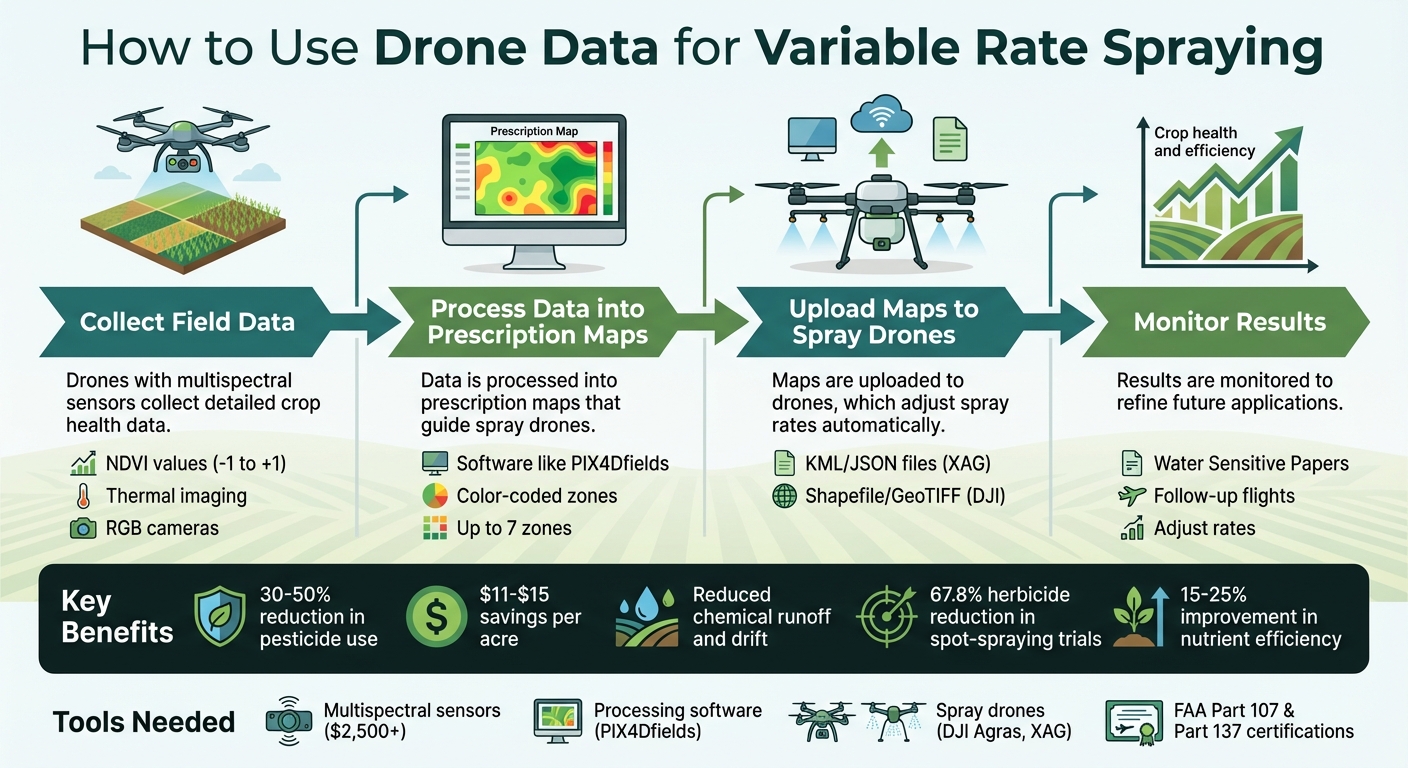
4-Step Process for Using Drone Data in Variable Rate Spraying
Pix4Dfields & DJI Mavic 3 - Variable Rate Application Mission In The Field
sbb-itb-3b7eef7
Step 1: Collecting Field Data with Drones
Accurate field data collection is the backbone of successful variable rate spraying. This data integrates with farm management software to enable precise spray applications. Drones equipped with specialized sensors gather detailed crop health and stress data, which serves as the foundation for creating prescription maps.
Using Multispectral and Thermal Sensors
Multispectral sensors are essential tools for variable rate applications. They capture light in wavelengths beyond human vision, particularly near-infrared (NIR) and red edge bands. These wavelengths are used to calculate vegetation indices like NDVI (Normalized Difference Vegetation Index) and NDRE (Normalized Difference Red Edge). NDVI values, ranging from –1 to +1, provide insights into vegetation health, with higher values indicating healthier crops. NDRE is especially helpful for detecting nitrogen deficiencies early, as it measures chlorophyll content and penetrates deeper into the canopy compared to NDVI[3].
Thermal sensors add another layer of insight by measuring surface temperatures to detect water stress and irrigation needs. When crops are under drought stress, their canopy temperature rises - a detail thermal imaging captures with precision. RGB cameras are suitable for basic tasks like plant counting and estimating canopy volume, while LiDAR sensors generate 3D field models by measuring crop height and terrain variations. Hyperspectral sensors, which analyze hundreds of narrow bands, can even distinguish between diseases or nutrient deficiencies that might look identical to the naked eye[7].
The choice of sensor depends on your goals and budget. Multispectral sensors typically start at around $2,500, thermal sensors at $2,000, and more advanced equipment like LiDAR can cost upwards of $10,000. However, for most variable rate spraying needs, multispectral sensors are usually sufficient.
Best Practices for Drone Data Collection
Timing and environmental conditions play a critical role in capturing high-quality data. It’s best to conduct mapping missions around solar noon or under consistent cloud cover to avoid harsh shadows and uneven reflectance values[3]. Unlike satellite imagery, drones can operate effectively in cloudy weather, offering reliable field overviews regardless of conditions[1]. To ensure the data reflects the current state of the field, schedule mapping flights just before fertilization or spraying.
Flight parameters are equally important. To ensure accurate orthomosaic stitching, maintain an overlap of at least 70% between images[3]. Flying at altitudes between 60 and 120 meters (200–400 feet) is ideal, with lower altitudes (1–2 cm per pixel) suited for detailed weed detection and higher altitudes (3–5 cm per pixel) better for broader crop mapping[3]. Using a calibrated reflectance panel helps normalize data, ensuring consistent vegetation index readings throughout the field[3].
Georeferencing is another crucial step to align prescription maps with field boundaries and equipment guidance systems. Drones equipped with Real-Time Kinematic (RTK) GPS provide the precision needed for these applications. Modern drones, like the DJI Mavic 3M, come with downwelling light sensors that record ambient light during flights, allowing processing software to adjust for changes in sunlight intensity[3]. Lastly, define field boundaries accurately using SHP or KML files before analysis. This ensures vegetation indices represent actual crop conditions rather than including non-crop areas like roads or trees[4].
This detailed, georeferenced data forms the basis for creating precise and actionable prescription maps in the next step.
Step 2: Processing Data into Prescription Maps
Turn your drone imagery into prescription maps by analyzing vegetation indices and zoning fields. This step helps pinpoint problem areas and creates zone-specific application maps that your spray drone can follow automatically. Advanced software plays a key role in converting these insights into precise, actionable plans.
Analyzing Drone Imagery with Software
Tools like PIX4Dfields transform multispectral images into orthomosaics and vegetation index maps, such as NDVI heatmaps. These maps offer a clear picture of crop health across your field, highlighting problem areas like weed infestations, nutrient shortages, or water stress. The color-coded zones - where red often signals stressed vegetation and green indicates healthy growth - make it easy to spot patterns that aren’t visible to the naked eye.
PIX4Dfields' Targeted Operations feature simplifies this process by automatically converting index maps into prescription layers. It defines field boundaries, identifies obstacles like trees and power lines, and suggests application rates for grid cells. Manual adjustments can be made if needed to fine-tune the results [12][14].
For better performance and accurate analysis, trim orthomosaics to match field boundaries. This reduces disk space usage and ensures indices focus solely on crop areas [12]. Also, double-check that obstacles are properly marked - spray drones recognize these as no-go zones, helping to avoid crashes during automated missions [12][14].
Creating Prescription Maps for Variable Rate Spraying
Zonation groups areas with similar needs into distinct rate zones. PIX4Dfields supports up to seven zones, but the number of application rates your drone can handle depends on the model. For instance, XAG drones manage up to three rates, while DJI Agras models can handle more complex configurations [10][12].
To create an effective prescription map, align your grid with your equipment. For example, use a 5×5 meter grid for XAG drones or customize the size for DJI Agras models. Rotate the grid to match crop rows for better precision [8][9][10][12].
Here’s a real-world example: Agrarpohl, a German service provider, used PIX4Dfields to design variable rate maps for nitrogen fertilization and growth regulators. This approach boosted profits by €40 per hectare compared to traditional methods. In another case, a St. Augustine grass project saved 34.5 tons of fertilizer, translating to $25,875 in cost savings, by using custom nitrogen-based fertilizer maps [1][11].
"Targeted Operations creates highly customizable prescription maps for variable rate or spot spraying applications. You can use these directly with your spray drone, tractor, or field sprayer."
– PIX4Dfields [14]
When exporting your prescription map, be mindful of file format requirements. XAG drones need KML and JSON files and have a maximum mission area of 33 hectares (larger fields must be divided into smaller blocks). DJI Agras models typically use Shapefiles and GeoTIFFs [9][10]. Always ensure the source units (liters per hectare or gallons per acre) are correct, and verify the coordinate system matches WGS84 (EPSG:4326) before uploading to your drone’s controller [13].
| Drone Platform | Max Application Rates | File Formats | Area Limit | Grid Size |
|---|---|---|---|---|
| XAG (P100H, P150, V50H) | 3 rates [10] | KML, JSON [10] | 33 hectares [8][10] | 5×5 meters [8][10] |
| DJI Agras (T-series, T50) | Multiple rates [9] | Shapefile, GeoTIFF [9] | Not specified | Variable (1.5–3 m height) [9] |
| Generic Tractor Systems | Up to 7 zones [12] | Shapefile, ISOXML, GeoTIFF [13] | Not specified | Match implement width [12] |
These detailed maps guide spray drone missions, ensuring chemical applications are tailored to the specific needs of each zone in your field.
Building on your prescription maps, the next step is integrating them with your spray drone for fully automated missions. Once your maps are ready, you’ll transfer them to the drone and configure its system. While the exact steps depend on the drone model, the general process is the same: export the files in the right format, load them onto the controller, and set up mission parameters.
Uploading Maps to Spray Drones
The most common way to upload prescription maps is through a microSD card. Start by exporting your files from PIX4Dfields, then copy them to the card, and insert it into the drone's controller. For DJI Agras models (like the T20, T30, T40, T50, and T100), you’ll need to create a folder named "DJI" that includes TIF, TFW, and Shapefile data. On the other hand, XAG drones require KML and JSON files packaged together.
To import data on a DJI controller, navigate to the task menu, select the microSD card as the source, and import both the field boundary and prescription map. Set "Map Source" to "Other" and "Source Unit" to "ha" (hectares), no matter the original units. You’ll also choose a resampling method: "Max Value" applies the highest rate when the drone overlaps two cells, while "Average Value" uses the mean rate.
Keep file names under 45 characters to avoid compatibility issues with DJI systems. This ensures your data remains intact from the software to the controller. For XAG drones, set the tile size to exactly 5×5 meters and limit maps to three zones for compatibility. If the field is larger than 33 hectares, split it into smaller sections.
Configuring Spray Drones for Variable Rates
After importing the prescription map, link it to the corresponding field using the "+ folder" option. Next, set flight parameters, such as height (1.5–3 meters) and spray width (5 meters), ensuring the application rate (e.g., liters per hectare) matches your prescription.
If the display shows incorrect volumes, perform a quick test flight. Often, the drone applies the correct rates despite display errors. Also, mark obstacles like trees or power lines in your prescription map so the drone can avoid them.
To conserve battery life, adjust flight boundaries to focus only on application zones. This can shrink the flying area by 20% or more. Newer DJI models, like the Agras T50 and T25, support "Multitask" operations. This feature lets you import a shapefile with multiple polygons and cover several fields in one mission.
Once everything is set, your drone is ready for the automated spray mission.
Executing Automated Spray Missions
With the files uploaded and the drone configured, it’s time to start the mission. Launch the automated mission from the controller, and the drone will follow the prescription map, adjusting spray rates in real-time as it moves through different zones. Monitor progress on the controller, keeping an eye out for alerts or deviations.
Before starting, make sure your drone’s firmware is up to date. For example, DJI Agras models need Aircraft/RC firmware version 01.00.0602 or higher to support prescription imports. For larger areas (over 3 hectares), consider using a "Boundary Mission" format for better efficiency compared to a full variable rate map.
"Agremo's AI solution turns DJI's drone imagery into actionable insights, and its recipe maps make our AGRAS drone a truly intelligent and precise spraying tool."
– DJI Agriculture
Here’s a real-world example: In September 2021, Justin Metz, a Technology Integration Specialist at Bowles Farming Company in Los Banos, California, used a DJI Inspire 1 Pro to map 3,200 acres of cotton within a 12,000-acre operation. By applying a VARI index and creating variable rate maps for a second round of defoliant, he saved between $11 and $15 per acre on areas that didn’t need additional spraying. This also reduced equipment wear and boosted fiber yield.
For those looking for complete solutions, Drone Spray Pro offers a variety of spray drones tailored to support these advanced workflows.
| Feature | DJI Agras (T-Series) | XAG Spray Drones |
|---|---|---|
| Required Files | TIF, TFW, and Shapefile (in "DJI" folder) | KML and JSON (in "XAG" folder) |
| Import Method | MicroSD card to the remote controller | MicroSD card via Agremo or PIX4D |
| Zone Limits | Up to 7 zones | Up to 3 zones |
| Max Mission Size | Varies by model | Up to 33 hectares per mission block |
| Flight Height | 1.5–3 meters (recommended) | Not specified |
| Special Features | Multitask operations (T25/T50) | Automatic mission splitting for large fields |
Step 4: Monitoring Results and Improving Future Applications
Tracking Spray Coverage and Results
Once you've set up accurate application data, it's time to verify how well it performs in the field. Start by comparing the drone's actual application map to your original prescription map. This side-by-side view will reveal how accurately the system applied the spray [15].
To evaluate spray coverage, place Water Sensitive Papers (WSP) at various heights within the crop canopy before spraying. These papers turn blue when hit by spray droplets, giving you a visual record of coverage. Apps like SnapCard or DropLeaf can analyze photos of these samples to calculate coverage percentages [16][17]. Generally, coverage between 20% and 40% is sufficient for most applications [15].
Another useful check is a water capture test to validate flow meter readings. Fill the tank with clean water, let the nozzles spray into a container for one minute, and measure the output. Compare this volume to the drone's reported rate. If the difference exceeds 5%, adjustments are necessary [16][17].
About 10 days after spraying, conduct a follow-up drone flight to assess crop response. Use the same vegetation indices (like NDVI or VARI) from a multispectral mapping drone that informed your initial prescription map. This will help you gauge whether the treatment effectively addressed the problem areas [6][15]. To confirm drone data, physically inspect the field - this "ground truthing" helps identify which zones responded best to treatment.
| Evaluation Method | Tools Required | What It Measures |
|---|---|---|
| Coverage Analysis | Water Sensitive Paper, Scanner/App | Droplet density and % coverage [15][16] |
| System Accuracy | Drone Logs, GIS Software | % match between prescribed and actual rates [15] |
| Biological Efficacy | Field Surveys | Disease incidence and infestation levels [15] |
| Economic Impact | Farm Records | Input savings ($/acre), water reduction [6] |
| Crop Health | Multispectral Sensors | Vegetation vigor, stress recovery [6][15] |
Use these findings to refine your strategy for future spraying missions.
Making Adjustments Based on Outcomes
After analyzing your results, adjust your next mission settings to improve performance. Update your prescription map based on how different zones responded. For example, if a lightly treated area still shows stress, increase the treatment rate. Conversely, if a heavily treated zone didn’t require that much product, reduce the rate for future applications.
Examine swath overlap patterns using your WSP samples. If you notice heavy dye concentrations, it means you're overlapping too much - try increasing route spacing. If there are gaps between passes, decrease spacing or adjust the flight altitude [17]. Keep in mind that most drones achieve effective spray widths of only 65% to 75% of the advertised maximum, so field testing is essential [17].
Monitor your nozzles closely. Drone nozzles, with their small orifices (0.1 to 0.15 gallons per minute), are prone to clogging. Replace any nozzle with a flow rate deviation over 10% [17]. Even minor nozzle issues can impact application accuracy.
"In the early days of drones, it was, 'Here's your drone and a pretty image that shows a bad spot.' ... Now, we can see exactly when the issue is starting and how big it is, then create a plan to fix it."
– Justin Metz, Technology Integration Specialist, Bowles Farming Company [6]
Keep detailed records of every mission, including flight altitude, speed, wind conditions, nozzle types, and product rates. These logs will serve as a guide for future applications. Once you identify a configuration that works well under specific conditions, you can replicate it with confidence. Over time, this process will improve your mapping accuracy and spraying efficiency, ultimately boosting your farm's overall performance.
Considerations for Farmers in the United States
Making the most of drone data for variable rate spraying (VRS) requires understanding the practical advantages it offers and the regulatory responsibilities tied to U.S. farming practices.
Benefits of Drone-Based VRS in the US
Using drones for variable rate spraying offers several advantages for farmers across the U.S. One key benefit is targeted spot-spraying, which allows you to address specific weed or pest issues without applying chemicals across entire fields. This approach can cut herbicide use by 30% to 50% [19][23]. For example, in December 2024, Iowa State University's Digital Ag Innovation Lab tested this method on soybeans. The results? Nearly 50% savings on chemicals and a cost reduction of $13.42 per acre, all while maintaining yields comparable to traditional broadcast methods [19].
Drones also shine in areas where ground equipment struggles, like wet fields, steep terrain, or zones with obstacles. They can cover up to 52 acres per hour and operate during critical windows, including nighttime, thanks to anti-collision lights [23][20]. This flexibility means you can spray immediately after crop emergence or during periods when pollinators are vulnerable, without waiting for ideal ground conditions.
Safety is another highlight. Drone-based spraying reduces operator exposure to chemicals [23]. Plus, variable-rate systems adjust spray volumes in real time based on crop health, improving nutrient efficiency by 15% to 25% [23]. As of 2023, adoption rates for Variable Rate Technology in the U.S. stood at 71% for corn, 76% for soybeans, and 74% for cotton [5].
"While spray drones offer several benefits and are gaining popularity among consultants and growers, it is important to address that they are not meant to compete with or replace ground application equipment. In fact, the technology pretty well complements ground applications." – Aubrey Shirley, UGA Extension [18]
Before you start using drones, ensure you meet all regulatory requirements to operate safely and legally.
FAA Compliance for Spray Drones
In addition to their performance benefits, drone-based spraying in the U.S. comes with specific legal requirements. To operate spray drones, you’ll need several certifications. First, a Part 107 Remote Pilot Certificate is required. If you’re applying chemicals, you’ll also need a Part 137 Agricultural Aircraft Operator Certificate [20][21]. For drones weighing 55 lbs or more (including payload), a Section 44807 exemption and an FAA Medical Certificate are necessary [20].
All agricultural drones must be registered with the FAA. This costs $5 for a three-year period, and the registration number must be displayed on the drone [25][22]. Drones also need to broadcast Remote ID data, including their location, altitude, and control station details, in real time [20][22]. Additionally, state-specific requirements may apply, such as obtaining a Private or Commercial Pesticide Applicator License from your state’s regulatory agency [18][20].
Here’s a quick look at the FAA regulations for spray drones:
| Regulation | Drones Under 55 lbs | Drones 55 lbs or Heavier |
|---|---|---|
| Pilot Certification | Part 107 Remote Pilot Certificate | Part 107 + FAA Medical Certificate |
| Dispensing Authority | Part 137 Certification | Part 137 + Section 44807 Exemption |
| Registration | FA-number via FAADroneZone | N-number via Aircraft Registration Branch |
| Pesticide License | State Private/Commercial License | State Private/Commercial License |
Some companies, like Drone Spray Pro, offer services to assist with FAA licensing, making the process easier to navigate. Keep your Remote Pilot Certificate up to date by completing the required online recurrent training every two years [26]. For operations in controlled airspace, use the Low Altitude Authorization and Notification Capability (LAANC) system to get near real-time airspace approvals [25][22]. And unless you have a specific FAA waiver, always maintain a visual line of sight while flying [25][24].
Conclusion
Drone data is transforming how fields are managed. By enabling precise, plant-specific chemical applications, drones ensure that only the necessary amount is applied exactly where it’s needed. This reduces waste, safeguards the environment, and improves profitability.
The numbers back up these benefits. Farmers using drone-guided prescriptions have cut herbicide use by an impressive 67.8% in spot-spraying trials [3]. Additionally, avoiding unnecessary resprays has saved growers between $11 and $15 per acre [6]. Variable rate systems further enhance nutrient efficiency by 15% to 25% [23], leading to healthier crops and less nutrient runoff into waterways. These statistics highlight a more efficient and environmentally conscious approach to spraying.
The process is straightforward: gather field data, process it into prescription maps using specialized software, and upload these maps to automate spraying. Advanced platforms like the DJI Agras T40 can manage up to 52 acres per hour [23], making this technology viable even for larger farms.
"The biggest benefit for farmers who use drones and Agremo reports is that they increase their yields, reduce costs or improve their productivity. Ultimately, these benefits boost profitability."
With adoption rates soaring - 71% for corn, 76% for soybeans, and 74% for cotton as of 2023 [5] - drone-based variable rate spraying is quickly becoming the go-to method for efficient farming. To get started, ensure FAA compliance and invest in the right equipment. For guidance on licensing, training, and tools, Drone Spray Pro offers the support you need to embrace this game-changing technology.
FAQs
Which vegetation index should I use (NDVI vs. NDRE) for my spray decisions?
For making spray decisions, NDRE is more effective for assessing chlorophyll levels and early crop vigor. On the other hand, NDVI is generally used to evaluate overall plant health and biomass. The best option depends on your crop type and its current growth stage.
How accurate does my GPS/RTK need to be for variable rate spraying to line up correctly?
For variable rate spraying to work effectively, your GPS/RTK system needs to deliver centimeter-level accuracy, ideally around 1 cm horizontally. This precision is crucial to ensure that the spraying zones align perfectly with the field zones mapped by the drone, leading to better crop management and more efficient resource use.
What’s the best way to validate that the drone applied the right rates in each zone?
To ensure accurate application rates, start by analyzing GPS data to evaluate spray coverage and droplet distribution. Pay attention to external factors like wind and temperature, which can impact the effectiveness of the spray.
Next, calibrate your equipment by using flow meter verification to measure output precisely. Finally, conduct spray deposit sampling to confirm that the correct rates have been applied consistently across all zones. These steps help maintain precision and improve overall application efficiency.
