Call or Text: +1 (208) 425-2990
Email: Sales@DroneSprayPro.com

Selective Weed Targeting with Drone Sprayers
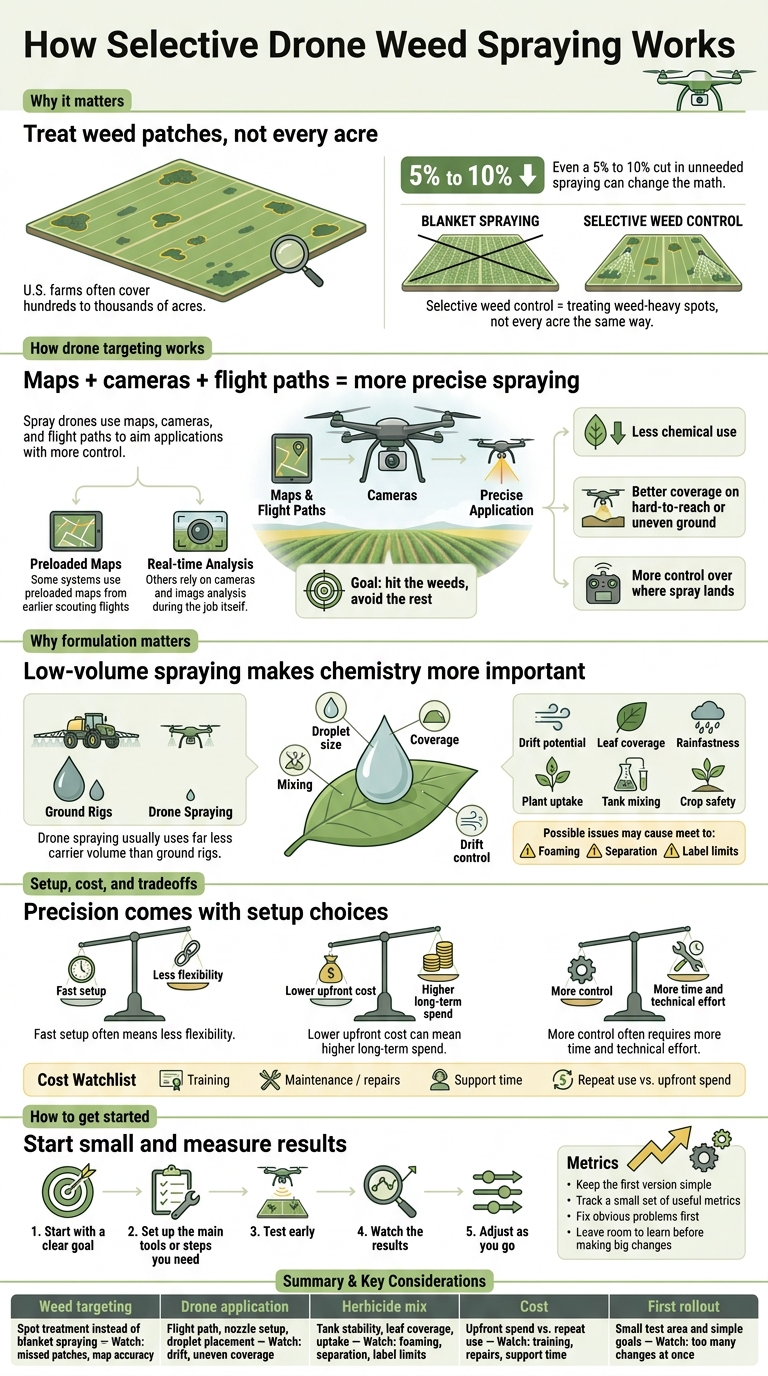
Selective drone spraying can cut waste, trim herbicide use, and put product on weed patches instead of whole fields. On U.S. farms, that can affect yield, crop safety, labor, and input costs across hundreds or thousands of acres.
Here’s the short version:
- Selective weed control means treating weed-heavy spots, not every acre the same way
- Spray drones use maps, cameras, and flight paths to aim applications with more control
- Formulation choice matters because low-volume drone spraying depends on droplet size, coverage, mixing, and drift control
- Setup and cost vary by system, training, maintenance, and how often you use it
- Getting started works best with a small trial, clear goals, and a short list of metrics
A few numbers help frame it:
- U.S. farms often cover hundreds to thousands of acres, so even a 5% to 10% cut in unneeded spraying can change the math
- Drone spraying usually uses far less carrier volume than ground rigs, which makes product behavior more important
- Input costs can shift fast when herbicide, labor, and fuel are spread across large fields
In plain English: the drone is only part of the job. If I want solid results, I need the right field map, the right spray plan, and a herbicide mix that works well in a low-volume aerial pass.
What I should expect is simple: more precision, more setup choices, and a learning curve at the start.
| Area | What matters most | What I should watch |
|---|---|---|
| Weed targeting | Spot treatment instead of blanket spraying | Missed patches, map accuracy |
| Drone application | Flight path, nozzle setup, droplet placement using high-output systems like the DJI Agras T50 | Drift, uneven coverage |
| Herbicide mix | Tank stability, leaf coverage, uptake | Foaming, separation, label limits |
| Cost | Upfront spend vs. repeat use | Training, repairs, support time |
| First rollout | Small test area and simple goals | Too many changes at once |
If I keep the first pass simple and track results closely, drone weed targeting can become a more exact way to handle weeds without treating every part of the field like it has the same problem.
How Selective Drone Weed Spraying Works
How spray drones target weeds more precisely
Spray drones don’t just fly over a field and dump herbicide everywhere. That’s the whole point. They’re built to spot where weeds are and treat those spots with far more control than replacing traditional crop dusting.
In practice, this usually comes down to a mix of sensors, mapping software, and flight automation. The drone scans the field, pinpoints weed patches, and then applies product only where it’s needed. Instead of treating every square foot the same, it can focus on problem areas.
That more targeted approach can help with a few things:
- Less chemical use in parts of the field that don’t need treatment
- Better coverage on hard-to-reach or uneven ground
- More control over where spray lands
Some systems use preloaded maps from earlier scouting flights. Others rely on cameras and image analysis during the job itself. High-end models like the DJI Agras T40 use these sensors to map and spray in real-time. Either way, the goal is simple: hit the weeds, avoid the rest.
It’s a bit like using a fine-tip marker instead of a paint roller. Both can get the job done, but one gives you a lot more control. In farming, that control matters when input costs are high and off-target spray can create problems fast.
sbb-itb-3b7eef7
Why chemical formulations matter in drone weed control
In drone weed control, the herbicide itself is only part of the story. The formulation matters just as much as the active ingredient.
Why? Because drone spraying works under tighter limits than ground rigs. Spray volumes are lower. Droplet behavior matters more. And the product has to perform well even when coverage is less forgiving.
A chemical formulation is the way a herbicide is built and delivered. That includes things like solvents, surfactants, oils, salts, and other ingredients that affect how the spray mixes, spreads, sticks, and enters the plant.
With drone applications, those details can make a big difference in:
- Drift potential
- Leaf coverage
- Rainfastness
- Plant uptake
- Tank mixing
- Crop safety
Think of it like coffee. The beans matter, sure. But grind size, water, and brew method change the result a lot. Herbicides work the same way in the field.
Some formulations are better suited to low-volume aerial use than others. A product that works fine through a boom sprayer may not behave the same way through a drone. It might foam too much, separate in the tank, or need more carrier volume than the drone can deliver well.
This is also why applicators pay close attention to label language, adjuvant needs, and droplet guidance. Small shifts in formulation behavior can change field results fast.
If the goal is solid weed control with fewer misses, the chemistry package can't be an afterthought. It needs to match the drone, the target weed, and the spray conditions.
Setup, cost, and tradeoffs
Getting started usually comes down to three things: how much work setup takes, what it costs, and what you give up in return.
Some sprayer drones are simple to launch but come with less control. Others take more time, more budget, and more hands-on work, but they can give you tighter control over performance, data, or customization. That's the tradeoff in plain English.
Cost can vary a lot too. An economy package that looks cheap at first can get expensive once usage grows. On the flip side, a setup with a higher upfront cost may save money over time if you plan to use it heavily.
It also helps to think beyond the sticker price. Setup time, maintenance, training, and support all matter. A $99/month tool isn't just $99/month if your team spends hours each week trying to make it work.
Here’s a simple way to look at it:
- Fast setup often means less flexibility
- Lower upfront cost can mean higher long-term spend
- More control often requires more time and technical effort
The best choice depends on your team, budget, and how much complexity you're willing to deal with day to day.
How to get started and what to expect
Getting started doesn’t need to feel like a big leap.
The best way is to begin small, get the basics in place, and build from there. That gives you room to learn what works without turning the whole thing into a headache.
Here’s a simple way to think about it:
- Start with a clear goal
- Set up the main tools or steps you need
- Test early
- Watch the results
- Adjust as you go
At first, expect a bit of trial and error. That’s normal. Most people don’t get everything right on day one, and honestly, they don’t need to.
You may also notice that progress comes in stages. The first stage is usually setup and learning. After that, things tend to feel smoother because you’ve got a better sense of what matters and what can wait.
If you’re working with a team, it helps to agree on roles early. Who owns setup? Who reviews results? Who handles changes? A little clarity up front can save a lot of back-and-forth later.
It’s also smart to keep your expectations grounded. Early wins can happen, but some results take time. Think of it like getting a car onto the highway: the first part is slower, then momentum starts to build.
A few things usually help:
- Keep the first version simple
- Track a small set of useful metrics
- Fix obvious problems first
- Leave room to learn before making big changes
The main thing to expect is progress, not perfection. If the setup is solid and you stay consistent, the process usually gets easier to manage.
FAQs
How accurate is drone weed targeting?
Drone weed targeting is highly accurate because the system can react on the spot. It uses real-time feedback, AI recognition, and low-latency communication to spot weeds and respond without much delay.
That matters in the field. These features make pinpoint application possible, cut chemical waste, and let operators adjust for things like uneven terrain and changes in crop density.
Which herbicides work best with spray drones?
Herbicides such as Armezon Pro (Dimethenamid-P + Topramezone), Assure II (Quizalofop-P-ethyl), and Authority Assist (Sulfentrazone + Imazethapyr) can work well with spray drones.
The main thing is simple: use them according to the label. That includes minimum GPA and any other application rules listed on the product label.
How do I start a small field trial?
Begin by scouting the field and mapping weed patches. From there, build a prescription map that marks only the areas that need treatment.
Before spraying, make sure the herbicide is labeled for aerial use. Also check local rules for spray volume, flight height, and nozzle type. Then treat only the mapped weed zones and track the results, including weed control, chemical savings, and overall effectiveness, before rolling it out on a larger scale.
