
Call or Text: +1 (208) 425-2990
Email: Sales@DroneSprayPro.com

How to prevent spray drone battery fires
Most spray drone battery fires start from the same few problems: heat, damage, overcharging, short circuits, dirty connectors, or bad storage. If I want to cut the risk, I need a simple routine: inspect every pack, let it cool, charge it only while someone is watching, and store it clean, dry, and partly charged when it will sit for more than a few days.
Here’s the short version:
- Pull any bad pack out of service at once if I see swelling, leaks, cracks, burn marks, smoke, hissing, corrosion, or a chemical smell.
- Do not charge a hot battery. Let it rest for 15 to 30 minutes or until it reaches room temperature.
- Charge only with the approved charger and only within the stated range, usually 32–105°F (0–40°C).
- Do not charge unattended or overnight.
- Store batteries at 59–77°F (15–25°C) in a dry, ventilated place.
- For storage longer than a few days, keep packs at about 40–60% charge.
- Keep batteries away from fuel, hay, cardboard, tools, fertilizer dust, and pesticide residue.
- If a pack smokes or vents, move people upwind, clear the area, and isolate the battery after it cools.
What matters most? I don’t need a long process. I need the same checks every day, because lithium packs can fail fast once heat builds and thermal runaway starts.
A spray drone battery should go back into use only if it is cool, clean, undamaged, and behaving like the rest of your fleet of agricultural drones.
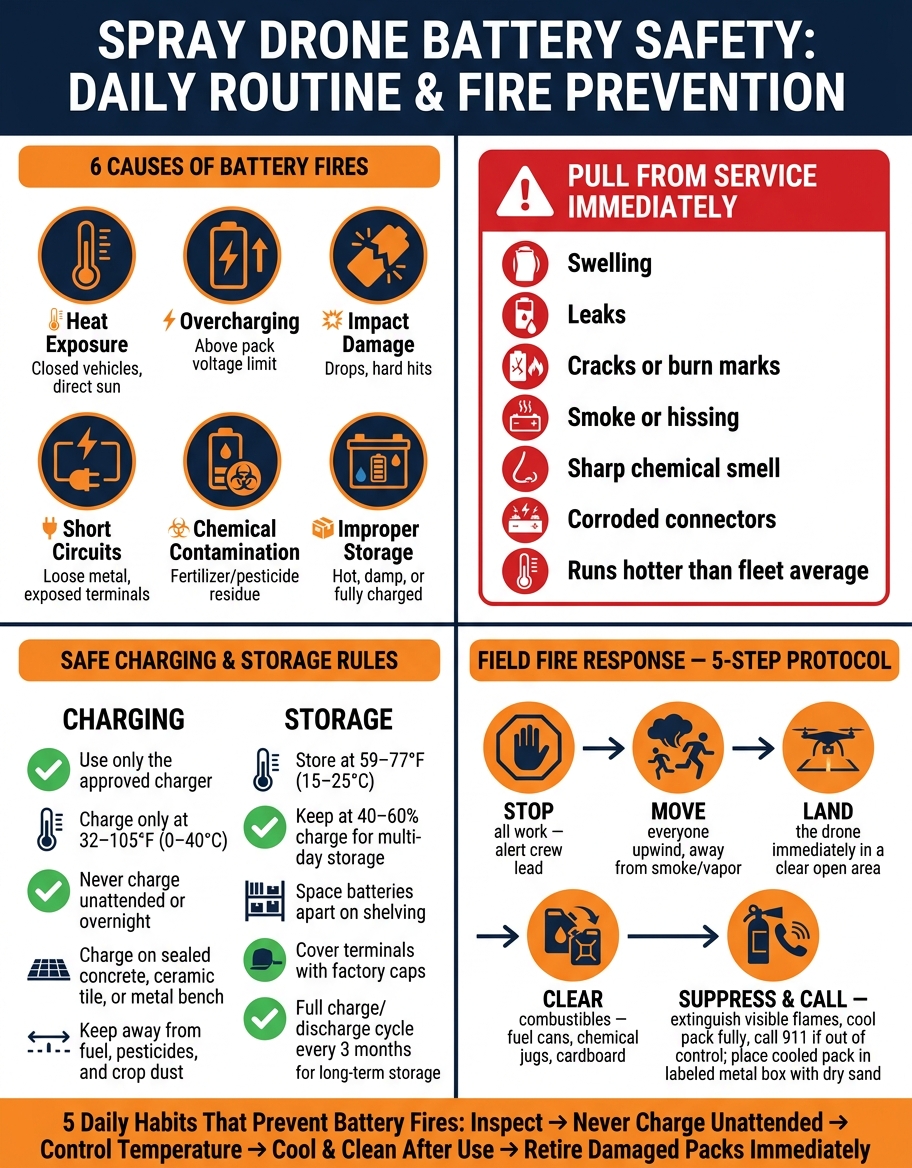
Spray Drone Battery Safety: Daily Inspection & Response Checklist
How to keep LiPos from burning down your house (safe lipo charging)
sbb-itb-3b7eef7
What causes spray drone battery fires
Spray drone lithium-ion and LiPo packs can go into thermal runaway. When that happens, heat kicks off a self-feeding reaction, the pack can vent flammable gas, and a fire can start fast.[12] In most cases, the trouble starts when a cell gets overcharged, overheated, or damaged. From there, one bad cell can heat the rest of the pack.[9]
Six conditions make this more likely on a working farm:
- Heat exposure - Closed vehicles and direct sun can overheat packs before charging or flight.[6][11]
- Overcharging - Charging above the pack's limit can upset the cells and build pressure.[4][5][7][8]
- Impact damage - A drop or hard hit can damage internal layers even when the case looks fine.[3][5]
- Short circuits - Loose metal, tools, or exposed terminals can cause sudden heating.[4][7]
- Chemical contamination - Fertilizer and pesticide residue can corrode connectors and create conductive paths.
- Improper storage - Hot, damp, or fully charged storage speeds wear and increases fire risk.[5][8][10]
High-risk situations crews should avoid every day
On the farm, these failures usually trace back to a handful of repeat mistakes.
Charging unattended is one of the big ones, especially when several packs are plugged in and no one is watching them. Using the wrong charger also increases the chance of an unsafe charge.[4][7][8]
Leaving packs in direct sun or inside a closed vehicle can overheat them before the afternoon flight.[6][11] Transporting batteries loose is another problem. It can lead to impact damage or short circuits.[3][5][7]
A swollen or leaking pack should be taken out of service right away.[8][11] Packs also need to be stored away from fuel, cardboard, and hay so a fault doesn't spread through the shed.[10][1]
That’s exactly what a daily battery check is supposed to catch before a pack goes back into service.
Run a battery check before and after every workday
A fast check at the start and end of each day helps stop a damaged pack from getting anywhere near the aircraft. If your crew rotates through several packs in a day, that routine is your first safeguard.
Preflight checks: pull unsafe packs before they reach the aircraft
Before a pack goes into the drone, give it a quick visual and hands-on check. Look for swelling, cracks, dents, punctures, burn marks, leaks, corrosion, or any wetness, oil, or residue on the pack. Check connectors and wiring for loose housings, bent pins, exposed copper, or melted insulation. If you see white, blue, or green powdery residue on the terminals, that’s corrosion, and the pack should be pulled from service.
Don’t stop at what you can see. A battery’s recent behavior matters too. If a pack has been throwing repeated low-voltage alerts, ending flights much earlier than the rest of the fleet, or running hotter than similar batteries, pay attention. That pack is giving you a warning. If it finishes charging with one cell noticeably lower than the others, log it and keep a close eye on it.[13][16]
Any pack with physical damage, swelling, leakage, or burn marks should come out of service right away. No gray area, no second chance.[14][15][16]
| Condition | Return to Service | Pull From Service |
|---|---|---|
| Casing | Intact, no visible damage | Swollen, cracked, punctured, burned |
| Connectors | Clean, tight, no corrosion | Corroded, loose, frayed, melted |
| Temperature | Cool, at ambient | Warm after resting |
| Performance | Normal runtime and voltage | Short runtime, repeated low-voltage alerts, cell imbalance |
Use that same standard after the last flight too. Otherwise, a stressed battery can go straight back on charge, and that’s asking for trouble.
Postflight handling: cool, clean, and recheck batteries after field work
After the last flight of the day, place batteries on a non-combustible surface like concrete, metal shelving, or a fire-resistant tray in a shaded, ventilated area. Let them rest for 15 to 30 minutes, or until they reach ambient temperature. Do not charge a pack until it reaches ambient temperature.
Once the packs have cooled, clean off dust and spray residue before storage or charging. Wipe the casings and connectors with a dry cloth. Use a brush or compressed air on the terminals. Keep water and spray residue off the contacts.
Then do one more visual pass. Check for new odors, soft spots, discoloration, or bulging that wasn’t there in the morning. Some damage doesn’t show up until after the pack has been stressed in flight.[14][15][17]
Log each battery’s ID, condition, alerts, and status so the next crew knows what to use and what to retire.
How to charge and store batteries safely on the farm
Charging rules: use approved chargers, fire-resistant surfaces, and active supervision
Once the postflight cool-down and inspection are done, move only clean, cool packs to the charging area. Set up a dedicated charging spot in your farm shop or another well-ventilated space. Good surfaces include sealed concrete, ceramic tile, or a heavy metal bench.
Keep that setup away from diesel, gasoline, propane, pesticides, herbicides, and crop dust. On mobile field jobs, charge on a metal shelf or a concrete pad beside the trailer. Don’t charge inside an enclosed truck cab or a packed chemical trailer, where heat and fumes can build up fast.
Use only the charger made for that battery model. The approved charger has the right voltage limits, cell balancing, and thermal monitoring built in. Charge only within the battery’s stated temperature range, usually 32–105°F (0–40°C).[2][22] And make sure the pack has cooled before you plug it in.
Don’t charge unattended. Don’t charge overnight either. If you notice swelling, smoke, odor, hissing, or unusual heat, disconnect the battery right away and move it to a fire-resistant isolation area, such as a metal box or sand bucket.[2][18][19] Do not reconnect it.
Storage rules: control heat, moisture, and state of charge
For day-to-day storage, aim for 59–77°F (15–25°C) in a clean, dry, ventilated room.[18][20][22] That matters even more in hot U.S. summer weather. A parked truck cab or enclosed trailer can heat up in a hurry, and that can increase fire risk. If packs feel warm after transport or field use, let them cool before stacking them or boxing them together.
If you’re storing batteries for more than a few days, bring them down to about 40–60% state of charge by using storage mode or the drone app’s discharge function.[18][20] DJI recommends a full charge/discharge cycle every three months for packs kept in long-term storage.[21]
A few simple storage habits go a long way:
- Keep batteries spaced apart on shelving
- Keep terminals covered with factory caps
- Store them away from metal tools, standing water, fertilizer dust, and any area where pesticides or herbicides are handled
In dusty or humid shop spaces, a sealed plastic bin or a dedicated battery cabinet can help cut dust and moisture exposure.
Any pack that swells, vents, or overheats belongs in the response procedure below.
Optional crew setup: standardize chargers, batteries, and training
If your farm uses more than one drone model, it helps to standardize charger labels, SOPs, and daily checklists.
How to respond to overheating, damaged packs, and battery fires
Even with solid checks, a pack can still overheat or fail in the field. If that happens, move fast and keep people away.
Warning signs that mean a battery should be isolated and retired
Use the same signals from your preflight and postflight checks. If the battery changes in shape, smell, heat, or sound, stop using it and isolate it right away.
Pull a battery from service at the first sign of:
- swelling
- leaks
- a sharp chemical smell
- smoke
- hissing
- burn damage
- corroded connectors
A pack that stays noticeably hotter than others after a similar flight is also a warning sign, even if the outside looks normal.
These signs can point to internal damage and fire risk. Never puncture, flatten, or try to reshape a swollen pack. Isolate it and do not reconnect it.
Field fire response: protect people first, then isolate the battery
If a battery starts smoking, venting, or catches fire, follow this order without delay:
- Stop all work and alert the crew lead.
- Move everyone upwind and away from smoke or vapor. Keep bystanders back.
- Land the drone immediately if it is still controllable. Use an open area clear of vehicles, fuel cans, and chemical totes. If control is lost, stay back.
- Clear combustibles from the area. Portable fuel containers, spray chemical jugs, and cardboard are the biggest nearby risks.
- Use the suppression method your manufacturer and local fire department require: put out visible flames first, then cool the pack all the way down. If the fire is beyond crew control, call 911, give your location, and report the battery type plus nearby fuel and chemical storage.
Once the pack is cool to ambient temperature, place it in a labeled metal box or steel drum with dry sand or gravel. Mark it with the date, battery ID, and what happened. Follow your manufacturer's disposal instructions or contact a licensed hazardous waste service. Do not throw a damaged pack in regular trash or a burn pile.
5 habits that lower battery fire risk most
The safest response is prevention, done every day. A steady daily routine does more to cut battery fire risk than any single piece of equipment. These five habits cover the main danger points in spray operations:
- Inspect every battery before and after work - look, listen, smell, and feel for heat. Pull anything abnormal before it gets near the aircraft.
- Never charge unattended - if you're stepping away for lunch or calling it a day, charging stops.
- Keep packs within safe temperature ranges - avoid hot vehicles, direct sun, and any area where heat can build up.
- Cool and clean batteries after every field session - let them reach ambient temperature using a battery cooling kit on a non-combustible surface, then wipe off dust or chemical residue before storing them.
- Retire damaged or swollen packs immediately - isolate the pack and start the disposal process.
Assign one crew member per shift to handle the battery check, and post a checklist in the charging area.
FAQs
How often should I replace spray drone batteries?
There’s no fixed schedule for replacing spray drone batteries.
Replace a battery immediately if you notice safety red flags, such as:
- swelling or deformation greater than 3 mm
- cracks, punctures, or leakage
- heat damage or damaged connectors/wiring
You should also take the battery out of service if it won’t hold a charge or can’t power the drone in a steady way after cooling down.
Regular inspections and avoiding deep discharges can help you get more life out of the battery.
Can I keep batteries in my truck between jobs?
No. Don’t leave batteries in your truck between jobs.
Lithium polymer batteries should be stored in a cool, dry, temperature-controlled place, usually between 50°F and 86°F. A truck can heat up or cool down fast, and those temperature swings can damage battery cells and increase fire risk.
When you’re not flying, keep batteries in a hard, fire-resistant case. It’s best to store them inside a climate-controlled building.
For transport, use battery-safe bags and place them in a ventilated, shaded area.
What should I do with a battery after a hard landing?
Inspect it immediately for physical damage such as swelling, cracks, punctures, bent connectors, leaking, or unusual heat. If you spot any of these signs, stop using the battery right away. It may pose a serious fire risk.
If the battery looks fine, keep a close eye on how it performs. Watch for trouble holding a charge or abnormal heat during use. If anything seems off, take it out of service.
