Call or Text: +1 (208) 425-2990
Email: Sales@DroneSprayPro.com

Orchard Drone Spraying: Canopy Penetration, Fruit Safety, and Setup Guide
Orchard spraying with drones is transforming pest control and crop management, offering precision and efficiency in challenging terrains. By using rotor downwash, drones deliver sprays deep into dense canopies, reducing pesticide use by up to 73% and minimizing ground spray loss by as much as 93%. This guide covers everything you need to know about optimizing drone spraying for orchards, from achieving better canopy penetration to ensuring fruit safety and setting up your equipment effectively.
Key Takeaways:
- Canopy Penetration: Adjust flight height (1.5–3 meters), speed, and nozzle angles to ensure sprays reach interior foliage. Use water-sensitive paper to verify coverage.
- Fruit Safety: Control droplet size (200–350 micrometers for fungicides/insecticides) and avoid spraying during high winds. Follow pre-harvest intervals to prevent residue issues.
- Drone Setup: Calibrate nozzles, confirm swath width, and test spray rates for accurate application. Pre-flight inspections are critical for performance and safety.
With proper setup and operation, drones can improve spray coverage, reduce waste, and enhance crop health. Models like DJI Agras T100, XAG P150, and ABZ L30 offer specialized features for orchard spraying, making them suitable for various canopy densities and terrains.
Orchard Drone Spraying Setup and Optimization Guide
How to Calibrate Your Orchard Kit on the Talos T60X
sbb-itb-3b7eef7
How to Achieve Better Canopy Penetration
This section focuses on fine-tuning drone settings to improve canopy penetration. The aim is to ensure sprays reach deep into the foliage, targeting pests and diseases hidden in the interior, rather than simply covering the outer leaves. Achieving this requires careful adjustments to flight settings, nozzle selection, and spray volume.
Flight Height and Speed Settings
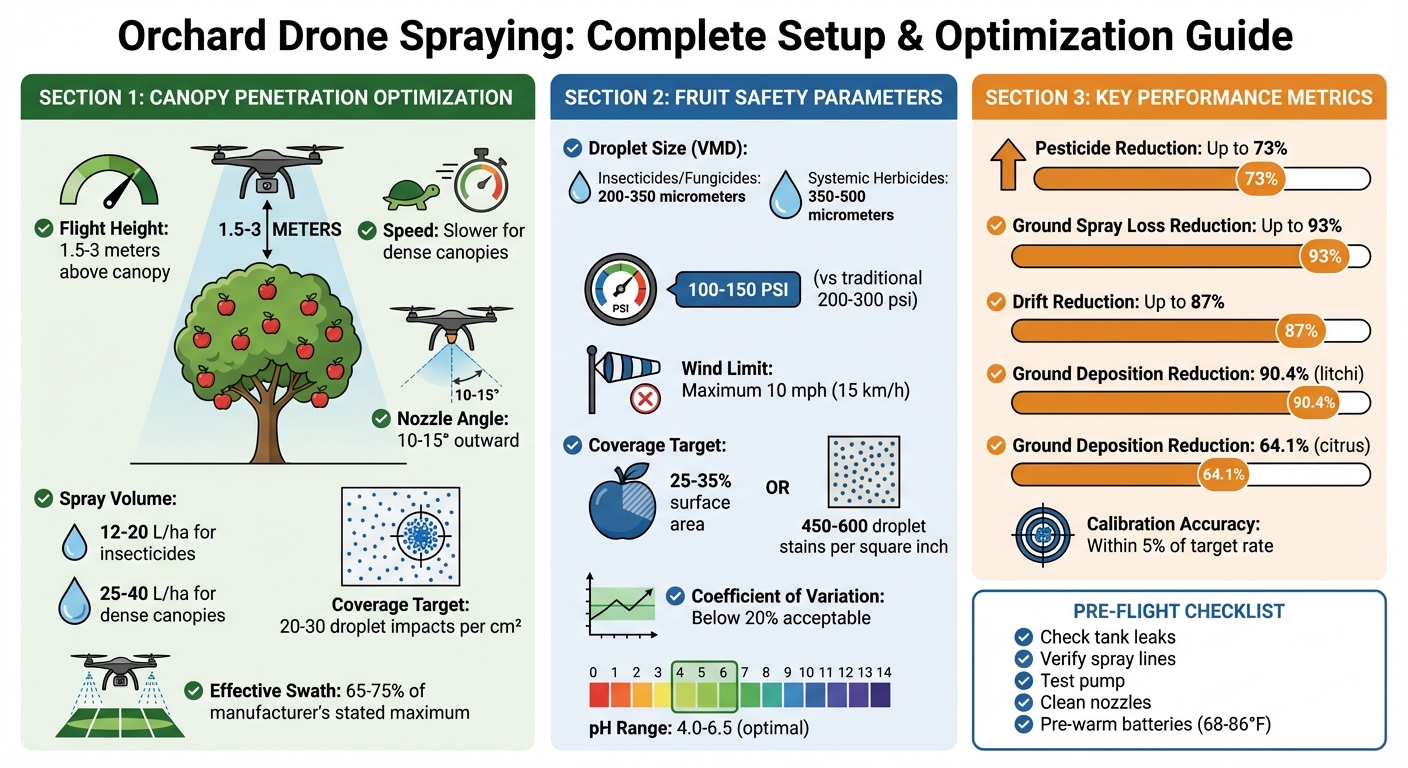
Getting the flight height right is crucial for effective canopy penetration. For most orchards, the ideal height is between 1.5 and 2.5 meters above the canopy [3]. However, some multirotor platforms show optimal results at 2.5 to 3 meters [6]. Flying too high - over 4 meters - spreads the spray too thin, while flying too low - under 2 meters - can cause excessive leaf movement, leading to droplet loss [6].
As Wiki Nest explains:
"Flying too high bleeds energy from the spray plume before it meets leaves. Flying too low can hammer the top foliage and starve the interior."
Speed is equally important. In dense orchards, slower flight speeds allow rotor downwash to push the spray deeper into the canopy [3]. For tall trees with thick foliage, combining lower flight heights with reduced speeds ensures better penetration, even if it means more frequent battery changes. Using auto-terrain sensors can help drones maintain consistent heights over uneven canopies [6].
To confirm the spray is reaching all areas, place water-sensitive paper at different depths of the canopy - top, middle, and interior. For fungicide or nutrient applications, aim for at least 20 to 30 droplet impacts per square centimeter on the paper [6].
Once flight settings are optimized, nozzle choice and spray patterns can further enhance the results.
Choosing Nozzles and Spray Patterns
The nozzles you choose play a big role in determining droplet size and coverage. Rotary atomizers offer digital control over droplet size, allowing adjustments based on canopy density and application needs without requiring a physical nozzle change [7].
Drone nozzles typically operate at low flow rates - around 0.1 to 0.15 gallons per minute (GPM) - due to pump limitations of under 5 GPM [7]. On multirotor drones, angling the nozzles 10–15° outward helps spread the spray as the rotor downwash pushes it downward [3]. Keep in mind that the effective spray width is usually 65% to 75% of the manufacturer’s stated maximum, so plan flight routes accordingly for even coverage [7]. Regular cleaning of nozzles is essential, particularly after using dry products, to prevent clogs and maintain performance [7].
Adjusting Spray Volume by Canopy Type
Spray volume should match the density of the canopy and the growth stage of the orchard. For insecticides, rates typically range from 12 to 20 liters per hectare. As the canopy reaches peak density, volumes may need to increase to 25 to 40 L/ha to ensure thorough coverage for disease control and fruit quality [3]. Dense canopies might also require slower flight speeds or higher volumes to achieve better penetration [8][2].
Advanced systems now use LiDAR to create 3D models of the canopy, enabling precise variable-rate applications. This technology has shown significant reductions in ground spray deposition - up to 90.4% in litchi orchards and 64.1% in citrus orchards - compared to traditional continuous spraying methods [9].
Seasonal adjustments are also key. Early in the season, when foliage is sparse, finer droplets and lighter spray volumes work best. In summer, heavier sprays may be needed to reach the undersides of leaves and interior fruit zones [3]. To check coverage, attach yellow water-sensitive paper to both upper and lower leaf surfaces at different canopy depths. Adequate coverage is typically 25% to 35% of the target surface area, or about 450 to 600 droplet stains per square inch [2].
Protecting Fruit Safety During Spraying
When it comes to safeguarding fruit during spraying, precision is everything. Proper spray placement, timing, and the right additives are key to ensuring thorough coverage without overdoing it. This approach not only protects consumers but also ensures compliance with food safety standards.
Droplet Size and Drift Control
Getting the droplet size right is crucial for effective spray application. For orchard insecticides and fungicides, aim for a Volume Median Diameter (VMD) of 200 to 350 micrometers. This size range ensures the spray reaches both fruit and foliage while minimizing fine droplets that could drift off-target. For systemic herbicides, coarser droplets - between 350 and 500 micrometers - are better suited to reduce unintended movement [3].
Traditional orchard sprayers typically operate at pressures of 200 to 300 psi, but drones can achieve the required droplet sizes with just 100 to 150 psi. As Erdal Ozkan, a specialist in pesticide application technology at The Ohio State University, explains:
"A pressure of 100 to 150 psi is more than adequate to generate the fine to medium size droplets that improve penetration and coverage on the target." [5]
Avoid spraying when wind speeds exceed 10 mph (about 15 km/h) or during temperature inversions, as these conditions can cause sprays to drift laterally for extended distances [3][5][10]. To prevent off-target residue, turn off nozzles facing away from trees in the final rows [5].
To ensure droplets are reaching all parts of the canopy, use water-sensitive paper at various depths. A coefficient of variation below 20% in droplet distribution is typically acceptable for most foliar sprays [10]. Fine-tuning droplet control is a critical step in adhering to pre-harvest intervals and maintaining fruit safety.
Pre-Harvest Intervals and Residue Control
Pre-harvest intervals (PHIs) specify the number of days required between the last spray application and harvest. Always follow the label's "aerial application" instructions and keep detailed records, including timestamps, batch numbers, and flight parameters, to demonstrate compliance during residue testing [3]. While drones allow for late-season sprays to rescue crops, timing is critical to ensure residues degrade to safe levels before harvest.
As the canopy thickens, you may need to increase the carrier volume from approximately 1.6 gallons per acre (15 L/ha) to 2.7–4.3 gallons per acre (25–40 L/ha) to ensure even distribution and avoid residue "hot spots" on outer leaves [3].
Drone tanks, which generally lack agitation, require extra attention. Perform jar tests to confirm that tank mixes stay uniform for at least 8 to 10 minutes [1]. If the drone is idle for more than 10 minutes, manually stir or recirculate the tank mix to avoid concentrated chemical "slugs" [3]. Regularly calibrate your sprayer with clean-water test runs to catch clogged nozzles that could lead to uneven applications and residue spikes [10].
Using Adjuvants for Better Coverage
Adjuvants play a big role in improving spray coverage by helping droplets stick to leaves and fruit, reducing the need for repeat applications. Nonionic surfactants (NIS) lower surface tension, allowing droplets to spread evenly [11][12]. For dense canopies, organosilicone surfactants - often referred to as "super-wetters" - can significantly improve spreading and penetration. However, they may increase runoff risk when applied at low volumes [11].
Oil-based adjuvants like methylated seed oils (MSO) and crop oil concentrates (COC) are particularly useful in low-volume drone applications. They help sprays penetrate waxy leaf surfaces and reduce evaporation [11][12]. In dry conditions, humectants and retention aids can prevent droplets from drying too quickly, giving pesticides more time to absorb and reducing solid residues on fruit [11][12].
Water conditioners, such as ammonium sulfate (AMS), prevent hard water minerals from deactivating pesticides. Most pesticides work best in slightly acidic water, with an ideal pH range of 4.0 to 6.5 [12]. For example, carbamate insecticides can break down in as little as 10 minutes in alkaline water [13].
When mixing sprays, follow the W-A-L-E-S sequence: start with Water (and conditioners), then Agitation, add dry (Lead) formulations, followed by Emulsifiable concentrates, and finish with Surfactants/Oils/Drift reducers [11][12]. Always perform jar tests with new mixes to ensure compatibility [12]. During hot weather (above 90°F), lower the doses of oil-based adjuvants and organosilicones to prevent fruit scorch [11]. Adding a silicone-based anti-foam agent early in the mix can also help avoid cavitation in small tanks [11].
Adjuvant costs for drone spraying usually range from $2 to $8 per acre [11]. Use water-sensitive paper at different canopy heights to verify that your adjuvant and nozzle setup achieve the desired droplet density - around 80 droplets per cm² for fungicides [11]. By optimizing adjuvant use, you can improve spray coverage and keep fruit residues within safe limits.
Drone Setup Guide for Orchard Spraying
Before you take to the skies, a pre-flight inspection is a must. Check for tank leaks, ensure spray lines are intact, verify the pump is working correctly, and make sure the nozzles are clean. If any nozzle deviates by more than 10% from its standard flow rate, replace it [7][14].
Nozzle Selection and Flight Height
Choosing the right nozzle is key when spraying in orchards. Opt for medium-to-coarse droplet nozzles like AIXR or AirMix to reduce drift [1]. For fungicide applications, centrifugal nozzles are a great choice - they keep droplet sizes consistent while letting you adjust flow rates as needed [6]. Keep your flight height between 8–12 feet (2.5–3.5 m). Flying higher increases drift, while flying too low can cause the leaves to flutter, disrupting your spray pattern [6][1].
Determining Effective Swath Width
To find your effective swath width, lay water-sensitive paper at half-meter intervals across a test strip. Add more papers at different canopy depths to ensure you’re hitting the target of roughly 80 droplets per cm² for fungicides. Keep in mind that the actual effective swath is usually 65% to 75% of what the manufacturer claims [7][14][6].
Many modern drones come with auto-rate modes that adjust pump flow to match ground speed. However, in windy conditions, especially near treelines, you might want to switch to constant flow mode for better overlap [6].
Calibration and Preparation
Once you’ve adjusted your nozzles and confirmed your swath width, it’s time to calibrate the system. Calibration ensures your drone delivers the correct spray rate for effective and safe coverage. Spray water over a one-acre test area at your chosen speed and height, then measure the output. If it’s off by more than 5% from your target rate, adjust the controller settings. Don’t forget to use a 50–80 mesh screen while filling the tank to keep out debris [6][7][14].
For top performance, especially on cool mornings, pre-warm your batteries to 68–86°F (20–30°C). This helps maintain stable voltage and ensures the pump runs smoothly [6].
Final Pre-Flight Check
Before takeoff, do a physical field check to spot any obstacles that satellite maps might have missed [1]. As Quadrotor Services wisely puts it:
"The human eye and a few dye cards remain the final arbiters"
of spray accuracy, no matter how advanced your drone’s sensors may be [6].
Drone Spray Pro Packages for Orchards
Drone Spray Pro packages are specifically designed to tackle the unique challenges of orchard spraying. They focus on penetrating dense canopies and navigating uneven terrain, offering options tailored to orchard size, canopy density, and terrain complexity.
DJI Agras Settings for Canopy Penetration
The DJI Agras T100 is built to excel in canopy penetration. With its 100L tank and a maximum flow rate of 40 L/min, it uses a coaxial dual-rotor design and 62-inch carbon-fiber propellers to create powerful downwash, pushing spray into the mid-to-lower layers of dense canopies. Its advanced systems, including RTK, LiDAR, radar, and multi-vision sensors, ensure precise terrain tracking even in complex orchard layouts [17].
For medium-scale operations, the DJI T50 and T25 are excellent choices. Both models feature flow rates of up to 24 L/min and are equipped with four nozzles. The T50 can cover about 21 hectares per hour, while the T25 handles approximately 12 hectares per hour. With fast charging times of just 9–12 minutes, they minimize downtime and maximize efficiency. Additionally, their dual phased-array radar systems enhance terrain sensing, making them ideal for large-scale orchards [16].
Other models outside the DJI lineup also offer specialized features for controlling flow rates and adapting to varied terrains.
XAG Models for Flow Rate and Speed Control
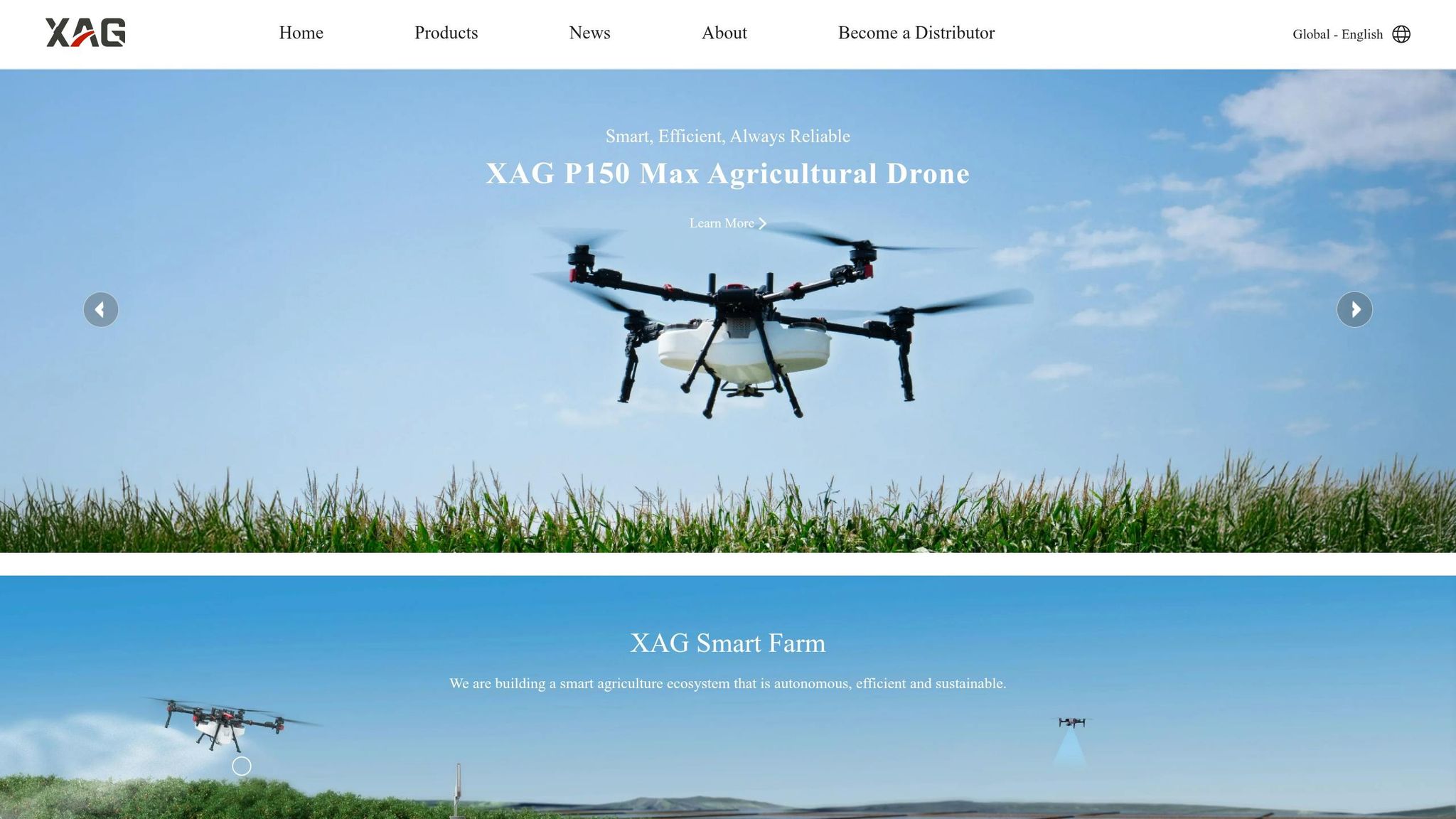
The XAG P150 stands out for its precise flow rate control, adapting seamlessly to different canopy densities. For low-density canopies, operators can fly faster while maintaining efficiency by reducing flow rates. For high-density canopies, slower speeds with increased flow rates ensure thorough spray penetration. Its auto-rate mode adjusts pump flow based on ground speed, while a constant flow mode is better suited for windy conditions near treelines.
ABZ Innovation Drones for Uneven Terrain
The ABZ L30 is specifically designed to handle uneven terrain and complex orchard layouts. Its multibeam LiDAR system detects thin obstacles like power lines with a level of precision that standard radar systems can't achieve [16]. This drone can treat up to 21 hectares per hour and uses optimized downward thrust to improve spray distribution in dense canopies, making it ideal for orchards and vineyards [15]. It also offers a wide droplet size range of 40–1,000 μm, allowing for adjustments based on canopy type and application needs [16]. With open-source software, the L30 supports custom shapefile integration and third-party app compatibility, enhancing its mapping and operational flexibility [16].
Conclusion
Getting the most out of orchard spraying with drones boils down to three key elements: deep canopy penetration, fruit safety, and precise equipment setup. When these factors align, pesticides can reach even the densest parts of the canopy, improving pest control effectiveness [2][4]. Advanced spraying technologies also play a big role, with some systems reducing airborne spray drift by as much as 87% [2].
Using variable-rate application technology is another game-changer. It can cut total spray volume by 47% to 73% without sacrificing pest control performance [2]. Professor Erdal Ozkan from The Ohio State University highlights this balance perfectly:
"A successful spray operation in orchards and vineyards achieves maximum efficacy from the pesticide applied while also reducing the off-target losses in the air (drift) or on the ground" [4].
This balance - between effective pest control and minimizing waste - sets apart an ordinary spraying operation from an exceptional one. While cost savings are a clear advantage, precision in setup ensures these technologies deliver their full potential.
Accurate drone calibration is non-negotiable. Errors during setup should be kept under 5% [4]. Additionally, using water-sensitive cards at various canopy depths can help confirm that coverage is sufficient [4]. These steps ensure that your investment in drone spraying technology pays off, maximizing both pest control results and financial returns.
For orchard-specific challenges, Drone Spray Pro offers tailored solutions. Whether you need the DJI Agras T100 for thick canopies, the XAG P150 for precise flow control, or the ABZ L30 for uneven terrain, these systems are equipped with cutting-edge sensors and features to handle complex orchard layouts. Check out our range of orchard spraying solutions to find the perfect fit for your needs.
FAQs
How do I know my spray is reaching the inner canopy?
To see if your spray is effectively reaching the inner canopy, try using water-sensitive paper. Place it at various spots within the canopy to assess how well the spray is covering those areas. If you notice gaps or insufficient coverage, consider adjusting your drone's flying height. Flying lower can help the spray penetrate deeper into the canopy, improving droplet deposition. Also, make it a habit to regularly calibrate and test your spray patterns before starting operations to ensure the coverage is thorough and penetrates as needed.
What weather conditions are safest for drone spraying to limit drift?
The best weather for drone spraying is when wind speeds range from 3 to 8 mph. If the wind exceeds 8 mph, the risk of spray drift increases. On the other hand, wind speeds below 3 mph can result in uneven coverage. It's also important to avoid spraying during rain, extremely high temperatures, or when humidity is very low, as these conditions can cause evaporation and uneven application. Choosing the right timing helps achieve more accurate spraying and better crop protection.
How often should I calibrate my drone sprayer in an orchard?
It's a good idea to calibrate your drone sprayer regularly during the spraying season to keep your application rates accurate. If you notice that the actual application rate is off by more than 5% from what you intended, it's time to recalibrate. Agricultural experts stress that routine checks and adjustments are key for maintaining both effectiveness and safety. While there aren't strict guidelines on how often to do this, making calibration a consistent part of your routine ensures your sprayer operates efficiently and provides proper coverage all season long.