Call or Text: +1 (208) 425-2990
Email: Sales@DroneSprayPro.com

How to Match Drone Payload to Farm Needs
Selecting the right drone payload saves time, reduces costs, and ensures efficient farm operations. Here's what you need to know:
- Payload Capacity: Determines how much weight a drone can carry, impacting coverage area, refill frequency, and flight time.
- Farm Size: Small farms (under 100 acres) benefit from 20 kg payload drones, while large farms (over 500 acres) may require high-capacity sprayer drones.
- Terrain & Altitude: High altitudes or steep slopes reduce payload capacity by up to 30%. Adjust loads accordingly for safe operation.
- Flight Performance: Heavier payloads shorten flight time. Aim for a 2:1 thrust-to-weight ratio for stability and efficiency.
- Spraying Needs: Use the formula: Tank Volume ÷ Spray Volume per Acre = Area Covered per Flight to calculate coverage.
For best results, align your drone's payload with your farm’s acreage, terrain, and operational schedule. Proper equipment like tanks, nozzles, and sensors ensures consistent and precise spraying. Always consider battery life, thrust-to-weight ratios, and real-time adjustments for optimal performance.
What Is Drone Payload Capacity and Why It Matters
What Payload Capacity Means
Payload capacity refers to the extra weight a drone can carry in addition to its essential components like the frame, batteries, motors, and accessories. This includes items such as spray tanks, chemicals, sensors, or granules. It’s different from Maximum Takeoff Weight (MTOW), which is the total weight limit for the drone. Payload capacity is usually measured in liters for liquids or kilograms for dry materials [2][5][6].
For instance, the DJI Agras T50 has a maximum takeoff weight of 92 kg when spraying at sea level, with an operating payload of 40 kg [5].
Factors like ambient temperature and altitude can impact payload capacity. For every 1,000 meters (3,280 feet) increase in altitude, the payload should be reduced by about 10 kg (22 lbs) to ensure safe operation [5]. Many drones include manufacturer apps or software that provide real-time payload recommendations based on current conditions, which can be a helpful guide.
Knowing these limits is essential for understanding how payload affects a drone’s efficiency during spraying tasks.
How Payload Affects Coverage and Efficiency
Payload capacity plays a big role in determining how much area a drone can spray in a single flight and how often it needs refilling. To figure out the coverage, you can use this formula:
Tank Volume (L) ÷ Spray Volume (L/acre) = Area Covered per Flight
For example, a drone with an 8-liter tank spraying at a rate of 2 L/acre can cover 4 acres per flight. Matching your drone’s payload capacity to your farm’s needs is crucial for efficient operations. The DJI Agras T10, with its 8L tank, can spray an average of 15 acres per hour at a dosage rate of 4.8 L/acre [6].
A larger payload can also increase the effective swath width, which is the width of the area covered in a single pass. In tests conducted in Burleson County, Texas, increasing the payload from 5L to 15L widened the swath from 5.60 meters to 10.11 meters. However, further increasing the payload to 20L only slightly boosted the swath to 10.60 meters [1].
There’s a trade-off, though: flight time. For example, the DJI T10 can hover for 19 minutes with a 16 kg payload, but this drops to just 8.7 minutes when carrying 26 kg [6]. To ensure stability and performance, aim for a minimum 2:1 thrust-to-weight ratio, though a 3:1 or 4:1 ratio is better for handling wind and maintaining agility [2].
sbb-itb-3b7eef7
Evaluating Your Farm's Spraying Requirements
Calculating Your Farm Size
The first step in determining your spraying needs is measuring your farm's acreage. This will help you figure out the payload capacity required for your operations. Modern drone controllers can map about 16.5 acres in just 10 minutes, providing a quick and efficient way to assess your land area [3][7].
For farms with orchards or uneven, mountainous terrain, 3D mapping is often necessary to achieve precise coverage. Tools like the Phantom 4 RTK drone and software such as DJI Terra are designed to create detailed 3D maps, which are vital for navigating and spraying in complex landscapes [6].
Once you’ve mapped your farm, use that data to align your payload capacity with the specific demands of your land. From there, consider how your terrain and operational schedule will affect your equipment needs.
Terrain Type and Spraying Frequency
The type of terrain you’re working with plays a key role in determining the payload and drone capabilities you’ll need. For example, operating at high altitudes (around 10,000 feet) or in strong winds can cause payload capacity to decrease by up to 30% and 20%, respectively [8]. In such conditions, a drone with a higher thrust-to-weight ratio is essential to maintain stability and effectiveness.
Your spraying schedule is another crucial factor. If you need to spray daily or frequently, modern charging systems can recharge drone batteries in just 7–11 minutes, enabling almost continuous operation [6][3][10]. For tasks like spreading heavy materials such as fertilizer with a DJI Agras T40 Spreading System, high-capacity drones are a must. Some models can handle up to 1.5 tonnes per hour, making them ideal for large-scale operations [3].
Drones also shine in challenging conditions like waterlogged or muddy fields, where traditional ground equipment might struggle. Unlike ground-based machinery, drones avoid soil compaction and can apply pesticides or fertilizers more efficiently, potentially reducing usage by 30–50% in these tough environments [9]. This targeted approach not only saves resources but also minimizes environmental impact.
Four powerful drones in agriculture - #1 Multi-Rotor
Matching Payload Capacity to Farm Size
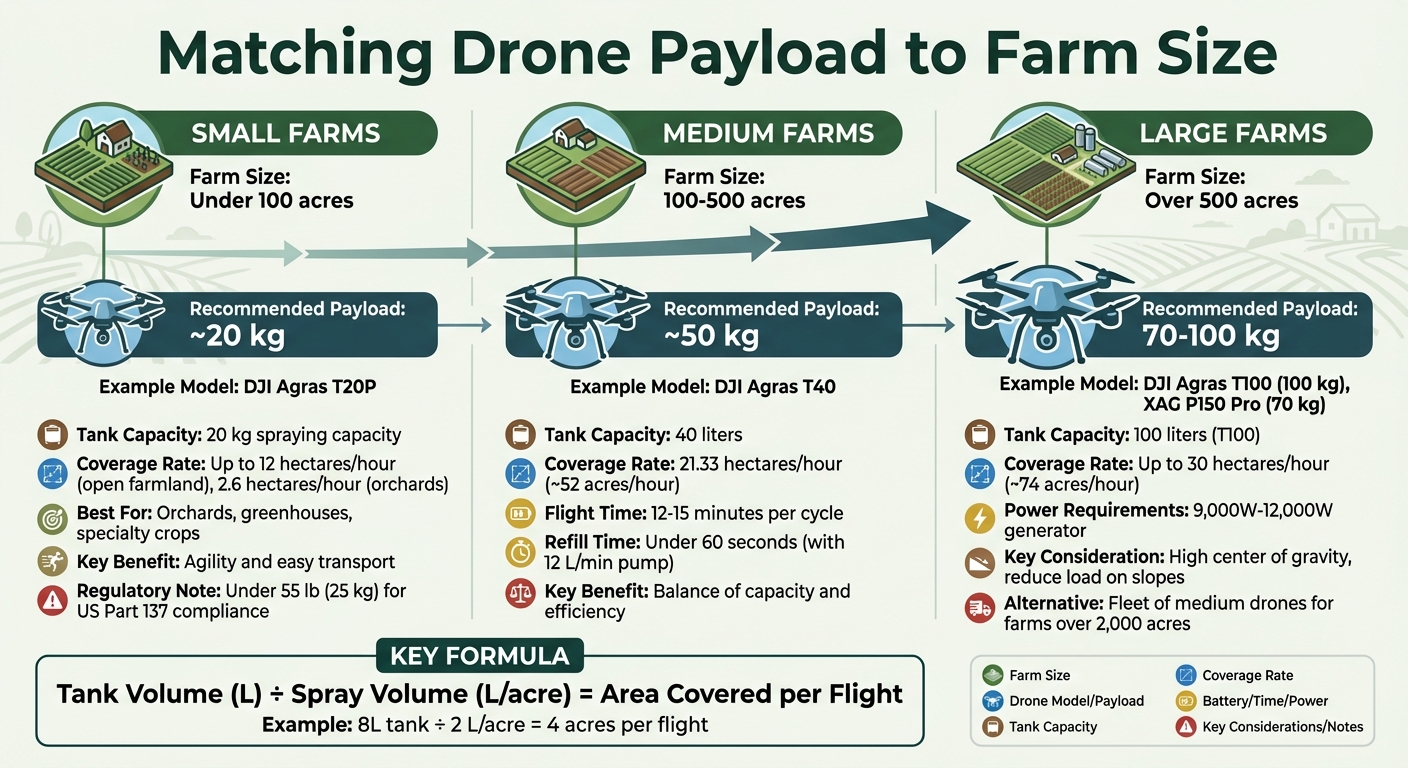
Drone Payload Capacity Guide by Farm Size
Small Farms: Approximately 20 kg Payload Drones
For farms under 100 acres, drones with a 20 kg payload are a practical choice. These lightweight models excel in areas like orchards, greenhouses, and specialty crops, where agility is essential. They’re easier to transport, require minimal infrastructure, and can navigate tight rows effectively.
Take the DJI Agras T20P as an example. With its 20 kg spraying capacity, it can cover up to 12 hectares per hour on open farmland and 2.6 hectares per hour in orchards [7]. Staying under the 55 lb (about 25 kg) weight limit also simplifies compliance with US Part 137 regulations [4]. This payload range strikes a balance, offering small-scale farms efficient spraying without unnecessary capacity.
For farms with larger acreage, stepping up to a higher payload capacity can significantly improve efficiency.
Medium Farms: Approximately 50 kg Payload Drones
For farms between 100 and 500 acres, drones with a 50 kg payload offer a good mix of capacity and efficiency. These drones are designed to cover more ground without overly frequent refills. A prime example is the DJI Agras T40, which features a 40-liter spray tank and a 50 kg payload capacity. It operates at an average efficiency of 21.33 hectares per hour (around 52 acres per hour) [3]. Typical flight cycles last 12–15 minutes, and rapid battery recharging ensures minimal downtime [7].
To keep operations smooth, ground crews should aim to refill the 40-liter tank in under 60 seconds using pumps with a discharge rate of at least 12 liters per minute [4]. This payload range is ideal for medium-sized farms, offering a balance of coverage and manageable refill schedules.
For farms exceeding 500 acres, even higher payload capacities may be necessary to maintain efficiency.
Large Farms: 70–100 kg Payload Drones
For farms larger than 500 acres, heavy-duty drones with payloads of 70–100 kg are the go-to option. Models like the DJI Agras T100 and XAG P150 Pro are built for high coverage rates. The DJI Agras T100, for instance, offers a 100 kg payload and a 100-liter spray tank, capable of covering up to 30 hectares per hour (around 74 acres per hour) [10]. Similarly, the XAG P150 Pro, with its 70 kg payload, can cover approximately 26 hectares per hour (about 64 acres per hour) [10].
Operating these high-capacity drones comes with unique challenges. They require powerful generators (9,000W–12,000W) for fast battery charging and generate significant downwash, which can flatten seedlings or disturb topsoil during early growth stages [4]. For very large farms - especially those over 2,000 acres - using a fleet of medium-capacity drones with 20–30 liter tanks can offer better redundancy and simplify battery management [4].
"Terrain is the silent killer of heavy-lift drones. A drone carrying 50 liters of liquid has a very high center of gravity and high inertia. It wants to keep moving in a straight line."
On hilly terrain, it’s wise to reduce the liquid load. Even if a drone is rated for 50 liters, filling it to only 30 liters during slope operations can help maintain stability and prevent motor overheating [4]. This approach ensures heavy-lift drones perform efficiently while minimizing risks.
At Drone Spray Pro, we provide a carefully selected range of agricultural spray drones to meet these varying needs, helping you find the perfect solution for your farm’s spraying requirements.
Balancing Payload Weight with Flight Performance
Getting the right balance between payload weight and flight performance is crucial for making your drone as efficient as possible in real-world conditions.
Thrust-to-Weight Ratio Requirements
Your drone's propulsion system needs to deliver at least twice the thrust of the combined weight of the drone and its payload[8].
"Total thrust should be at least twice the combined weight of the drone and payload for stable flight." - JOUAV[8]
A 1:1 thrust-to-weight ratio allows for little more than hovering in calm conditions, while ratios from 1.1 to 1.3 provide limited control. For agricultural drones, a 2:1 ratio is optimal, but high-performance drones might push this to 3:1 or more for better maneuverability[8].
To ensure safe operation, avoid exceeding 80–85% of your drone's rated payload capacity. This buffer not only improves control but also minimizes motor strain and reduces the risk of mid-air failures[12]. Wind gusts can lower your usable payload capacity by as much as 15–20%, making this safety margin even more critical[8].
Payload weight doesn’t just affect maneuverability - it also directly impacts battery usage and flight time.
Battery Life and Flight Time
Carrying heavier payloads means your drone's motors need to spin faster (higher RPM) to generate more thrust, which drains the battery more quickly[11].
"To overcome a higher weight, more thrust is required from the propellers, which requires higher RPM, which draws more power from the battery, thus decreasing the available battery life and flight time." - Lauren Nagel, Tyto Robotics[11]
For example, a drone rated to carry 5 lbs might see a 40–50% drop in flight time when fully loaded compared to flying without a payload[8]. The DJI Agras T40 demonstrates this trade-off, typically flying for just 10–15 minutes on a full 40-liter tank[8].
To counteract these limitations, consider using a Battery Management System (BMS) and a high-wattage generator. A BMS can monitor voltage and temperature in real time, preventing deep discharges and extending battery life[13]. For quick recharging between flights, a 9,000W generator is ideal. If you’re storing batteries for more than 48 hours, keep them at 40–50% charge to maintain their longevity[13].
Altitude also plays a role in performance. At higher elevations, thinner air reduces lift capacity. For instance, a drone capable of lifting 10 lbs at sea level might only manage 7 lbs at 10,000 feet[8]. If you're working in mountainous or high-altitude areas, adjust your payload expectations accordingly.
Selecting Compatible Equipment for Your Drone
After aligning your drone's payload capacity with your farm size and ensuring a balance between weight and flight performance, the next step is choosing tanks, nozzles, and accessories that work seamlessly together. This ensures that your equipment complements both the drone's payload limits and its flight dynamics.
Tank Sizes and Spray System Options
Your tank size must match your drone's payload capacity and operational requirements. Many modern spray systems are modular, allowing you to switch between liquid tanks and granular spreaders. For instance, drones like the DJI Agras T40 and T50 are equipped to handle granular particles ranging from 0.5 to 5 mm in diameter, making them versatile tools for different applications [3][5]. Keep in mind that payload adjustments may be necessary for operations at higher elevations [3][5].
DJI highlights the efficiency of their systems, noting:
"the T40's spreading payload is increased to 50 kg... the tank inlet is bigger which makes it faster to refill and increases operating efficiency" [3].
Once you've selected the right tank, focus on refining your spray system by choosing nozzles, pumps, and sensors that enhance precision and performance.
Nozzles, Pumps, and Sensor Systems
With your tank in place, select spray components that align with your payload capacity and optimize application precision. Nozzle choice depends on your crop type and the required droplet size. Centrifugal atomizers, adjustable from 50 to 500 μm, are particularly effective for high-payload drones, as they enable deeper canopy penetration in orchards [3][5]. For example, the DJI Agras T50 features a dual atomizing system capable of a maximum flow rate of 16 L/min with two sprinklers, which increases to 24 L/min when using four sprinklers [5].
For pump systems, magnetic drive impeller pumps are recommended as they isolate chemicals from the motor, helping to extend the system's lifespan [5][7]. DJI also emphasizes the importance of consistent spray quality, stating:
"the dual atomized spray disc ensures even droplets and more efficient pesticide usage" [7].
To maintain accurate spray patterns during flight, RTK dongles provide centimeter-level positioning accuracy (±10 cm), which is crucial as the payload decreases [5][6]. Additionally, many modern systems include real-time weighing sensors to monitor the remaining payload, ensuring consistent application rates throughout each flight [7].
For compatible RTK accessories and guidance on selecting the right equipment for your drone, you can check out Drone Spray Pro. They offer a variety of options tailored to specific drone models.
Conclusion
Once you've evaluated your needs and balanced your strategies, the next step is to integrate the right equipment for your drone. To ensure your drone's payload matches your farm's requirements, consider factors like acreage, terrain, and load weight. Whether you're working with small, medium, or large payload drones, it's important to align the tank size, nozzles, and sensors with your drone's capacity. This ensures you're getting the most out of your equipment. Keep in mind that the heavier the payload, the shorter the flight time - so striking the right balance between carrying capacity and efficiency is key.
"Matching drone specs to your task saves time and cuts costs"
Pre-configured packages can make this process easier. These systems are designed for compatibility, reducing the risk of errors from mismatched components.
For example, Drone Spray Pro offers pre-configured packages specifically tailored for crop spraying. They also provide FAA licensing support and hands-on training to help you get started. Whether you're looking for a DJI Agras model for precision spraying or accessories like RTK dongles and extra batteries, their team can help you choose the right setup for your farm's unique needs.
FAQs
How do I choose the right payload for my crops?
When choosing the right payload for your drone, think about factors like the size of your farm, the type of crops you're working with, and your efficiency targets. For larger farms, drones with a payload capacity of 40–50 liters are a good fit, as they can typically cover 30–50 acres per hour. This strikes a balance between productivity, battery refills, and weight management.
It's important to match the payload capacity to your specific needs. Overloading the drone can compromise flight stability and drain the battery faster, especially during tasks that demand longer flight times. Prioritizing the right balance ensures both efficiency and safety during operations.
How much payload should I drop for high altitude or hills?
For areas with high altitudes or hilly terrains, using a payload of 40–50 liters is typically ideal for maintaining efficiency. However, if you're working on larger farms, you might want to increase the payload to around 100 liters to achieve a balance between coverage and flight stability. Tailoring the payload to match the terrain not only improves performance but also enhances safety during operations.
Is one large drone or a fleet of drones better for my farm?
A fleet of drones can be a game-changer for large farms. By dividing tasks among multiple drones, you can cut down on downtime and cover significantly more ground in less time. This approach boosts efficiency compared to using just one large drone for all operations.
