Call or Text: +1 (208) 425-2990
Email: Sales@DroneSprayPro.com

How Low-Latency Improves Drone Spraying Accuracy
Low-latency communication is transforming how drones handle agricultural spraying. It allows drones to make real-time decisions, ensuring precise chemical application while reducing waste and drift. By enabling faster data transfer between sensors, GPS, and control systems, drones can adjust spray rates, flight paths, and altitude with millisecond precision. This technology has been shown to cut pesticide use by up to 70%, improve coverage uniformity, and lower drift losses by nearly 90%.
Key takeaways:
- Real-time adjustments: Drones use low-latency systems to instantly respond to terrain and crop density changes.
- Improved accuracy: Centimeter-level GPS positioning ensures precise targeting, even at high speeds.
- Reduced waste: Spray systems minimize chemical overuse and drift, saving costs and protecting nearby areas.
- Efficiency boost: Drones can cover 15–30 hectares per hour, far surpassing traditional methods like crop dusting.
For Idaho farmers, companies like Drone Spray Pro provide advanced drones with these capabilities, offering tools, training, and ongoing support to simplify adoption and improve farming outcomes.
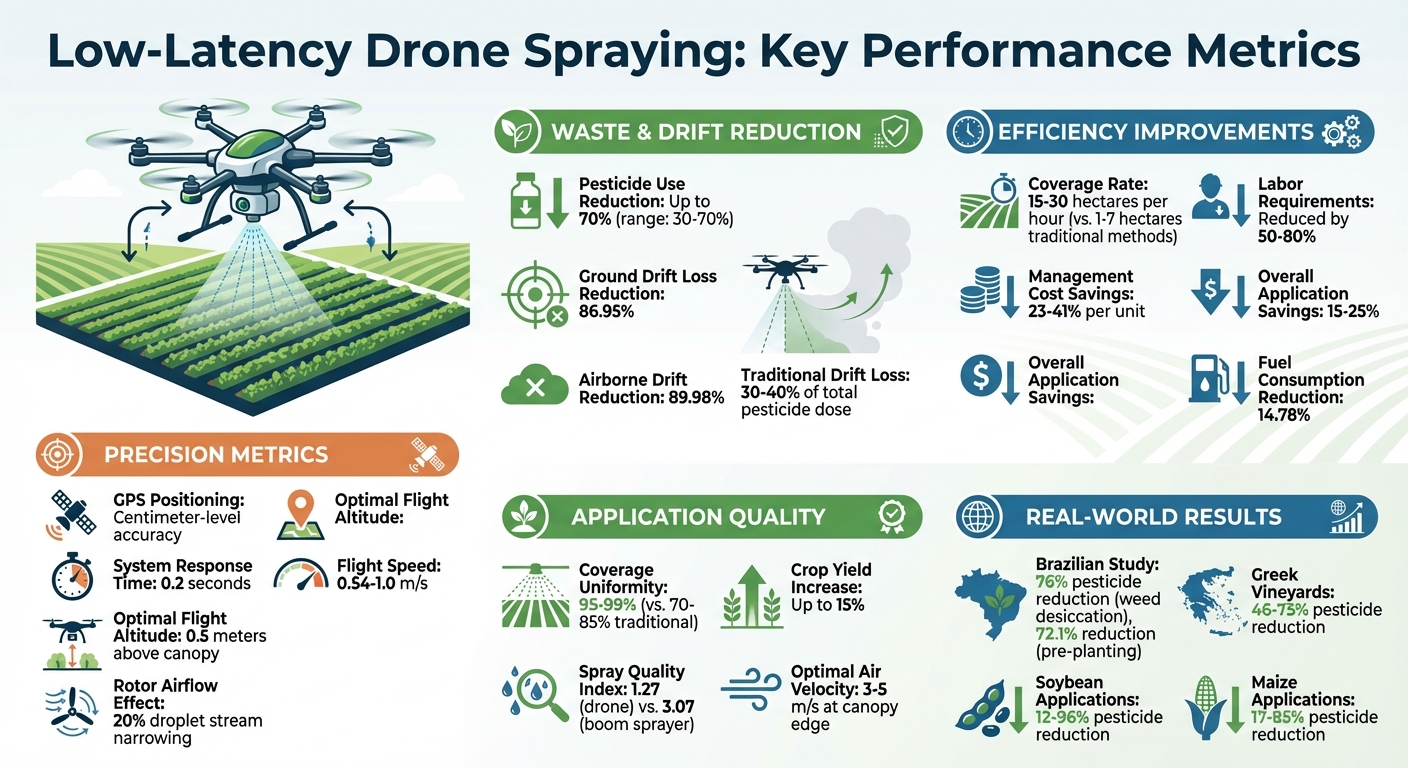
Low-Latency Drone Spraying Performance Metrics and Benefits
Low-Latency Communication in Agricultural Drones
What is Low-Latency Communication?
Low-latency communication in agricultural drones refers to the near-instant transfer of data within aviation information networks. Essentially, it’s the brief time it takes for a drone’s sensor to detect something - like a pest or an obstacle - and for the spraying system to respond. In precision agriculture, this delay is measured in milliseconds, making it incredibly fast.
Here’s how it works: drones equipped with AI-powered recognition systems rely on real-time feedback loops between their sensors and spraying hardware. For instance, when a drone identifies a specific target area, low-latency communication ensures that the spraying nozzles activate at exactly the right moment, even at flight speeds of 0.54–1.0 m/s [1]. This kind of split-second precision is what makes spot-spraying far more accurate than broader, less targeted methods.
This fast data flow is essential because even a tiny delay can compromise the accuracy of the chemical application.
Why Latency Matters in Drone Spraying
Now, let’s look at why minimizing delays is so important. Every millisecond counts when applying chemicals. At typical drone speeds, even a short delay could mean missing the target area entirely, which affects both efficiency and effectiveness.
Low-latency systems also play a big role in dynamic obstacle avoidance. For example, drones carrying liquid payloads need to quickly adjust their flight paths to avoid obstacles like trees, power lines, or uneven ground. The ability to make these adjustments in real-time ensures smoother operations and safer navigation.
There’s also the challenge of rotor airflow, which can narrow the droplet stream by about 20% [1]. Without fast communication, drones would struggle to adapt spray patterns to changing conditions, such as variations in the Leaf Area Index (LAI) - a measure of leaf coverage that ranges from 0.877 for rapeseed to 6.273 for potatoes [1].
Another advantage of minimal-delay systems is the ability to shift from fixed flight paths to adaptive, AI-driven controls. Drones can process high-resolution images on the spot, identify pests or weeds, and activate sprayers with pinpoint precision. This not only reduces chemical waste but also improves crop protection by targeting problem areas more effectively.
sbb-itb-3b7eef7
How Low-Latency Systems Improve Spraying Accuracy
Real-Time Feedback in Spray Control
Low-latency communication is a game-changer for online Variable Rate Application (VRA). Using sensors like laser, ultrasonic, or LiDAR, these systems scan canopy geometry in real time and instantly adjust spray output based on the data they collect [2]. By dividing the canopy into vertical zones, the system fine-tunes the spray for each zone independently, ensuring precision.
Pulse Width Modulation (PWM) solenoid valves play a crucial role here. These valves operate within milliseconds, offering a much faster response than traditional pressure-based systems [2]. They stabilize droplet size while adjusting flow rates without relying on spray pressure. This results in system response times as quick as 0.2 seconds, ensuring spray reaches the intended target exactly when needed and with pinpoint accuracy [2].
Advanced systems like the ABZ Innovation L30 Spraying Drone benefit significantly from this real-time feedback. By maintaining a flight altitude of just 0.5 meters above the canopy, they achieve better spray uniformity and deeper penetration into dense foliage [1]. As terrain or crop density shifts, low-latency systems instantly adjust the drone's height, ensuring consistent coverage. These rapid adjustments not only improve accuracy but also help minimize chemical waste and reduce spray drift.
Reducing Waste and Drift
Precision in real-time adjustments also translates into significant reductions in waste and drift. For example, real-time VRA systems have been shown to cut pesticide usage by 69.90% compared to traditional application methods [2]. This is especially important when you consider that conventional orchard spraying often results in drift losses of 30% to 40% of the total pesticide dose [2].
Low-latency systems go further by reducing ground drift loss by 86.95% and airborne drift by 89.98%, thanks to sensor-driven adjustments [2]. A 2024 study published in Applied Engineering in Agriculture highlighted how a "swath offset" mechanism can make a big difference. By accounting for wind-driven movement, the study showed that ground spray deposition was significantly reduced - from 10 meters to 4.5 meters for medium nozzles, and from 6 meters to 2.7 meters for extra coarse nozzles [3]. These findings came from 12 replications using a fine spatial resolution of 0.5 meters to compare drone drift against tractor-mounted sprayers.
Additionally, these systems optimize fuel consumption, cutting it by about 14.78% through real-time adjustments to fan and pump operations [2]. By maintaining air velocities between 3 and 5 meters per second at the canopy's outer edge, they ensure efficient droplet transport into tree canopies, striking the perfect balance for effective application [2].
Research Findings: Measuring Accuracy Improvements
Key Findings from Experimental Studies
Field trials have shown that low-latency systems improve spraying performance by making real-time adjustments. In December 2025, researchers at the Julius Kuehn Institute (JKI) conducted ISO 22866 drift trials to compare the DJI Agras T30 (equipped with air-induction nozzles) and the T25 (fitted with rotary atomizers). These tests were conducted at flight heights ranging from 4.9 to 9.8 feet and speeds between 5.6 and 10.1 mph. The results indicated that rotary atomizers produced more consistent droplet spectra, but their drift sensitivity increased significantly at higher speeds. However, under practical conditions - 6.6 feet height and 5.6 mph speed - rotary atomizers achieved drift levels comparable to or even lower than air-induction nozzles [4].
Another study, published in Scientific Reports, compared the DJI Agras MG-1P drone to a 400B8 TF boom sprayer in Iran's Lorestan Province. The drone achieved a Spray Quality Index of 1.27, indicating better uniformity, compared to 3.07 for the boom sprayer. However, its average deposition rate was lower, at 69.9% compared to the boom sprayer's 82.8% [5].
In February 2026, a research team led by Bogusława Berner at VSB-Technical University of Ostrava conducted lab tests to study how rotor airflow affects spray patterns. Tests performed at altitudes of 1.6 and 3.3 feet and speeds of 1.2 and 2.2 mph revealed that rotor airflow narrowed the droplet stream by approximately 20%. The 1.6-foot altitude provided better uniformity and deeper penetration compared to the 3.3-foot altitude [1].
These findings provide a foundation for evaluating the specific metrics that quantify the benefits of low-latency spraying systems.
Performance Metrics of Low-Latency Systems
To assess the performance of low-latency systems, researchers rely on precise metrics. The coefficient of variation (CV) of spray distribution is a key measure for autonomous control systems, enabling drones to adjust their spraying in real time to ensure uniform application [1]. Another critical metric is coverage uniformity (CU), which evaluates how evenly the liquid is distributed across various crop types.
Droplet-size analysis, based on ISO 25358 standards, measures the volumetric 50th percentile of droplet diameter (DV50) and the percentage of spray volume with droplets smaller than 100 micrometers (V100) [4]. These metrics are directly linked to drift potential and application efficiency. Research shows that maintaining flight parameters within a "safe operating window" - such as 6.6 feet height and 5.6 mph speed - helps minimize the drift sensitivity of rotary atomizers [4].
Field trials also highlighted how crop characteristics affect spray performance. For instance, liquid settled more evenly on rapeseed, which has a Leaf Area Index (LAI) of 0.877, compared to potato plants with an LAI of 6.273. Higher LAI values make it harder for the spray to penetrate into lower plant levels [1]. This demonstrates the importance of low-latency systems continuously adjusting spray parameters based on real-time feedback from the crop canopy to maintain consistent application quality across diverse field conditions.
Benefits for Farmers and Agricultural Businesses
Cost Savings and Efficiency Gains
Low-latency drone systems bring substantial savings and improve operational efficiency. One standout feature is precision spraying, which can cut pesticide usage by 30% to over 70%, according to various studies [6][7]. This means farmers can achieve significant cost reductions - up to 2.3 times lower compared to traditional pesticide application methods across entire fields [6].
For example, a 2022 study conducted in Mineiros, Brazil, highlighted the large-scale impact of this technology. Researchers tested site-specific spraying over 22 fields, encompassing 3,702 hectares, using the Weed-it™ system with real-time sensors. The results? A 76% reduction in pesticides during weed desiccation and a 72.1% reduction during pre-planting operations for soybean crops - all without compromising crop yields when compared to historical data [6]. Similarly, in Greek vineyards, the XAG P100 UAV demonstrated a 46% to 75% reduction in pesticide usage by leveraging integrated RGB image analysis for real-time decisions [7].
When it comes to efficiency, low-latency drone systems can cover 15–30 hectares per hour (with high-efficiency models like the DJI Agras T50 reaching over 21 hectares), far outpacing the 1–7 hectares per hour achieved by conventional methods. This improvement slashes labor requirements by 50%–80% [8]. Additionally, integrated UAV systems lower management costs by 23%–41% per unit, leading to overall savings of 15%–25% per application [7][8]. On top of that, their precision can increase crop yields by up to 15%, with coverage rates reaching 95%–99%, compared to the 70%–85% range typical of traditional methods [8].
These cost and efficiency benefits go hand-in-hand with the environmental advantages of targeted spraying.
Reduced Environmental Impact
Low-latency systems also play a key role in promoting sustainable farming by minimizing environmental harm. Using a "Perception-Decision-Execution" (PDE) framework, these systems ensure chemicals are applied only where necessary, avoiding wasteful blanket spraying [7]. This targeted approach significantly lowers the amount of chemicals released into the environment. For instance, real-time precision spraying has been shown to reduce pesticide use by 12%–96% in soybeans and 17%–85% in maize, depending on the crop's growth stage [6].
"Precision spraying technology - integrating UAV-based detection, real-time pesticide mixing, and adaptive variable-rate spraying - provides a critical pathway for sustainable crop protection by establishing a 'perception-decision-execution' closed-loop framework." - Scientific Reports [7]
The Real Breeze on Drone Spraying
Drone Spray Pro: Supporting Precision Agriculture in Idaho
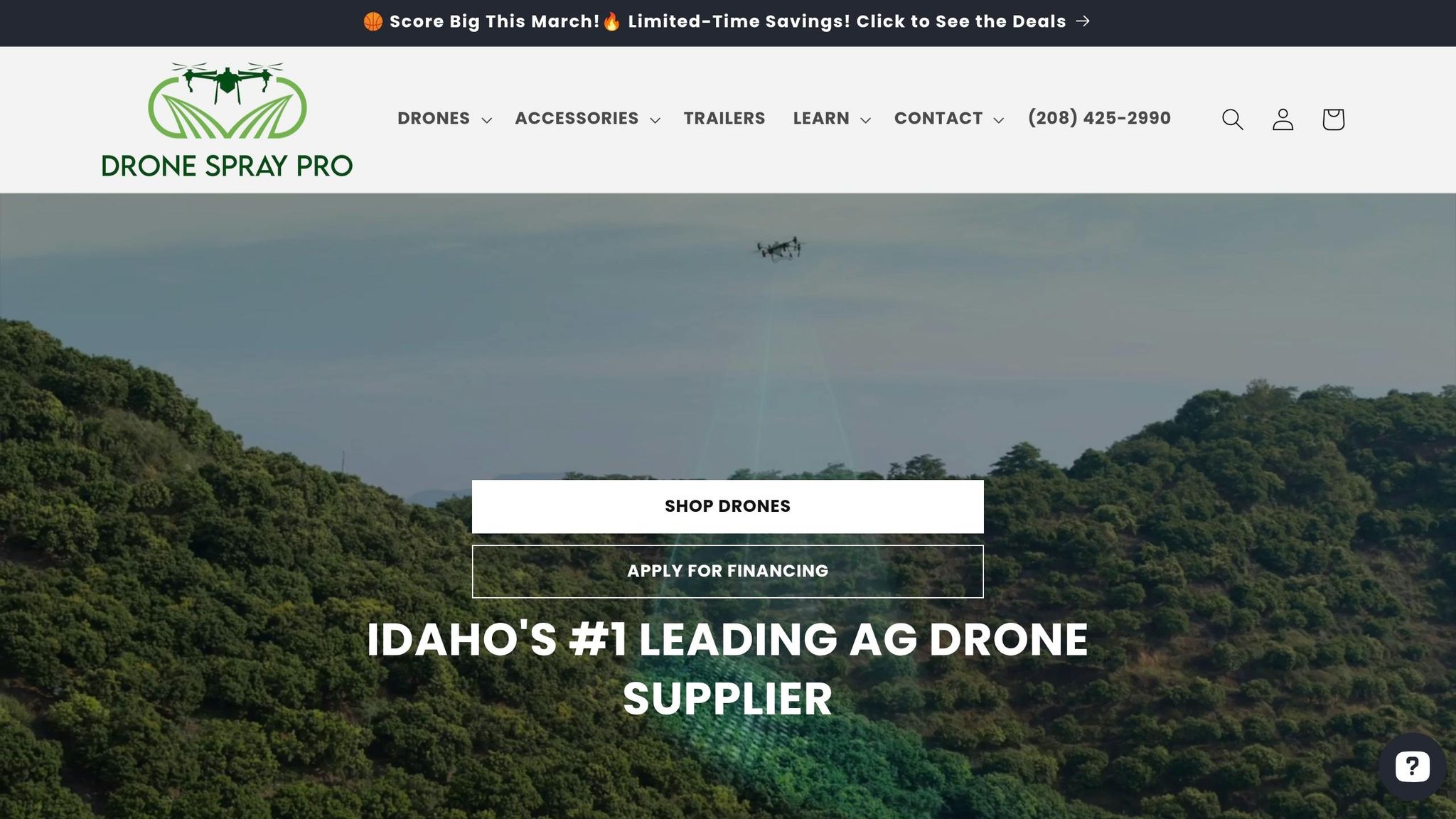
Drone Spray Pro is making precision agriculture a reality for Idaho farms by combining cutting-edge technology with practical farming expertise. Headquartered in Idaho, Drone Spray Pro specializes in agricultural spray drones equipped with low-latency communication systems to deliver exceptional accuracy. Their lineup includes DJI Agras drones, Talos T60X, XAG, and ABZ Innovation models. These drones are packed with advanced features like high-precision GPS, terrain-following radar, and real-time sensors, enabling responsive spray control that can cut pesticide use by 30–50% [10].
To make adoption seamless, Drone Spray Pro offers "Ready to Fly" packages. These kits include everything farmers need to get started: aircraft, controllers, spray systems, multiple batteries, and fast chargers. RTK dongles ensure centimeter-level positioning, which is critical for precise, real-time spray adjustments. The drones' multi-sensor fusion technology optimizes flight paths, maintaining altitudes of 1–3 meters and speeds of 2–5 meters per second, which minimizes off-target spray contamination.
Drone Spray Pro goes beyond just providing hardware. They assist farmers with FAA licensing, hands-on training in programming flight paths, sensor calibration, and managing low-latency telemetry for BVLOS (Beyond Visual Line of Sight) operations. They also support advanced workflows like "swarming", where multiple drones work in unison across different field zones. This technique effectively doubles the coverage rate while maintaining the same level of precision.
"As local Idaho farmers who use these drones ourselves, we'll help you get it right." - Drone Spray Pro [9]
To help farmers explore the benefits firsthand, Drone Spray Pro offers free flight demonstrations in Southeast Idaho. These demos let potential buyers see the drones' real-time performance and how they deliver the accuracy discussed in earlier research. With a perfect 5.0 rating from 15 Google reviews, customers frequently praise the company for its technical knowledge and fair pricing, solidifying its reputation as a trusted partner for precision agriculture in Idaho [9].
Conclusion
Low-latency communication is revolutionizing drone spraying by enabling real-time adjustments to flight paths and spray delivery systems [1]. This capability is key to achieving fully autonomous drone operations, as it supports dynamic route planning, immediate obstacle detection, and the use of deep learning for identifying pests. With these advancements, drones can target specific areas for spraying, avoiding the inefficiency of treating entire fields unnecessarily [1].
Farmers benefit from increased efficiency and reduced environmental harm. By processing sensor data in real time, drones can adapt to changing field conditions, ensuring even coverage across varying crop densities and minimizing problems like wind drift [1]. Paired with the right nozzles and drift-reducing agents, these systems can cut pesticide use by up to 30% and reduce off-target spray by as much as 67% [11].
These advancements are setting the stage for smarter, more sustainable farming. For Idaho farmers ready to step into the future of precision agriculture, Drone Spray Pro offers the expertise and custom solutions needed to optimize spraying operations - delivering real cost savings, protecting the environment, and boosting crop yields.
FAQs
How low is “low-latency” in spray drones?
In the context of spray drones, low-latency refers to the ability to communicate and respond with minimal delay. This ensures that the drone can operate with precision, making crop spraying more efficient and accurate. While specific latency times aren't usually mentioned, the key idea is to maintain real-time responsiveness, which is essential for applying sprays exactly where they’re needed.
Do I need RTK GPS to get accurate spraying?
For achieving centimeter-level accuracy in drone spraying, RTK GPS is highly recommended. This level of precision ensures minimal chemical overlap, leading to improved efficiency and better resource management.
Although RTK GPS is the gold standard, there are alternative correction services, such as NTRIP, that can also help improve accuracy. These options provide flexibility depending on your setup and requirements.
What weather limits drone spraying accuracy most?
High wind speeds - anything over 8 mph - pose a major challenge when it comes to drone spraying accuracy. Strong winds can cause the spray to drift off target, which not only reduces precision but also raises the risk of unintended environmental contamination. Because of this, wind is often the most restrictive weather condition for successful drone spraying.
