
Call or Text: +1 (208) 425-2990
Email: Sales@DroneSprayPro.com

How Payload Affects Drone Battery Life
When you increase the payload on a drone, its motors need to work harder to maintain lift, which drains the battery faster. This directly impacts flight time and efficiency, especially for agricultural drones carrying heavy loads like spray solutions or fertilizers. For example, the DJI Agras T40's hovering time drops from 18 minutes with no payload to just 7 minutes when fully loaded - a 61% decrease.
Key points to know:
- Battery Drain: Heavier payloads require more thrust, leading to faster power consumption.
- Flight Time Impact: Adding even small amounts of weight reduces flight time predictably.
- Efficiency Loss: Fully loaded drones can experience up to 50-80% reductions in flight time.
- Environmental Factors: Cold weather, high temperatures, wind, and altitude further reduce battery performance.
To optimize performance:
- Choose the right battery with sufficient capacity and discharge rates.
- Minimize unnecessary payload weight and use precise spray systems.
- Plan efficient flight patterns to conserve energy.
Understanding how payload influences battery life helps you plan better and achieve more efficient drone operations.
Energy-to-Weight Ratio Explained
What Energy-to-Weight Ratio Means
The energy-to-weight ratio measures how much energy a drone's battery can store compared to its total weight. To calculate this, you divide the battery's capacity in watt-hours (Wh) by its weight in kilograms, giving you Wh/kg [1]. A higher ratio indicates the drone can use stored energy more efficiently for longer flight times.
For agricultural drones, this ratio is especially important. Increasing battery capacity to extend flight time adds weight, which in turn demands more thrust to stay airborne. Take the DJI Agras T100, for instance - its battery weighs 32.4 lbs (14.7 kg) and delivers about 145 Wh/kg [4]. Compare that to the smaller DJI Agras T25P battery, which weighs 14.6 lbs (6.6 kg) and offers 122.6 Wh/kg [5]. These differences directly influence how long each drone can operate with a load. Balancing higher energy capacity against added weight is essential to optimizing flight performance, especially when payloads are involved.
How Payload Affects Energy Efficiency
Adding payload - whether it's spray solution, fertilizer, or granules - forces the propellers to spin faster to maintain lift, which drains the battery more quickly [1]. The effect isn’t linear, either. As Jessica May from DroneBundle explains, doubling the weight requires more than double the power to hover [3].
For example, the DJI Agras T40 can hover for 18 minutes at a weight of 110 lbs (50 kg). But when carrying an 88 lb (40 kg) payload, bringing the total takeoff weight to 198 lbs (90 kg), its hovering time drops to just 7 minutes [6]. That’s a 61% decrease in flight time due to the added payload. Fully loaded spraying systems can see flight times cut by 50-80% [3]. Understanding these dynamics is key to setting realistic coverage goals and managing payloads effectively for longer operational durations.
Why are drone flight times so short? Extend them like this...
How Payload Weight Reduces Battery Life
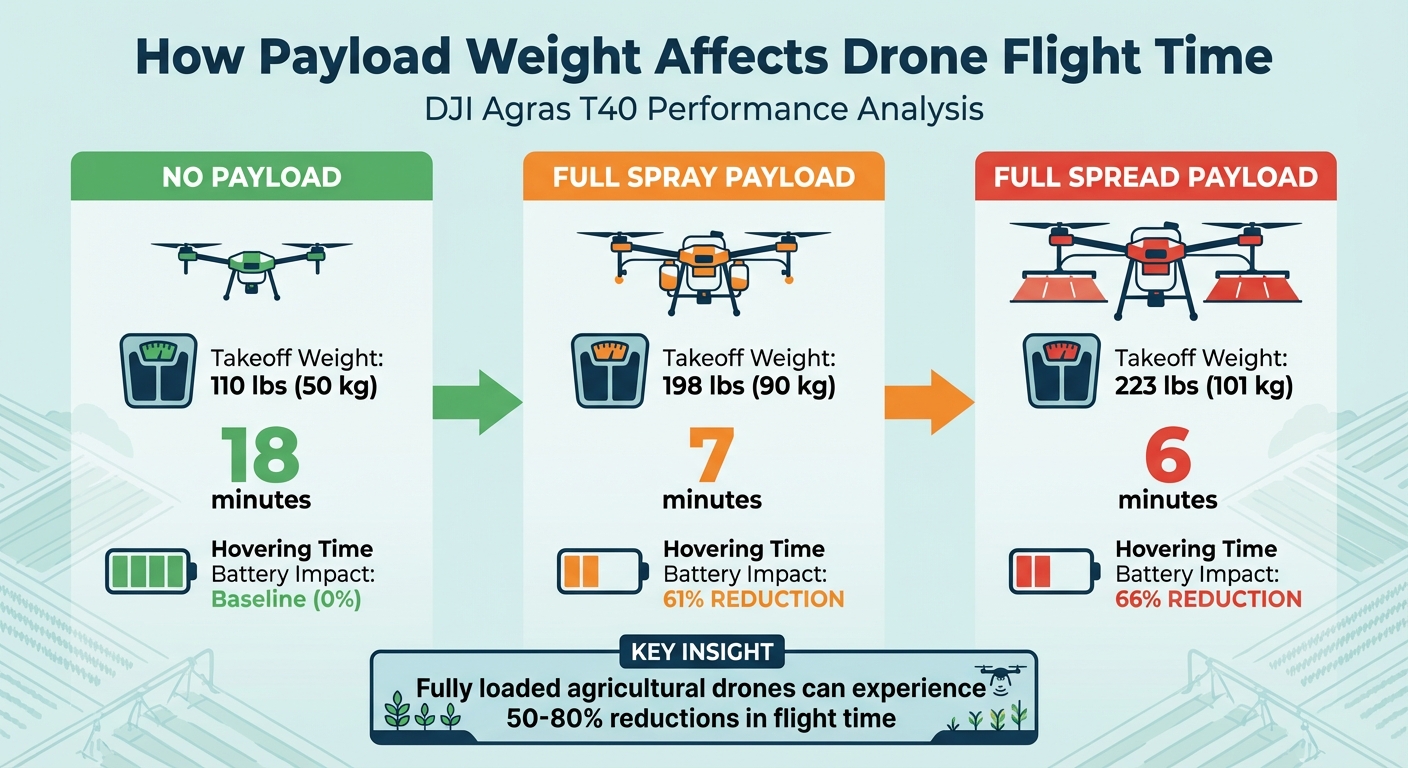
DJI Agras T40 Flight Time vs Payload Weight Comparison
Why Heavier Loads Demand More Power
When you add weight to an agricultural drone, you're working against the laws of physics. To stay airborne, the drone's propellers need to generate enough thrust to counteract the combined weight of the drone and its payload. Lauren Nagel from Tyto Robotics breaks it down:
To overcome a higher weight, more thrust is required from the propellers, which requires higher RPM, which draws more power from the battery, thus decreasing the available battery life and flight time. [1]
In simpler terms, the heavier the payload, the harder the propellers have to work. This not only drains the battery faster but also increases drag, further reducing efficiency. These principles aren't just theoretical - they've been proven in real-world testing.
Measuring the Impact of Added Weight
The relationship between added weight and reduced battery life isn’t just a guess - it’s measurable. In controlled tests, a drone weighing 3.5 lbs (1.6 kg) without a payload managed to stay airborne for 39.6 minutes. Adding just 0.44 lbs (0.2 kg) cut the flight time to roughly 35 minutes. Each small increase in weight continued to shave minutes off the flight time [1].
For agricultural spray drones, the impact is even more pronounced. As highlighted earlier, the DJI Agras T40 provides a stark example. With no payload, it can hover for 18 minutes at a takeoff weight of 110 lbs (50 kg). However, load it with a full spray payload, increasing the weight to 198 lbs (90 kg), and the hovering time drops to just 7 minutes - a 61% reduction. For spreading operations, where the weight rises to 223 lbs (101 kg), hovering time falls further to 6 minutes, marking a 66% drop from its empty state [6].
| Drone State (DJI Agras T40) | Takeoff Weight | Hovering Time | Reduction from Empty |
|---|---|---|---|
| No Payload | 110 lbs (50 kg) | 18 min | - |
| Full Spray Payload | 198 lbs (90 kg) | 7 min | 61% |
| Full Spread Payload | 223 lbs (101 kg) | 6 min | 66% |
This data paints a clear picture: even small increases in payload can significantly impact flight time. For operators of agricultural drones like the DJI Agras series, available through Drone Spray Pro, understanding how payload affects performance is crucial. Efficient payload management can make all the difference in maximizing operational efficiency in the field.
sbb-itb-3b7eef7
Environmental Factors That Affect Battery Life
How Temperature Affects Battery Performance
Temperature extremes can significantly impact battery performance, especially when drones are tasked with carrying heavy payloads. In cold weather, drone flight time can drop by as much as 20% to 40% [3]. Adding a full spray tank only worsens this efficiency loss.
The reason? Cold conditions slow down the chemical reactions in lithium batteries, reducing their power output. For agricultural operators in colder regions or for those working early mornings, it's a smart move to preheat batteries to room temperature. This simple step can help maintain power levels and avoid unexpected drops [3].
On the flip side, hot weather presents its own challenges. High temperatures combined with altitude create what's known as "density altitude", where thinner air forces propellers to work harder. Vision Aerial explains:
On a hot and humid day, a drone will need more power to attain lift than on a dry, cool day. Fewer air molecules in a given volume of air will result in reduced propeller efficiency [7].
Now imagine carrying 40 kg of spray liquid in 95°F heat - your drone's motors are not only battling the weight but also struggling with reduced air density. And when you factor in altitude and flight dynamics, the strain on the battery gets even worse.
Altitude and Flight Pattern Effects
Elevation and flight style are additional factors that influence battery life. For every 1,000 feet of elevation gain, flight time drops by about 3% [3]. This is a critical consideration for operators working in mountainous areas or high-altitude farmlands. DJI offers this rule of thumb:
The payload weight needs to be reduced by 10 kg for every 1,000m increase in altitude [6].
Flight patterns also play a big role in battery efficiency. Forward flight at moderate speeds - typically between 15 and 25 mph - is far more efficient than hovering. This is because the drone benefits from translational lift [3]. On the other hand, aggressive maneuvers like sharp turns, frequent stops, or rapid accelerations force the motors to constantly adjust, draining the battery faster. Even a 15 mph headwind can slash flight time by 25% or more due to the extra power needed to counteract the wind [3].
For drones like DJI Agras models, using automated flight patterns is a smart way to conserve power. Automated routes help maintain steady speeds and optimize flight paths, which is especially useful when carrying heavy liquid loads [3].
When planning missions, it's wise to base calculations on 70% to 80% of the advertised flight time to account for these real-world conditions [3].
How to Optimize Payload and Battery Life
Selecting the Right Battery for Your Drone
The first step in optimizing your drone's performance is choosing the right battery. This decision hinges on your payload requirements. Lithium Polymer (LiPo) batteries are a popular choice because they offer high energy density and the powerful current output needed for heavy-duty tasks like spraying. On the other hand, Lithium-ion (Li-ion) batteries are becoming more common due to their longer lifespan and enhanced safety, even though they provide less power density [3].
For agricultural drones carrying medium to heavy loads, higher voltage configurations - such as 12S, 14S, or 18S systems - are ideal for maintaining stable power output [8]. Additionally, the discharge rate (C-rate) is crucial. Drones with full spray tanks often need batteries rated at 30C to 40C or higher to meet the combined power demands of flight motors and spraying systems [8].
Modern Smart Battery Management Systems (BMS) are a must-have for professional drone operators. These systems track critical metrics like cell voltage, temperature, and charge cycles in real time, offering more accurate flight time predictions [3]. For operations requiring quick transitions between fields, look for batteries that support 3C to 5C fast charging, reducing downtime significantly [8].
Once you’ve got the right battery in place, managing payload weight becomes the next focus.
Tips for Managing Payload Weight
When it comes to maximizing flight time, every ounce counts. Efficient payload management goes hand in hand with selecting the right battery, helping to reduce unnecessary weight and optimize power usage. One key tactic is to adjust spray quantities for each mission. Use real-time weighing systems to monitor your remaining payload and avoid overfilling the tank - only carry what’s needed for the task at hand [2].
Another way to lighten the load is by removing unnecessary accessories and equipment. Even small items like extra memory cards or unused cameras can add up. Additionally, regularly calibrate your spraying system to ensure the nozzles are operating at the correct output and pressure. This not only improves efficiency but also minimizes waste [2]. For even more precision, consider using variable rate spraying with prescription maps. This approach ensures you’re applying inputs only where they’re needed, avoiding excess weight from carrying too much product.
By streamlining payload weight, you’ll enhance your drone’s overall efficiency and make the most of its battery performance.
Planning Missions for Longer Flight Times
After fine-tuning your battery and payload, the next step is to plan your missions strategically. Start by calculating your Maximum Takeoff Weight (MTOW) before each flight. This ensures that the combined weight of the battery and payload stays within the drone’s structural limits [8]. Also, factor in real-time conditions like wind, altitude, and temperature, as these can influence operational time.
Whenever possible, use automated flight patterns. Automated routes with steady speeds - typically between 15–25 mph - and consistent altitudes take advantage of aerodynamic lift, reducing energy consumption compared to the frequent adjustments required during manual piloting [3]. Route planning software can further optimize efficiency by calculating the shortest paths and avoiding sharp turns, which tend to drain power more quickly.
Conclusion
Efficient agricultural drone operations hinge on finding the right balance between payload weight and battery performance. Heavier payloads require more motor thrust, which drains batteries faster - sometimes cutting flight times by as much as 50% to 80% compared to flying without a load [1] [3].
To maximize efficiency, selecting the right battery setup and planning automated flight routes can significantly increase coverage per charge. It's important to note that actual flight times are often only 60% to 70% of what manufacturers claim [3]. Adding a safety margin when calculating mission capacity is a smart move to avoid unexpected battery depletion. Additionally, external factors like temperature and wind can further reduce flight time, so accounting for these variables is essential for smooth operations.
The impact of these strategies is well-documented. For instance, in 2021, the Jiangsu Farming Group utilized precision drone spraying to cut fertilizer use by 10% while increasing rice and wheat yields by 5% [2]. By carefully managing payloads, optimizing battery performance, and planning missions strategically, you can achieve similar gains in efficiency and cost savings for your agricultural projects.
For more insights and cutting-edge solutions in agricultural drone technology, check out Drone Spray Pro.
FAQs
How can I extend my drone's battery life when carrying heavy payloads?
To get the most out of your drone's battery while carrying heavy loads, it’s essential to recognize how added weight impacts performance. The heavier the payload, the harder the motors have to work, which means the battery drains faster. Even a small increase - like an extra 0.5 lbs - can noticeably cut down your flight time. Keeping unnecessary weight to a minimum is crucial for better efficiency.
Using high-capacity batteries with a favorable energy-to-weight ratio is one way to counteract the effects of heavier payloads. Another effective approach is to focus on careful payload distribution and planning flight routes that are more efficient. Choosing lightweight materials for your drone and ensuring an aerodynamic design can also help reduce energy use and improve overall performance.
By carefully managing payload weight, selecting the right battery, and optimizing your flight planning, you can significantly extend flight times - even when your drone is carrying heavier loads.
What other factors can impact a drone's battery life besides payload weight?
When it comes to a drone's battery life, payload weight isn't the only thing to keep in mind. Environmental conditions play a big role too. Factors like wind speed, temperature, and air density can significantly impact how long your drone stays in the air. For instance, flying in strong winds or extreme heat or cold makes the drone work harder, which drains the battery faster. Wind, in particular, forces the drone to consume more energy just to maintain stability.
The drone's design and weight are also key considerations. Heavier drones or those with less streamlined, aerodynamic designs demand more power to stay airborne. On top of that, proper battery care and maintenance can make a huge difference. Following the right charging practices and storing batteries correctly can help extend their lifespan and improve overall performance. By keeping these factors in mind, you can get the most out of your drone's battery and enhance your flight experience.
Why does the weight of a payload affect a drone's battery life?
When it comes to drones, the weight of the payload plays a big role in how long the battery lasts. Heavier loads demand more power to keep the drone in the air, which shortens its flight time. For tasks like agricultural spraying, this can reduce how much ground a drone can cover before needing a recharge.
For agricultural drones, finding the right balance between payload weight and battery capacity is key. This balance helps maximize performance, allowing drones to cover larger areas without constant interruptions for recharging. Knowing how these factors interact makes it easier to plan operations efficiently, boosting productivity and cutting down on downtime.
