Call or Text: +1 (208) 425-2990
Email: Sales@DroneSprayPro.com

How Drones Target Crop Diseases by Season
If I wait too long on crop disease, I can lose yield fast. In 2024, disease cut U.S. corn yields by 963.4 million bushels (6%) and soybean yields by 250.9 million bushels. The main point is simple: I get better results when I scout and spray by crop stage and season, not by fixed calendar dates.
Here’s the short version:
- Spring: I use drones to check open canopies after emergence and after wet weather to find early stress and small infected areas.
- Summer: I tighten flight intervals to every 7 to 10 days in warm, wet periods and use maps to spray only problem acres.
- Late season: I focus on edges, low spots, and humid pockets, then decide if a late pass still has a return.
- Sensors matter: Choosing the right drone is key; RGB helps me confirm visible symptoms, while multispectral and thermal data can flag stress before lesions are easy to see.
- Spray setup matters: In many cases, sprayer drone fungicide at 2 to 3 GPA has matched ground rigs at 15 to 20 GPA in corn trials.
- Rules matter: I need the right FAA and pesticide approvals before any spray job.
What I like about this approach is that it keeps the decision simple: find stress early, confirm the cause, map the acres, and treat only where the pass makes sense. That can cut chemical use by up to 40% and water use by up to 90% versus blanket applications.
This article walks through that season-by-season plan in plain terms so I can line up scouting, spraying, and recordkeeping with the way disease pressure shifts through the year.
Build a seasonal drone disease plan before problems spread
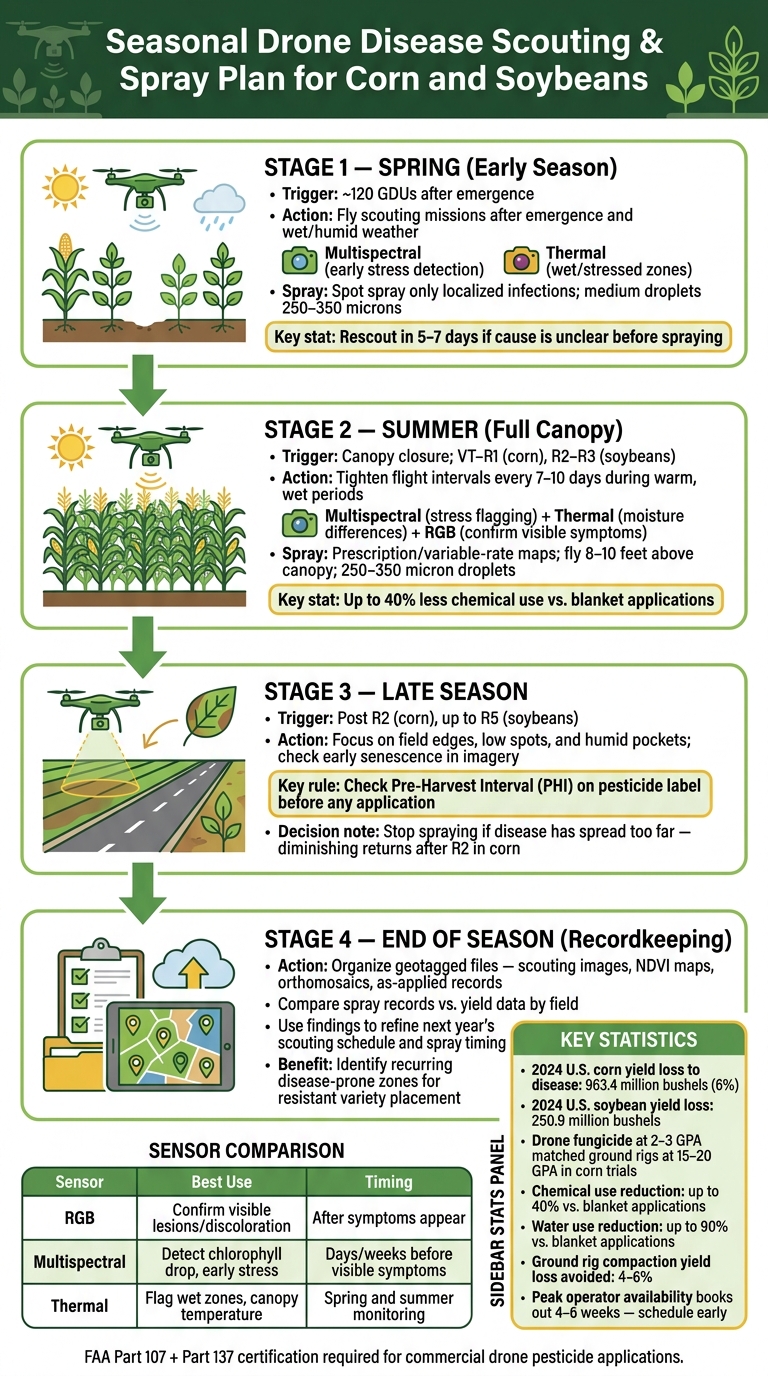
Seasonal Drone Disease Scouting & Spray Plan for Corn and Soybeans
Build your plan around crop stage, not calendar dates. In corn, VT/R1 timing shifts with planting date, hybrid, and latitude. If you lock flights to fixed dates, your maps can get stale fast from one field to the next. Stage triggers keep scouting and spraying lined up with what the crop is actually doing, and that makes spring scouting far more useful before symptoms start moving.
A simple way to do this is with a six-flight scouting schedule tied to GDUs. Start at about 120 GDUs after emergence, then tighten the flight rhythm as fields move through VT and R1–R2. For soybeans, use a similar stage-based rhythm around R2/R3. This matters because peak-season operator availability can be booked 4 to 6 weeks out, so waiting until symptoms show up is often too late. Set the schedule early, then match sensors and spray settings to each stage.
Match sensors and spray settings to crop stage
The right sensor depends on what you need to spot. RGB cameras are a good fit once symptoms can be seen, like lesions, discoloration, or other visible plant damage. Multispectral sensors can spot trouble earlier by picking up drops in chlorophyll and other plant stress signals days or even weeks before symptoms show up to the eye [5][7]. That early window is where intervention has the most upside.
Spray setup needs to change as the canopy changes. Recalibrate flow rates and nozzles for the crop stage you’re treating. For both image quality and spray deposition, fly in winds under 10 mph, ideally in the early morning or evening.
The field results here are hard to ignore:
- Drone-applied fungicide at 2 to 3 GPA matched the efficacy of ground rigs applying 15 to 20 GPA in corn trials [1].
- Targeted spraying from drone-based prescription maps can cut chemical use by up to 40% and water use by up to 90% versus blanket applications [7].
- In mature soybean fields, cutting ground rig passes also helps avoid soil compaction and plant lodging, which can lead to 4% to 6% yield loss [4].
Get ready for FAA, pesticide, and label rules
Before any spray mission, make sure both certifications are covered. FAA Part 107 applies to remote pilot operations. FAA Part 137 applies to agricultural aircraft operations and is required for any commercial pesticide application by drone [1].
The product itself also has to be cleared for the job. A pesticide must be labeled for drone-approved aerial use before spraying. Check the product label first, then confirm state pesticide rules before the mission. Once the plan, gear, and rules are lined up, spring scouting becomes the first test in the field.
Next, use that plan to scout spring fields while canopies are still open.
sbb-itb-3b7eef7
Spring: find early disease pressure while canopies are still open
Spring is your first shot to turn a season-long plan into an actual field call. That timing matters. Crops are still short, the canopy is open, and early disease is much easier to pick out before it starts moving through the field.
Fly scouting missions after emergence and wet weather
Fly after emergence, especially when cool, humid conditions follow rain or heavy dew. Keep flights lower and use high overlap so you get sharper images of early symptoms [3][5].
Watch for stand gaps, uneven color, and patchy vigor. This is where drones can help sort out one problem from another. A stressed patch might be disease, but it could also be water stress, compaction, or a nutrient issue. Canopy temperature and chlorophyll data help you tell the difference [5][8]. Thermal sensors can flag wet or stressed zones, while multispectral sensors can spot disease-linked stress before lesions show up [5][6].
If those flights point to a small trouble spot, act on it before the canopy closes.
Use spot spraying when symptoms stay localized
When infection is limited to a small area, spot spraying lets you treat the problem without covering the whole field. In early-season applications on short crops, medium droplets in the 250–350 micron range help balance drift control with canopy penetration [3]. Rotor downwash also helps material reach lower leaf surfaces [3].
Use RTK positioning to keep flight lines lined up with the treatment zone and improve spray uniformity on infected patches [4]. If stress is showing but the cause still isn't clear, rescout in 5 to 7 days instead of spraying right away [6]. That short wait can save an unnecessary pass. On fast-moving diseases like Southern rust, finding the issue even a week earlier can change whether a fungicide pass still makes economic sense [6].
Summer and late season: watch dense canopies and treat the right acres
Once canopies close, scouting gets tougher. At the same time, disease can move faster, especially in warm, humid weather or after rain. This is when drones shift from simple detection to selective treatment. The big edge comes from steady monitoring. If you check fields on a set rhythm, you have a much better shot at acting before a problem spreads.
Summer scouting and variable-rate treatment in full canopy
As canopies close, move from broad scouting to tighter flight intervals and prescription maps. During warm, wet periods, fly every 7 to 10 days [2][10]. In a full canopy, each data layer plays a different role: multispectral data can flag stress, thermal data can show moisture differences, and RGB helps confirm visible symptoms.
When scouting shows patchy disease pressure, build a prescription map and spray fungicide only where it's needed. That variable-rate approach can cut chemical use by up to 40% compared to blanket applications [7]. That's a big deal. You're not treating the whole field just because one pocket is lighting up.
Timing still matters:
- In corn, the VT–R1 window is the best time to target diseases like Gray Leaf Spot and Southern Rust [3][9].
- In soybeans, focus on R2–R3 for White Mold and Frogeye Leaf Spot [3].
To move product deeper into a dense summer canopy, fly 8 to 10 feet above the canopy and use medium droplets in the 250–350 micron range. That setup lets rotor downwash carry material into the mid and lower leaf surfaces [3].
Late-season decisions: when a drone spray still makes sense
Late in the season, narrow your scouting flights to field edges, low spots, and humid pockets. These areas often hold disease pressure longer. They're also the places where a targeted pass may still protect yield. Early senescence in imagery can also point to disease-related stress.
But there is a line. If disease has moved too far, stop spraying.
For corn, applications made after the R2 stage usually show diminishing returns [2]. In soybeans, an R5 pass can still make sense if disease pressure supports the move [2]. Before any late-season application, check the Pre-Harvest Interval (PHI) on the pesticide label to make sure the timing is legal and safe [2][11].
Record each flight and spray result so you can compare pressure, coverage, and crop response at season's end.
Track results, improve next season, and close out the year
Season records give you a better shot at making smarter disease calls next year. Flight logs and spray records aren't just paperwork. They show you what happened, where it happened, and when it started to go sideways.
Start by organizing geotagged files by field and year. That includes scouting images, NDVI maps, orthomosaics, and as-applied records. When those records are easy to sort through, you can line up spring disease maps with late-season yield maps and spot patterns that would be easy to miss in a messy folder. Over time, recurring disease-prone zones become a lot easier to flag before next spring.
That multi-year view helps with a few key decisions:
- Place disease-resistant varieties in high-pressure areas
- Tighten spray timing based on when issues showed up in past seasons
- Keep a record that agronomists and crop insurance documentation can use
As-applied maps matter a lot here. They show exactly where product was placed, not just where you intended to fly.
At the end of the season, compare spray records against yield data. Look at spray rate, timing, coverage, and yield response by field. Then use what you find to shape next year's scouting schedule and spray timing.
### Main takeaways for U.S. growers and drone operators
Drones do their best work in crop disease control when scouting, spray timing, and application rates line up with crop stage. Build a seasonal calendar before problems show up. Scout early while canopies are still open. Check that you're dealing with disease, not some other crop stress, before you spray. And focus on the acres where treatment has clear economic value.
Keep your records organized every season, and each year's plan gets sharper than the last.
FAQs
How do I tell disease stress from nutrient or water stress?
Use thermal, multispectral, and environmental data together.
Thermal imaging is the main tool for spotting water stress. When plants don’t have enough moisture, canopy temperatures go up. But here’s the catch: the same heat pattern can also signal disease or pest pressure.
To separate one issue from another, compare thermal maps with multispectral indices like NDVI or NDRE. These layers can reveal nutrient deficiencies, shifts in chlorophyll and biomass, or localized fungal infections.
When should I choose RGB, multispectral, or thermal sensors?
Choose the sensor based on what you’re trying to diagnose and where the crop is in its growth cycle:
- RGB for 3D terrain modeling, field documentation, and obvious damage
- Multispectral for crop health and stress; use NDVI early to mid-season and NDRE after canopy closure
- Thermal for water stress, irrigation leaks, or heat anomalies
Drone Spray Pro offers drones and accessories to support these data-driven farming needs.
What records should I keep after each drone scouting or spray flight?
Keep georeferenced records for every flight so you can track field health from week to week. Include multispectral imagery and index maps like NDVI or NDRE to make problem zones stand out.
After scouting, log the GPS coordinates for any flagged areas so your ground-truthing is tied to the right spots. For spray missions, save the prescription zones you used. Then rescan the fields 10 to 14 days later and compare the pre- and post-treatment maps.