Call or Text: +1 (208) 425-2990
Email: Sales@DroneSprayPro.com

How Altitude Affects Drone Spraying
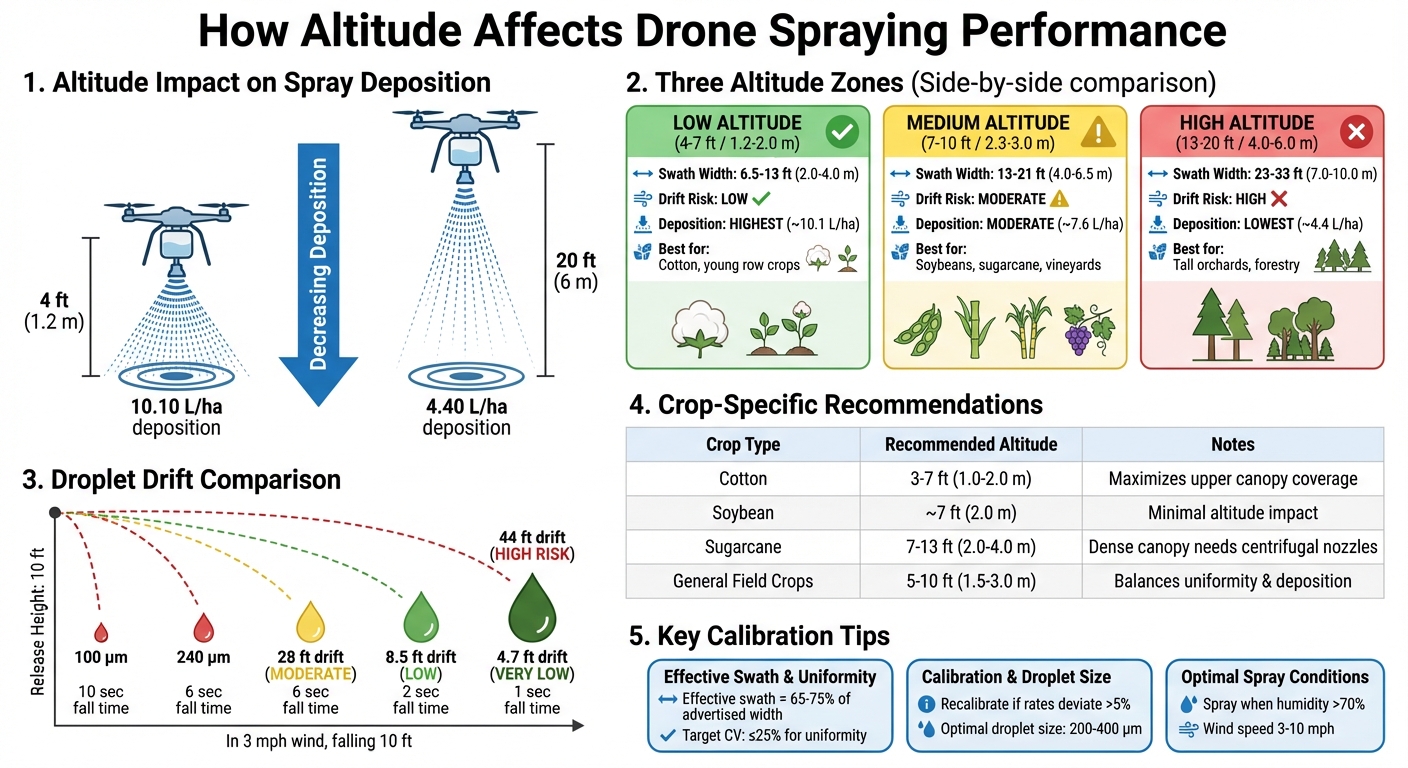
In drone spraying, altitude directly impacts spray coverage, drift, and efficiency. Flying lower improves droplet deposition and reduces drift but limits coverage area. Higher altitudes spread the spray wider but risk evaporation and off-target drift. For example, cotton trials showed spray deposition dropped from 10.10 L/ha at 4 ft to 4.40 L/ha at 20 ft. Optimal altitude depends on crop type, canopy density, and weather conditions.
Key takeaways:
- Lower altitude (4–7 ft): Better deposition, less drift; ideal for row crops like cotton.
- Medium altitude (7–10 ft): Balanced coverage and efficiency; works for soybeans and sugarcane.
- Higher altitude (13–20 ft): Wider swath, reduced efficiency; suited for tall crops like orchards.
Adjust your drone’s settings based on crop type, weather, and droplet size to maximize effectiveness while minimizing waste and drift. Always calibrate your equipment and test spray patterns before operations. High-performance models like the DJI Agras T50 offer advanced settings to simplify this calibration process.
Drone Spraying Altitude Guide: Optimal Heights by Crop Type
Setting Up Spray Drone Parameters for Perfect Pasture Herbicide!
sbb-itb-3b7eef7
How Altitude Affects Spray Patterns
The height at which a drone operates has a major impact on spray patterns. At lower altitudes, the spray forms a narrow, high-density deposition, while at higher altitudes, it spreads out more broadly but becomes less concentrated. Researchers describe this distribution as a "bell-shaped" curve - droplets are densest directly beneath the drone's flight path and taper off sharply toward the edges [1]. Altitude essentially determines how concentrated or dispersed the spray will be and how evenly it covers the target area.
Flying lower results in a focused spray pattern with higher deposition but limited area coverage. On the other hand, flying higher spreads the spray over a larger area but reduces the amount of product reaching the crops. For instance, in cotton trials conducted in Lecompte, Louisiana, between June 15 and July 15, 2024, Louisiana State University researchers observed that when drones were flown at 4 ft (1.2 m), the spray deposition reached 10.10 L/ha. However, increasing the altitude to 20 ft (6 m) reduced the deposition to 4.40 L/ha [2].
To ensure consistent spray coverage, industry standards recommend a Coefficient of Variation (CV) of 25% or less [6]. For example, the DJI Agras T30 demonstrated improved spray coverage when flown at altitudes up to 10 ft (3.0 m) [1].
The Physics Behind Spray Patterns
Drone rotors create strong downward air currents, known as rotor downwash, which push spray droplets into the crop canopy [1]. When drones fly closer to the ground, this downward force is more intense, helping droplets reach their target faster and minimizing their exposure to wind and evaporation. Conversely, as the altitude increases, the downwash weakens, reducing the spray's ability to penetrate dense foliage [3]. At higher altitudes, droplets also have more time to drift or evaporate before reaching the crops. It's important to note that the effective spray width of a drone is usually only 65% to 75% of the maximum swath width advertised by manufacturers [5].
Altitude Settings for Different Crop Types
The ideal flight height varies depending on the crop's canopy density and height. Here's a quick breakdown:
- Cotton: Flying 3–7 ft (1.0–2.0 m) above the canopy ensures optimal coverage of the upper layers.
- Soybeans: A height of approximately 7 ft (2.0 m) works well, with altitude having minimal impact on deposition.
- Sugarcane: Due to its tall and dense canopy, a height of 7–13 ft (2.0–4.0 m) is recommended. In the Louisiana State University study, the upper canopy received 7.39 L/ha of spray, while the lower canopy only received 2.34 L/ha, highlighting how altitude affects penetration.
- General Field Crops: A height of 5–10 ft (1.5–3.0 m) strikes a good balance between coverage uniformity and deposition.
| Crop Type | Recommended Flight Height (Above Canopy) | Key Consideration |
|---|---|---|
| Cotton | 3–7 ft (1.0–2.0 m) | Maximizes upper canopy coverage |
| Soybean | ~7 ft (2.0 m) | Minimal altitude impact on deposition |
| Sugarcane | 7–13 ft (2.0–4.0 m) | Dense canopy benefits from centrifugal nozzles |
| General Field Crops | 5–10 ft (1.5–3.0 m) | Balances uniformity and deposition |
Understanding these altitude-specific adjustments helps explain how droplet behavior changes with flight height.
Droplet Size and Drift at Different Altitudes
Altitude doesn't just influence spray patterns - it also affects how droplets behave in the air. The time droplets stay airborne and their movement depend heavily on flight height. When drones operate at higher altitudes, droplets linger longer in the air, making them more prone to being carried away by wind, evaporating, or getting caught in air currents. For example, droplets smaller than 100–150 µm (roughly the width of a human hair) fall very slowly and are easily pushed around by turbulent air instead of simply dropping to the ground [2][8].
Here’s a striking comparison: a 100-µm droplet takes about 10 seconds to fall 10 ft and can drift 44 ft sideways in a light 3-mph wind. On the other hand, a 400-µm droplet covers the same vertical distance in just 2 seconds and drifts only 8.5 ft laterally [8]. This makes finer droplets more prone to drifting, while coarser ones are more likely to hit their intended target. Studies confirm that higher altitudes lead to a noticeable drop in deposition rates [2].
Managing drift isn’t just about maximizing efficiency - it’s also about preventing environmental harm and protecting nearby areas. Greg R. Kruger, a Pesticide Application Technology Specialist at the University of Nebraska-Lincoln, emphasizes:
"Potential off-target movement needs to be a primary consideration for all pesticide applications" [8].
Uncontrolled drift can contaminate water supplies, harm beneficial organisms like pollinators, and even leave illegal pesticide residues on neighboring crops [8][9]. This makes it crucial to find a balance between droplet size and effective coverage.
Finding the Right Balance Between Droplet Size and Coverage
Fine droplets are great for even coverage, spreading widely and coating surfaces thoroughly. However, they’re more likely to evaporate or drift away. Coarse droplets, on the other hand, are better at penetrating dense foliage and resisting wind, though they don’t spread as evenly. The trick lies in adjusting droplet size based on your altitude and crop type to ensure effective coverage while minimizing drift.
When you switch from crop dusters to drones for field applications, aim for droplets in the 200–400 µm range, which are considered medium to coarse. When flying at lower altitudes (4–7 ft above the crop canopy), finer droplets are generally safe as they have less time to drift. At higher altitudes, coarser droplets or air-induction nozzles are better options. Air-induction nozzles, in particular, produce larger, heavier droplets that are less likely to drift, improving deposition rates to around 80% [4]. But altitude isn’t the only factor - weather conditions also play a big role.
How Weather Conditions Affect Altitude Performance
Weather can amplify the effects of altitude on droplet behavior. Factors like temperature, humidity, and wind speed determine whether your spray stays on target or drifts away.
Humidity is key in reducing evaporation. When relative humidity drops below 50%, small droplets shrink quickly as they fall, increasing their drift potential [8]. Spraying when humidity is above 70% helps minimize this risk. Wind speed is another critical factor - avoid spraying when winds are below 3 mph (to prevent temperature inversions that trap droplets near the ground) or above 10 mph (to limit excessive drift) [8]. Temperature inversions, where cooler air is trapped beneath warmer air, can cause droplets to hang in the air and travel long distances. Watching the horizontal movement of smoke near the ground is a simple way to check for inversions [8].
| Droplet Diameter | Time to Fall 10 ft | Lateral Movement (3-mph wind) | Drift Risk |
|---|---|---|---|
| 100 µm | 10 seconds | 44 ft | High |
| 240 µm | 6 seconds | 28 ft | Moderate |
| 400 µm | 2 seconds | 8.5 ft | Low |
| 1,000 µm | 1 second | 4.7 ft | Very Low |
Coverage Uniformity and Swath Width
Altitude plays a key role in determining both swath width and spray uniformity. Flying at higher altitudes increases the swath width but often compromises uniformity. This balance is measured using the Coefficient of Variation (CV), with industry standards setting acceptable uniformity at a CV of 25% or lower [1].
Interestingly, the effective swath width - the area where consistent coverage is achieved - is usually only 65% to 75% of the advertised maximum [5]. For instance, a drone like the DJI Agras T40 marketed with a 30 ft swath might only deliver reliable coverage over 20–22 ft. If you exceed this effective range, you risk uneven chemical application.
Spray patterns tend to follow a bell-shaped curve, where the highest droplet concentration is directly beneath the drone, tapering off toward the edges [1]. Flying at lower altitudes enhances canopy penetration and uniformity because the rotor downwash is stronger. However, as altitude increases, this downward force weakens, leading to lighter deposition and droplets that are more prone to drifting [1][2]. Field trials consistently show that higher altitudes significantly reduce deposition [2].
Although higher altitudes provide wider coverage, they also dilute deposition density and increase the likelihood of drift [2]. For crops with dense canopies, like cotton or sugarcane, this reduction in coverage can hinder pest control or nutrient application. On the flip side, flying too low means more passes are needed, which increases fuel use and extends spray times. The table below compares how different altitudes affect performance across various crop types.
Low, Medium, and High Altitude Comparison
| Altitude Level | Height (Metric/Imperial) | Swath Width (Approx.) | Drift Risk | Droplet Deposition | Recommended Crop Types |
|---|---|---|---|---|---|
| Low | 1.2–2.0 m (4–6.5 ft) | 2.0–4.0 m (6.5–13 ft) | Low | Highest (~10.1 L/ha) | Cotton, young row crops, early-stage soybeans |
| Medium | 2.3–3.0 m (7.5–10 ft) | 4.0–6.5 m (13–21 ft) | Moderate | Moderate (~7.6 L/ha) | Sugarcane, mature soybeans, vineyards |
| High | 4.0–6.0 m (13–20 ft) | 7.0–10.0 m (23–33 ft) | High | Lowest (~4.4 L/ha) | Tall orchards or forestry where penetration is less critical |
When planning your drone's flight path, always use the effective swath width rather than the maximum advertised width [5]. This helps ensure proper overlap between passes, avoiding gaps or over-application. To fine-tune your settings, perform a swath test with water-sensitive paper whenever you adjust altitudes, as flight height has a big impact on deposition patterns [5].
Practical Tips for Setting the Right Altitude
Getting the altitude right is key to achieving effective spray coverage while avoiding waste. For most row crops, aim to keep your drone flying between 8 and 12 feet above the canopy. However, the exact height can depend on your drone model and the type of spray application you're performing [7].
Pre-Flight Calibration Steps
Before you take off, make sure your equipment is calibrated correctly. Start by testing your flow meter. Run the pump for one minute, collect the liquid from all nozzles, and compare the collected volume to what your drone's monitor shows [10]. If the difference between the actual and intended application rates is more than 5%, adjust your equipment before proceeding [5].
Next, inspect each nozzle individually. Run each one for at least 30 seconds, and replace any nozzle that deviates by more than 10% from the standard performance. This helps prevent clogs and ensures consistent spray coverage [5]. To visually check spray patterns, you can add food-grade dye to your tank and spray over ground tapes or water-sensitive paper [5].
To determine your effective swath width, use water-sensitive paper placed at intervals of 1 to 3 feet perpendicular to your flight path. Fly a test pass and review the deposits on the paper. The effective swath is the distance between the points where spray deposits drop to 50% of the center average. Keep in mind that the true swath width is usually only 65% to 75% of the advertised maximum [5] [10]. As Jason and Tom from Sprayers101 explain:
"Calibration is a fundamental step in any spray application. To apply the correct product rate, we need to know how much liquid per unit land area is deposited under the sprayer" [10].
Once calibration is complete, monitor your drone during flight and adjust as needed.
Making Adjustments During Flight
After calibration, take advantage of your drone's automatic features to maintain the correct altitude. For example, the DJI Agras T30 uses radar altimeters and terrain sensors to keep a consistent height, even over uneven ground [5]. Its RTK system offers vertical positioning accuracy of ±1 cm when connected to a GNSS base station, making it especially reliable in hilly areas [1].
If you notice under-application, consider increasing your gallons per acre (GPA) manually, as automated systems may not fully adjust for altitude changes in windy conditions [5] [7]. Avoid operating at maximum speed, as spray performance can drop when the system is pushed to its limits [7]. Finally, if wind speeds exceed 10 mph, lower your altitude to minimize drift and keep your spray on target [7].
Altitude Settings for DJI Agras Drones
DJI Agras drones offer advanced features to manage altitude effectively, ensuring optimal spray performance. Knowing how to adjust altitude for various crops can make a big difference in achieving better results.
DJI Agras Drone Features That Impact Altitude
Modern DJI Agras models like the T20P, T40, and T50 are equipped with cutting-edge tools such as Active Phased Array Radar and Binocular Vision systems. These technologies allow the drones to maintain precise altitude control. For instance, the T20P’s radar detects altitudes ranging from 1 to 45 meters and supports terrain following between 1.5 and 30 meters [12]. This means the drone can automatically adjust its height, keeping a consistent distance above the crop canopy. The T50 stands out with its ability to handle slopes up to 50° without requiring pre-mapping [14].
The T20P and T40 also feature dual atomized centrifugal nozzles that produce droplet sizes between 50 and 300 μm [12]. These nozzles are especially effective for dense crops like sugarcane but need careful altitude adjustments to avoid spray drift. Field trials in Lecompte, Louisiana, conducted between June 15 and July 15, 2024, showed that centrifugal nozzles delivered a spray deposition of 5.97 L/ha in sugarcane, nearly doubling the 3.37 L/ha achieved with hydraulic AIXR11002 nozzles [2].
For drones like the T30 with hydraulic nozzles, switching to Air Induction (AIXR) or AirMix nozzles can cut drift by up to 60% [11].
Altitude adjustments are also crucial for payload management. For every 1,000-meter increase in altitude, reduce the payload by 10 kg to maintain performance and ensure effective spray deposition [14]. The DJI Agras app simplifies this process by offering recommendations based on altitude and temperature, so always check these settings before loading your tank.
With these features in mind, let’s look at some recommended altitude settings for common spraying scenarios.
Altitude Recommendations for Common Crops
Using these advanced systems, here’s how to set the right altitude for specific crop applications:
- T20P General Applications: Set the altitude to 2.5 meters (about 8 feet) above the crop canopy. At this height and a speed of 6.5 m/s, the drone achieves a 7-meter spray width, covering up to 12 hectares per hour [12][13].
- Low Crops (e.g., Cotton): Spray at approximately 1.2 meters (4 feet) above the canopy. Research shows that flying closer - around 1 meter - improves spray deposition and coverage in the upper canopy. As the LSU AgCenter research team noted:
"Lower flight heights around 1 m above the canopy level can enhance spray deposition and coverage in the upper canopy region." [2]
- Tall, Dense Crops (e.g., Sugarcane): Use an altitude between 2 and 4 meters (6.5 to 13 feet) above the canopy. This range ensures the spray pattern develops fully before reaching the leaves. The T40, with its centrifugal nozzles, performs particularly well under these conditions [2].
- T30 Guidance: Simer Virk, a Precision Ag Specialist at UGA Extension, advises:
"Determine an optimal height range for your drone, such as 8 to 12 ft for DJI T30, and stay within that range for adequate application performance." [7]
Flying above 12 feet doesn’t expand the swath width and increases the risk of spray drift.
When working on uneven terrain or hillsides, activate the terrain-following feature. This allows the radar to keep the drone at a consistent height, ensuring uniform spray deposition even over varied landscapes. For instance, the T50 can manage slopes up to 50° using its mapping-free terrain-following capabilities (1.5–30 meters) [14].
Conclusion
As discussed earlier, altitude plays a critical role in both droplet behavior and spraying efficiency, influencing spray patterns, droplet size, and how evenly coverage is distributed. Flying too low reduces your swath width and limits efficiency, while flying too high increases the risk of drift and decreases deposition on the target crop. For example, in cotton trials, lowering the flight height from 6 meters (approximately 20 ft) to 1.2 meters (around 4 ft) significantly improved spray coverage from 1.15% to 2.75% and increased deposition from 4.40 L/ha to 10.10 L/ha [2]. Adjusting altitude to approximately 3.0 meters (roughly 10 ft) can further enhance uniformity across the swath by reducing the Coefficient of Variation to acceptable levels [1].
Precise calibration is key, as highlighted in earlier sections. Effective swath widths are often narrower than advertised, making accurate calibration even more important. According to Purdue Pesticide Programs:
"A drone can only be effective, efficient, and safe if operators properly check and calibrate them for each type of application (corn, pastures, aquatic, and so on)" [5].
Using tools like water-sensitive paper to verify spray patterns and recalibrating when switching nozzles or crops ensures consistent results. Regular equipment calibration is essential to maintain application rates within a 5% margin of the target [5].
Altitude adjustments should also be tailored to crop type. For low-growing crops like cotton, flying at around 1.2 meters (4 ft) above the canopy is recommended. Taller crops such as sugarcane benefit from an altitude range of 2–4 meters (6.5–13 ft). For DJI Agras T30 drones, optimal performance is typically achieved within 1.5–3.0 meters (5–10 ft). Flying higher than this can increase drift without offering meaningful improvements in swath width.
Key Takeaways
Achieving optimal altitude requires balancing spray physics, nozzle design, and weather conditions. Lower altitudes provide better canopy penetration but may require multiple passes, while higher altitudes cover more area but demand careful monitoring of wind and drift. Always test your setup before full-scale operations and recalibrate your equipment if application rates deviate by more than 5% from your target [5].
For operators looking to refine their altitude strategies, reliable support is essential. Drone Spray Pro offers training, calibration assistance, and a full lineup of DJI Agras drones with advanced altitude control systems. Whether you're managing cotton fields in the Southeast or sugarcane in Louisiana, fine-tuning your altitude settings can make all the difference between wasted resources and effective pest control.
FAQs
How do I choose the right flight height for my crop?
To choose the best flight height, it's essential to balance precision and coverage while considering expert recommendations and research. Flying at lower altitudes, such as 6–12 feet, ensures more accurate application, minimizes drift, and is ideal for fragile crops or areas with thick canopies. On the other hand, higher altitudes allow you to cover larger areas but may lead to uneven distribution and increased drift. Research suggests that flying at heights around 2–3 meters can enhance spray patterns for certain drones. Ultimately, the right height will depend on factors like weather conditions, the type of crop, and the capabilities of your drone.
What droplet size should I use at different altitudes?
At lower altitudes, using larger droplets - typically between 140–180μm - is ideal for maintaining good coverage while cutting down on drift. On the other hand, at higher altitudes, slightly smaller droplets, around 200μm or more, are better suited to ensure proper coverage and to keep the risk of drift in check. Adjusting droplet size according to altitude is key to improving spraying efficiency and minimizing waste.
How do I measure my drone’s effective swath width?
To determine your drone’s effective swath width, start by flying it over the target area under typical operating conditions. Collect spray deposits along the spray path and evaluate the coverage pattern. Take several measurements to ensure consistent results, paying close attention to both uniformity and overall coverage. Additionally, measure the distance between the outermost points where the spray coverage is acceptable during flight. This will help you pinpoint the effective swath width.
