Call or Text: +1 (208) 425-2990
Email: Sales@DroneSprayPro.com

When High-Capacity Spray Drones Pay Off
If I’m spraying less than about 1,200 to 1,500 applied acres a year, a high-capacity spray drone usually doesn’t pencil out. If I’m above that range, making multiple passes, or selling custom work, the math starts to look much better.
Here’s the short version:
- Applied acres matter more than farm acres. A 500-acre farm with 3 passes is 1,500 applied acres.
- Tank size helps only if I keep the drone busy. A 40–60 L drone can cut refill stops and treat more acres in short spray windows.
- Cost per acre drops as yearly use goes up. That’s because fixed costs like the drone, batteries, insurance, and licensing get spread across more acres.
- Custom rates often run about $12 to $25 per acre in the U.S., which sets the yardstick for buy-vs-hire decisions.
- Crew flow, batteries, wind, and licensing can make or break ROI. A drone that sits still doesn’t earn.
A few numbers stand out:
- At $20 per acre, hiring out 1,500 applied acres would cost about $30,000 per year.
- A $40,000–$60,000 drone setup can be hard to justify at 500–1,000 applied acres, but the picture changes above 1,250–1,500 acres.
- At 2 GPA, a 10.56-gallon tank covers about 5.28 acres per fill.
- High-capacity drones can often hit 20 to 40 acres per hour in clean field conditions at 1–2 GPA.
Here’s a fast comparison:
| Use level | Applied acres/year | What I’d usually do |
|---|---|---|
| Low | 300–800 | Hire it out or use a smaller drone |
| Mid | 800–4,000 | Compare mid-size vs. high-capacity closely |
| High | 4,000+ | High-capacity often makes more sense |
My takeaway: I’d buy a high-capacity drone only if I have enough applied acres, enough passes, and a setup that keeps the machine flying instead of waiting on batteries, mixing, or paperwork.
Spray Drone Business Math: Cost vs Profit (How Much Can You Earn?)
sbb-itb-3b7eef7
Break-even point: how many applied acres justify a larger drone
High-Capacity Spray Drone ROI: Break-Even by Annual Applied Acres
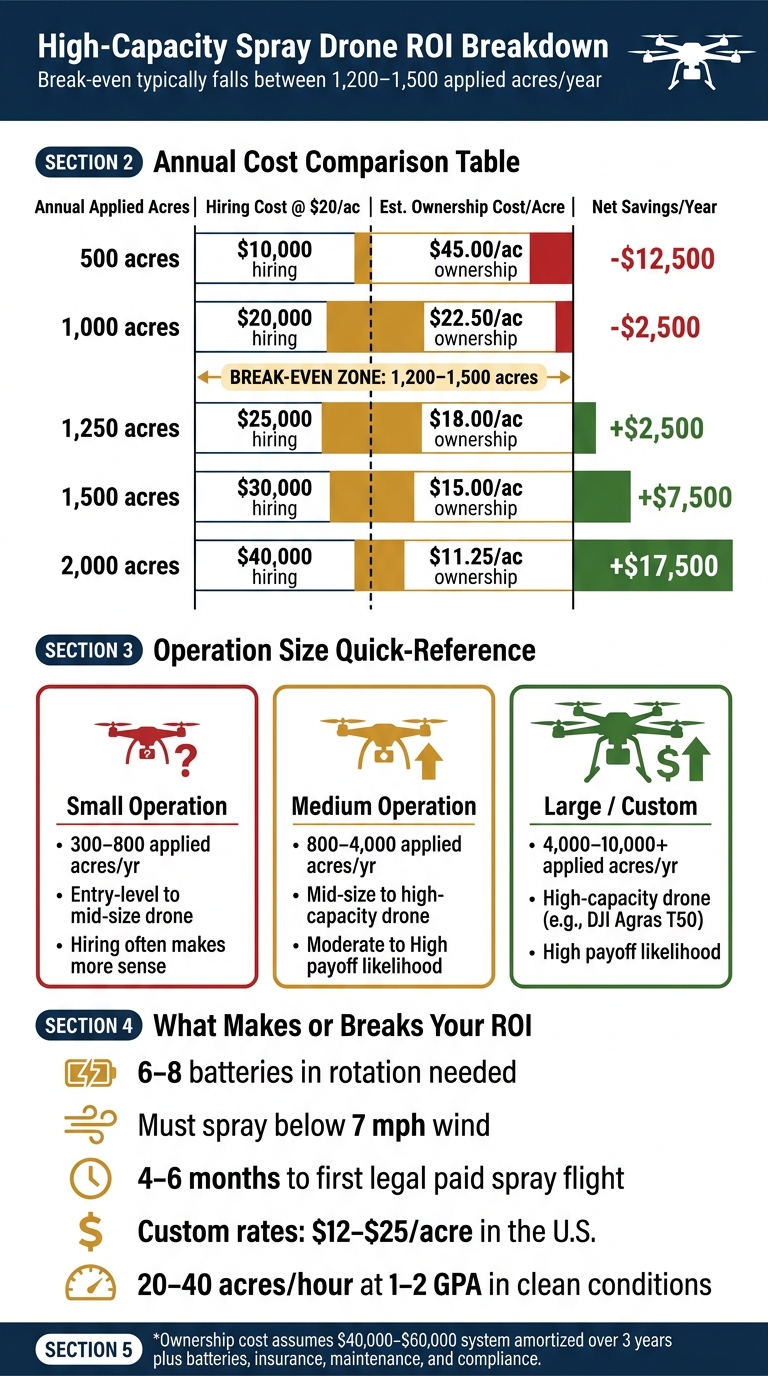
For many operators, the break-even point lands around 1,200 to 1,500 applied acres per year. That range isn’t random. It reflects the stuff that hits your budget in the field: weather delays, battery replacement, labor, and compliance costs.
Run a simple annual cost comparison before buying
The simplest way to judge ownership is to compare two numbers:
- what you’d pay a custom operator to spray your applied acres
- what it would cost you to own and run the drone yourself
In the U.S., custom drone spray rates usually fall between $12 and $25 per acre. On the ownership side, you need to factor in depreciated equipment value, insurance, maintenance, and compliance fees.
Using a midpoint custom rate makes the break-even picture easier to read.
| Annual Applied Acres | Annual Hiring Cost (@ $20/ac) | Est. Ownership Cost Per Acre* | Net Savings per Year |
|---|---|---|---|
| 500 | $10,000 | $45.00 | -$12,500 |
| 1,000 | $20,000 | $22.50 | -$2,500 |
| 1,250 | $25,000 | $18.00 | $2,500 |
| 1,500 | $30,000 | $15.00 | $7,500 |
| 2,000 | $40,000 | $11.25 | $17,500 |
Estimated ownership cost assumes a $40,000–$60,000 system amortized over three years, plus batteries, insurance, maintenance, and compliance.
That table tells a pretty clear story. Below 1,200 to 1,500 applied acres, fixed ownership costs are tougher to spread out. Once you get past that range, a larger setup has a much better shot at paying for itself.
Why high-capacity models require enough yearly use
A bigger drone only makes financial sense if it stays busy. The machine itself is just part of the setup. A working operation usually needs:
- 6 to 8 batteries in rotation
- a fast charger or parallel charging system
- an RTK base station for accurate positioning
- a trailer or other transport setup
- insurance
- training
- compliance costs tied to Part 107, Part 137, and state pesticide applicator licensing
Each of those expenses gets divided across your annual applied acres. That’s how you arrive at cost per acre.
If annual use is low, those fixed costs hit hard and cost per acre stays high. If annual use is high enough, the same costs get spread out much more efficiently.
Farm size, spray volume, and job frequency: when bigger capacity actually helps
Once you have a rough annual cost range, the next step is simple: will your spray schedule give a bigger drone enough work? That comes down to two things: how many acres you spray each year and how often you go back across those same fields. If you run multiple crops and make multiple passes, those acres pile up fast. That total is what tells you whether a larger tank is worth it.
How payoff points differ by operation size
This table shows when high-capacity drones start to pencil out.
| Operation Size | Annual Applied Acres | Recommended Drone Class | Payoff Likelihood |
|---|---|---|---|
| Small (under 800 annual applied acres) | 300–800 | Entry-level to mid-size | Low - hiring often makes more sense |
| Medium (800–4,000 annual applied acres) | 800–4,000 | Mid-size to high-capacity | Moderate to High |
| Large / Custom (4,000+ annual applied acres) | 4,000–10,000+ | High-capacity (e.g., DJI Agras T50, Talos T60X) | High |
After that, the math shifts to field workload. Some acres are easy to cover. Some are a grind. And the more often the same fields need another pass, the more useful a larger drone becomes. If your program only calls for a small number of passes, you usually won't log enough annual flight time to make a larger tank pay off. But once you get into several thousand applied acres, the case gets much stronger.
How spray volume and acres per hour change the math
Gallons per acre (GPA) directly changes how many acres you can get done in a day. At 1–2 GPA, high-capacity drones can often cover 20 to 40 acres per hour in efficient field conditions. Move up to 3–5 GPA, and throughput falls off. Why? Each tank covers fewer acres, so you spend more time stopping, refilling, and getting back in the air. Actual output depends on GPA, field shape, and refill speed.
Field shape can make or break the numbers too. Big, square, open fields let a high-capacity drone stretch out and run long passes with fewer turns. That's when you get close to the top end of the throughput range. Irregular fields, tree lines, terraces, and pivot corners chip away at that edge. If most of your acres are broken up or hilly, a bigger drone still helps, but the gap gets smaller.
Why frequent in-season passes increase the value of larger tanks
High-capacity drones tend to pay off fastest in crops that need multiple applications in a season. Corn fungicide near tassel is a good example. So is soybean fungicide for frogeye leaf spot or white mold. Pasture weed control tied to growth stages can do the same thing. Those jobs stack applied acres in a hurry, and they often hit during the same tight weather windows. Specialty crops can also support high-capacity ownership because they often need several well-timed applications.
If the drone will cover your own acres, the next step is comparing that use case with paid-acre service rates.
Service rates and owner-operator math: spraying your farm or building a spray business
Once you know your annual applied acres, the next step is simple: are those your own acres or paid acres?
That split changes the math. If you're doing custom spray work, income comes down to three things: your rate, your margin, and how many paid acres you can cover.
Common U.S. drone spray rates by crop and terrain
These rates set the upper limit on what custom work can bring in. In most cases, row crops land around $12–$18 per acre. Pasture and rangeland often come in at $14–$25 per acre. Orchards and specialty crops usually sit higher because the work takes more time and tends to be more complex [1].
If row-crop pricing starts to get squeezed, a niche can make a big difference. Orchard fungicide work, for example, or other specialty jobs can help keep margins in better shape.
How to estimate the paid acres needed to hit your income goal
The basic formula is straightforward.
Gross margin per acre = service rate - operating cost
Return = gross margin per acre × paid acres
The table below uses a $20,000 return goal and typical owner-operator cost assumptions [1].
| Crop/Service Type | Service Rate (per acre) | Estimated Owner Cost (per acre) | Gross Margin (per acre) | Applied Acres Needed for $20k Return |
|---|---|---|---|---|
| Row crops | $15.00 | $5.00 | $10.00 | 2,000 |
| Pasture/rangeland | $20.00 | $7.00 | $13.00 | 1,538 |
| Orchards/specialty | $35.00 | $12.00 | $23.00 | 870 |
Owner cost includes labor, fuel, battery depreciation, maintenance, and insurance.
A quick read of the table tells you a lot. At a $10.00 margin, row crops need 2,000 acres to get to $20,000. Pasture and rangeland need 1,538 acres at a $13.00 margin. Orchards and specialty work need only 870 acres because the margin is much higher at $23.00 per acre.
How Drone Spray Pro can shorten time to revenue
If your goal is to get to paid acres sooner, startup delays can eat up time. Bundled equipment, such as Talos Ag Drones, and training can cut some of that friction.
Drone Spray Pro offers bundled spray packages, FAA licensing support, training, and accessories to help operators get to paid acres faster.
Regulatory and practical limits that affect ROI
Getting a high-capacity spray drone into paid work usually takes more setup than buyers expect. Paperwork alone can push back your first job by months. And even when the per-acre math looks good on paper, licensing and field workflow are what decide if that margin turns into cash.
Part 107, Part 137, and requirements for heavier drones
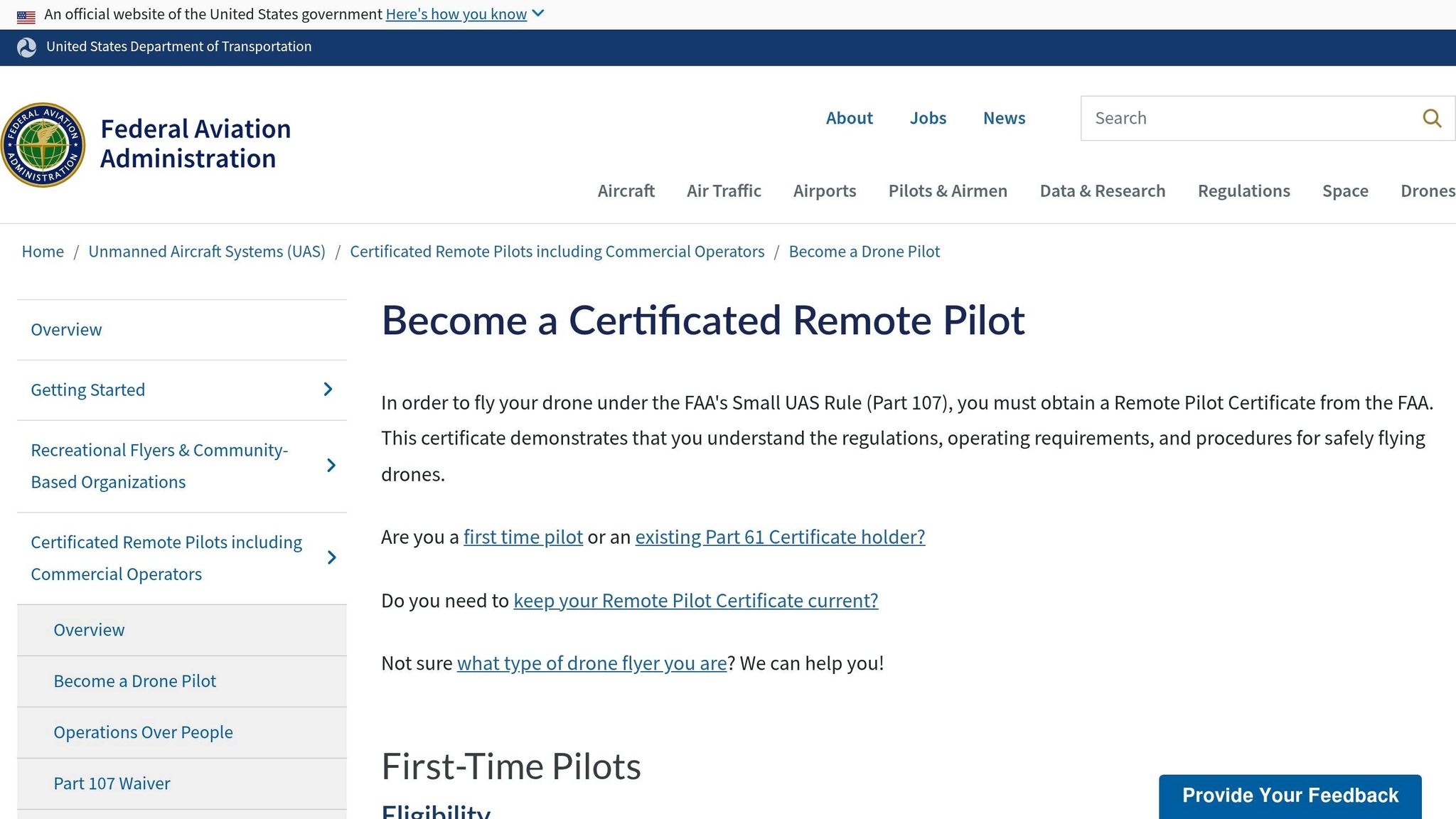
Paid spray work isn’t as simple as buying a drone and heading to the field. To spray pesticides legally, you need a Remote Pilot Certificate, Part 137 agricultural operator approval, and the required spraying exemption. If the drone weighs 55 lbs. or more, you also need a Section 44807 exemption and N-number registration. That can delay the first paid flight [2].
The timeline matters. Plan on 4–6 months from filing to your first legal spray flight, and exemption petitions must be filed at least 120 days before operations begin [2]. On top of that, you’ll need state-level pesticide applicator licenses.
Crew workflow, battery planning, and weather windows can decide ROI
A profitable rate doesn’t mean much if the drone can’t stay working. Daily acres are shaped by battery rotation, refill speed, and weather. If any of those break down, output drops in a hurry.
Drone spraying is limited to wind below 7 mph for safe, effective spraying, which cuts down the hours you can actually work [2]. That tighter window puts even more pressure on field setup and crew flow.
| Factor | Helps ROI | Hurts ROI | ROI impact |
|---|---|---|---|
| Battery count | 6+ packs with cooling rotation | 2–3 packs with heat delays | Insufficient batteries create downtime between every 10–15 min flight [1] |
| Generator size | 14 kW+ matches charge to refill | Under 10 kW slows charging | Undersized power setups can stretch a 100-acre job over multiple days [1] |
| Refill logistics | Purpose-built trailer with quick-fill | Slow manual mixing and filling | Quick-fill caps and high-flow pumps can cut ground time from 10 minutes to under 2 minutes [1] |
| Crew size | Two-person crew: one flies, one mixes | Solo operator stops to mix | Solo operators lose 5–10 minutes per cycle when mixing interrupts flight [1] |
| Wind conditions | Stable conditions below 7 mph | Winds above 7 mph | Drones have tighter wind tolerances than planes, shrinking workable hours [2] |
A two-person crew, a properly sized generator, a fast-fill nurse tank setup, and a 6-battery rotation can keep a high-capacity drone moving through the day at a steady pace. Cut one corner, and your acres per day can fall off fast.
The clearest signs a high-capacity spray drone pays off
A high-capacity spray drone makes the most financial sense when a few things line up at the same time:
- Annual applied acres are high
- Multiple spray passes are common
- Local custom rates are strong
- You’re ready for the licensing and field demands that come with a heavier, higher-output machine
These drones pay off only when they stay busy enough to spread fixed costs across enough applied acres. Match tank size and throughput to your actual annual use, and the numbers usually make sense. Buy ahead of your real volume, and you’re stuck carrying costs that don’t earn their keep.
Drone Spray Pro offers high-capacity spray drones, training, FAA licensing support, and accessories to help operators start spraying sooner.
FAQs
How do I calculate my applied acres?
Use this formula: tank volume (L) ÷ spray volume (L/acre) = acres covered per flight.
Here’s the math in plain English: if you have an 8-liter tank and you spray at 2 liters per acre, you’ll cover 4 acres per flight.
For total land area, modern drone controllers can map about 16.5 acres in 10 minutes.
What costs should I include in a break-even estimate?
Include one-time costs like the drone, package/accessories, training and FAA licensing support, and initial spares such as extra batteries, PPE, and pumps.
Also include recurring costs: charging infrastructure and station maintenance, battery replacement, routine maintenance, and, for service work, fuel, insurance, depreciation, travel/service time, and chemical costs when applicable.
When does a high-capacity drone make more sense than hiring out?
A high-capacity drone starts to make sense when you’re spraying enough acres each year to earn back the $30,000–$40,000 equipment cost without a long wait. In many cases, that payback can happen in just 4–6 weeks, and a common break-even point is around 980 acres per year.
Once you’re operating at that level, the math gets a lot more appealing. Ownership runs about $12.27 per acre, compared with roughly $16 per acre for custom hire. And speed matters too: with coverage of up to about 52 acres per hour, owning the drone can be the smarter buy.
