Call or Text: +1 (208) 425-2990
Email: Sales@DroneSprayPro.com

Drone Survey Laws Farmers Must Know
Using drones for agricultural surveys? Here's what you need to know to stay compliant and avoid hefty fines:
-
FAA Regulations:
- Drones over 0.55 lbs must be registered with FAA ($5 fee, valid for 3 years).
- Obtain a Part 107 Remote Pilot Certificate by passing a 60-question test ($175 fee, 70% passing score).
- Follow Remote ID rules: drones must broadcast identification and location data.
-
Airspace Rules:
- Most farmland lies in Class G airspace (no approval needed up to 400 ft).
- Controlled airspace (near airports) requires LAANC authorization.
- Check for Temporary Flight Restrictions (TFRs) before flying.
-
State Laws:
- Privacy and property laws vary by state. Avoid flying near homes or private areas without permission.
- For pesticide use, additional state-specific certifications may be required.
-
Insurance:
- Standard farm policies don’t cover drones. Get specialized UAV insurance for liability, equipment, and payload coverage.
-
Advanced Operations:
- FAA waivers are necessary for Beyond Visual Line of Sight (BVLOS), night operations, or flying multiple drones.
-
Stay Updated:
- Regulations like Part 108 (coming in 2026) will change BVLOS rules. Regularly check FAA updates.
Noncompliance can lead to fines up to $250,000 or voided insurance. Staying informed and following these steps ensures safe and legal operations.
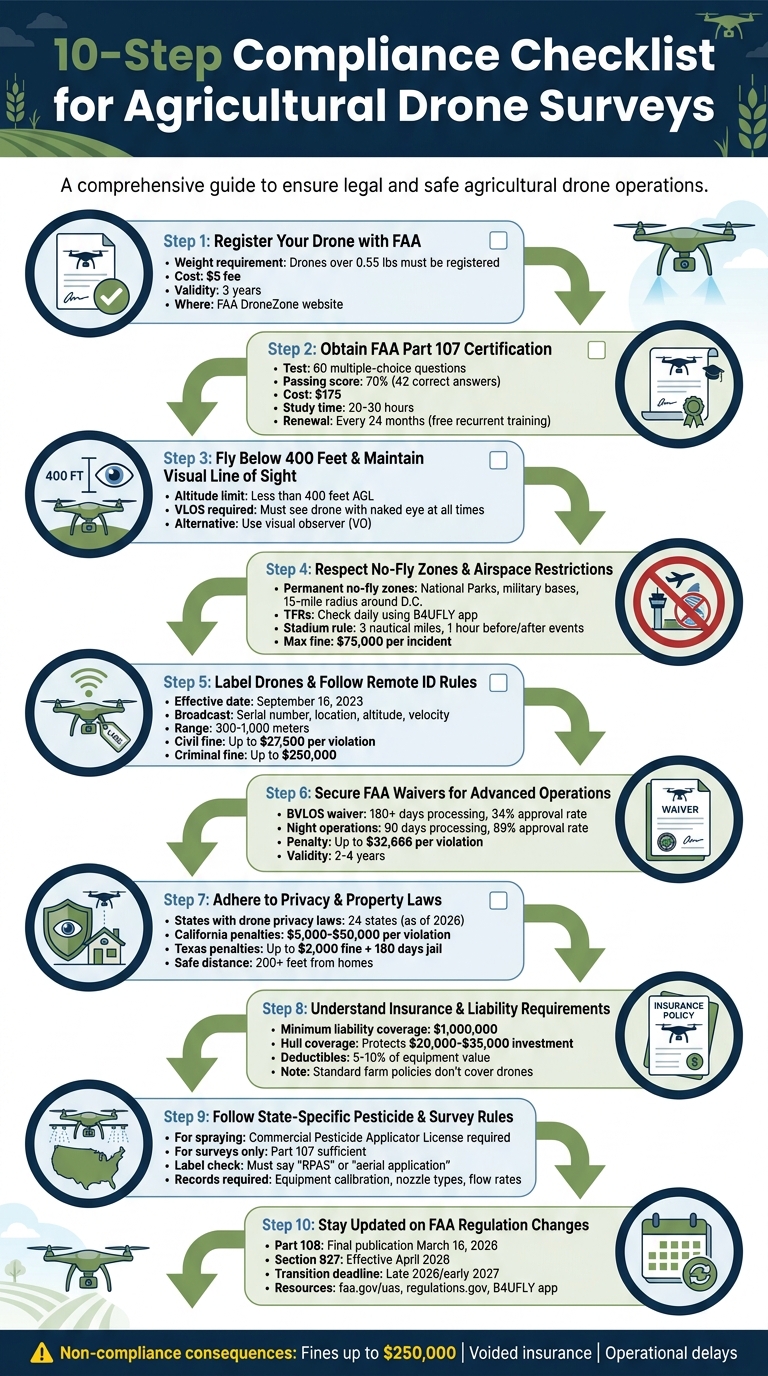
10-Step Compliance Guide for Agricultural Drone Surveys
Faa Drone Regulations For Farmers
sbb-itb-3b7eef7
Legal Requirements for Agricultural Drone Surveys
When conducting agricultural drone surveys, you need to follow three key legal frameworks: FAA regulations, state privacy and property laws, and insurance requirements. Overlooking any of these can jeopardize your operation.
FAA Registration and Certification
If your drone weighs 0.55 pounds or more, it must be registered through the FAA DroneZone website. The registration fee is $5 and is valid for three years [3]. Make sure to carry your registration certificate - either a physical or digital copy - during every flight. For drones over 55 pounds, registration is more complex and involves filing FAA Form 8050-1 along with a notarized affidavit of ownership [3].
For commercial operations, Part 107 certification is a must. As Iowa State University Extension explains:
"If drones are used to collect imagery to help make management decisions, this is classified as commercial use of the drone" [2].
To obtain Part 107 certification, you’ll need to pass a 60-question knowledge test at an FAA-approved PSI testing center. The test costs $175, and you’ll need a minimum score of 70% to pass [6]. Once certified, you must complete free recurrent training every 24 months to maintain your license [6].
Airspace Authorization
After registration and certification, securing airspace authorization is essential. Most rural farmland lies in uncontrolled Class G airspace, where you can fly up to 400 feet without prior approval [7]. However, if your fields are near small airports or controlled airspace, you’ll need authorization. The Low Altitude Authorization and Notification Capability (LAANC) system makes it easy to get near-instant approvals for flying in Classes B, C, D, and surface Class E airspace [7]. Before every flight, check for Temporary Flight Restrictions (TFRs) using tools like the B4UFLY app [2].
State Regulations and Insurance
In addition to FAA rules, you’ll need to navigate state-specific laws. Privacy regulations vary widely, and some states have additional rules for activities like pesticide applications and agricultural surveys. Securing proper insurance is also critical. It protects you from personal liability in case of damages or injuries during your drone operations.
1. Register Your Drone with the FAA
If you're using a drone for agricultural surveys, registering it with the FAA is a must for compliance. This applies to any drone weighing over 0.55 lb, which includes the majority of survey drones [8].
The registration process varies by weight. For drones under 55 lb, you can register online through the FAA DroneZone. You'll need to provide details like your physical address, email, phone number, the drone's make and model, and its Remote ID serial number. The fee is $5 per drone, and registration lasts for three years [8]. For drones weighing 55 lb or more, you'll need to complete the process using FAA Form 8050-1 and submit a notarized affidavit [3].
Once registered, label your drone with its registration number. Also, keep your registration certificate handy during operations, as law enforcement may request to see it [8] [3].
Keep in mind, only U.S. citizens or legal permanent residents aged 13 or older can register a drone. If you don’t meet these requirements, a qualified representative will need to handle the registration for you [8]. After registering, double-check that you meet all other certification and operational requirements before flying.
2. Obtain FAA Part 107 Certification
Getting certified under Part 107 is a key step to staying compliant with FAA regulations. If you’re using drones to survey your fields, you’ll need an FAA Part 107 Remote Pilot Certificate. Even if you’re not charging for drone services, the FAA still considers any drone operations that support your business or boost yields as commercial activity - so certification is mandatory [6]. Here’s what you need to know to get started.
First, make sure you meet the basic eligibility criteria. To qualify, you must be at least 16 years old, fluent in English, and physically and mentally fit for safe drone operation. The process involves passing an aeronautical knowledge test at an FAA-approved testing center and undergoing a TSA security background check [6].
The test itself includes 60 multiple-choice questions covering topics like airspace classifications, weather conditions, and Part 107 regulations. To pass, you’ll need a score of at least 70%, which means answering 42 questions correctly. Most people spend 20–30 hours studying for the exam. The test costs $175, and you’ll need to take it in person at a PSI testing center [6].
Before scheduling your test, you’ll need to create a profile in the Integrated Airman Certification and Rating Application (IACRA) system to obtain your FAA Tracking Number (FTN). Once you pass the test, your Remote Pilot Certificate is valid for 24 months. After that, you’ll need to complete free online recurrent training to keep your certification current. Always carry your certificate - either a digital or physical copy - during drone operations in case it’s requested for inspection [6].
3. Fly Below 400 Feet and Maintain Visual Line of Sight
Once you're registered and certified, it's essential to follow specific operational rules. For instance, you generally need to keep your drone at an altitude of less than 400 feet above ground level (AGL), with some exceptions [5].
Always maintain a visual line of sight (VLOS). This means you must be able to see your drone with your own eyes at all times - no binoculars, cameras, or other devices are allowed to assist your vision [5]. This rule is in place to ensure you can detect and avoid manned aircraft, steer clear of obstacles, and quickly handle any emergencies [2][3]. It's a critical part of broader airspace safety measures.
"Unmanned aircraft must remain within the visual line of sight of the remote pilot or visual observer in command and the person manipulating the flight controls." - Iowa State University Extension and Outreach [2]
If keeping VLOS is tough - like when you're flying over large fields - you can rely on a visual observer (VO) to keep the drone in sight. Using a VO is especially important when operating with First Person View (FPV) technology [5].
For farms located in controlled airspace (Class B, C, D, or E), you'll need to get clearance through the Low Altitude Authorization and Notification Capability (LAANC) system. This system provides quick, digital authorization for drone flights [2][5]. However, if you're flying in Class G airspace, no approval from air traffic control (ATC) is needed [2].
4. Respect No-Fly Zones and Airspace Restrictions
When flying drones, it's essential to stay informed about no-fly zones and temporary airspace restrictions. These areas are off-limits to drones, either permanently or temporarily, to ensure safety and security. According to the FAA and local authorities, permanent no-fly zones include places like National Parks, military installations, nuclear power plants, federal prisons, and the 15-mile radius surrounding Washington, D.C. [11][12].
Temporary Flight Restrictions (TFRs) add another layer of complexity. These restrictions are often tied to specific events such as presidential travel, active wildfires, space launches, or major sporting events [11][12]. For instance, drone flights are banned within 3 nautical miles of stadiums hosting MLB, NFL, NCAA Division I football games, or major auto races, starting one hour before and lasting until one hour after the event. Additionally, TFRs for presidential movements impose strict no-drone zones that override regular airspace permissions [12].
Since TFRs can pop up with little notice - sometimes just hours before an event - it’s crucial to check airspace conditions on the day of your planned flight. Tools like the B4UFLY app provide real-time updates, using green, yellow, and red indicators to signal safe, cautionary, or restricted zones [12].
"A 2-minute B4UFLY check on the day of the flight is faster than explaining a violation to the FAA." – Paul Posea, Author, Dronesgator [12]
Ignoring these restrictions can lead to hefty consequences. Fines can reach up to $75,000 per incident, with one of the highest recorded FAA fines being $36,770 for a drone flown near emergency aircraft during a wildfire in 2025 [12].
5. Label Drones Externally and Follow Remote ID Rules
Staying within the required flight altitude and maintaining a clear line of sight are important, but following Remote ID rules is just as critical. Think of Remote ID as a digital license plate for your drone - it broadcasts key details like identification and location. Since September 16, 2023, all Part 107 commercial drone operations, including those for agricultural surveys, must meet these Remote ID requirements [14].
Here’s what each drone must broadcast continuously: its unique serial number, real-time location, altitude, velocity, and the position of its control station. This data is transmitted via Bluetooth or Wi-Fi and can typically reach devices within 300 to 1,000 meters [14].
To comply, you have two choices:
- Use a drone with built-in Standard Remote ID (most drones made after September 2022 include this feature).
- Attach an FAA-approved broadcast module to the drone. This module must be mounted securely, and the drone’s exterior must display a visible compliance label. Per 14 CFR 89.525, these labels need to be in English, easy to read, and permanently attached [13].
Before flying, always verify that the broadcast is functioning properly. Apps like OpenDroneID can help with this. Additionally, make sure every drone or broadcast module is registered in your FAA DroneZone account, and double-check that the Remote ID serial number matches its registration. Mismatches could lead to enforcement actions [14][15].
The consequences of non-compliance are steep. Civil fines can go up to $27,500 per violation, while repeated offenses could lead to criminal fines as high as $250,000 [14]. These rules are part of the broader regulatory system designed to ensure safe and secure drone operations.
"Remote ID lays the foundation of the safety and security groundwork needed for more complex drone operations." – Federal Aviation Administration [15]
6. Secure FAA Waivers for Advanced Operations
Part 107 covers the basics of drone operations, but advanced agricultural tasks often require specific FAA waivers. For example, if you need to fly beyond your visual line of sight (BVLOS) over large areas, operate multiple drones at once, or control a drone from a moving tractor, you'll need to go through the FAA's waiver process.
To apply, submit your request through the Aviation Safety Hub. Be clear about the specific Part 107 regulation you’re seeking a waiver for - such as Beyond Visual Line of Sight (§ 107.31) or Multiple UAS Operations (§ 107.35). Along with your application, include a detailed Waiver Safety Explanation. This document should outline the nature of your operation, potential risks, and the strategies you’ll use to mitigate them, like geofencing or parachute systems [16].
"If your waiver application does not identify operational hazards and propose risk mitigation strategies, we will not be able to make a complete safety analysis and will disapprove your application." – Federal Aviation Administration [16]
The approval process varies depending on the type of waiver. For instance, night operation waivers are typically processed within 90 days and have an 89% approval rate. In contrast, BVLOS waivers can take over 180 days to process, with only 34% of applications being approved [18]. To improve your chances, provide well-defined operational areas using GPS coordinates instead of vague requests like "entire county" [17]. Starting with a simpler waiver can help you build a safety record before moving on to more complex requests.
Keep in mind that operating without the necessary waiver can result in federal penalties of up to $32,666 per violation [17]. Most waivers are valid for 2 to 4 years, so it’s a good idea to submit renewal applications at least 90 days before they expire to avoid interruptions in your operations [17]. While the FAA doesn’t charge application fees, hiring professional consultants for complex waivers like BVLOS can cost anywhere from $5,000 to $25,000 [17].
Securing these waivers is an essential step before tackling other legal aspects of advanced drone operations.
7. Adhere to Privacy and Property Laws
Once you've ensured compliance with flight and airspace regulations, it's equally important to respect privacy and property laws. While the FAA oversees airspace safety and registration, privacy concerns fall under state and federal jurisdiction.
The FAA does not handle privacy violations; these are governed by federal wiretapping laws and various state-specific regulations. For instance, by 2026, 24 states have implemented drone-specific privacy laws, each with its own set of rules and penalties [19].
"The FAA governs airspace, not privacy... Reporting a drone to the FAA because it's watching your house will result in exactly nothing happening: that complaint falls outside their jurisdiction." – Paul Posea, Founder, Dronesgator [19]
One key rule to follow is disabling audio recording. The Electronic Communications Privacy Act (18 U.S.C. 2511) prohibits recording private conversations without consent, with violations carrying penalties of up to five years in prison [19]. Since most agricultural drones don’t require audio functionality, turning off microphones can help avoid accidental breaches.
Courts also draw a distinction between "curtilage" (areas immediately surrounding a home) and "open fields" (farmland) [19]. While privacy expectations are lower in open fields, low-altitude flights near homes, backyards, or pools could lead to legal disputes [19].
State laws bring further complexity. For example, California's Civil Code Section 1708.8 enforces civil penalties between $5,000 and $50,000 per violation for privacy invasions involving drones [19]. In Texas, unauthorized drone surveillance is considered a Class B misdemeanor, punishable by fines up to $2,000 and up to 180 days in jail [19]. Meanwhile, Virginia law classifies flying within 50 feet of a dwelling without permission as a misdemeanor [20].
To avoid legal trouble, steer clear of hovering over neighboring properties, especially near residential areas. Maintain a flight altitude of at least 200 feet when near homes and ensure your cameras are focused on your own property. Open communication with neighbors and a review of local ordinances can help prevent complaints and conflicts [20].
8. Understand Insurance and Liability Requirements
Even though the FAA doesn't mandate commercial drone insurance, skipping it could leave you vulnerable to hefty liabilities. Most standard farm and ranch insurance policies don't cover aviation-related activities, meaning your current coverage likely won't protect you if your drone causes property damage or injury [21][1].
For agricultural drone operations, specialized commercial UAV insurance is essential. As Ann Herro from TrustedChoice explains:
"Your other farm insurance policies will not cover claims related to aviation. If you intend to fly a drone for agricultural purposes, you need special commercial UAV insurance."
– Ann Herro, TrustedChoice [21]
A comprehensive UAV insurance policy should include several key components:
- Hull coverage: Protects the drone itself, which is crucial if you're safeguarding an investment ranging from $20,000 to $35,000.
- Payload coverage: Covers expensive sensors and cameras.
- Liability coverage: Starts at $1,000,000 to protect against third-party injury or property damage.
Additionally, personal injury liability is a smart add-on to address claims related to privacy breaches during aerial data collection. Ground equipment like laptops, controllers, and transport cases also require separate coverage, as they're not included in standard hull policies [21].
Insurance providers will typically ask for proof of FAA Part 107 certification before issuing a policy. Operating without proper credentials could void your coverage entirely [1]. Furthermore, many landowners and corporate farms now require proof of insurance before allowing drone operations on their property [22].
"Insurance isn't a formality. It's often your ticket to credibility in agriculture."
– BWI Aviation Insurance Agency, Inc. [22]
To strengthen your claims and potentially lower premiums, maintain detailed pilot training logs and flight records. Keep in mind that most hull policies carry deductibles of 5% to 10% of the equipment's value [22].
9. Follow State-Specific Pesticide and Survey Rules
In addition to federal FAA regulations, individual states impose their own rules for drone use in spraying and surveys. FAA Part 107 serves as the baseline, but each state has its own pesticide applicator licensing program, with varying requirements depending on your location. Most states mandate a Commercial Pesticide Applicator License, which typically includes a "Core" certification for general safety and an "Aerial" endorsement specifically for drone operations.
If you're only using drones for field mapping or surveys without applying any substances, state pesticide licensing usually isn't necessary - your FAA Part 107 certification will suffice. However, as soon as you start spraying, state-level regulations kick in. These rules are designed to ensure safe pesticide use and protect both crops and the surrounding environment. For example, in Tennessee, operators must meet several requirements: hold an FAA Part 107 certification, pass the Unmanned Aircraft General-Small exam, obtain Part 137 certification, secure either Category 1 (agriculture) or Category 2 (forest pest) certification, and display an aerial decal if charging for services [23].
Before beginning any spraying, always check the EPA pesticide label. If the label specifies "ground application only", drone spraying is prohibited [23]. Look for labels that reference "RPAS" (remotely piloted aircraft systems) or explicitly allow "aerial application." According to Simer Virk from UGA Extension:
"If a pesticide has been approved for an aerial application, it can be applied with a spray drone following the similar application i.e. spray volume, droplet size and other drift management requirements listed on the label."
– Simer Virk, UGA Extension [24]
It's a good idea to contact your state's Department of Agriculture pesticide bureau for guidance, as many states haven't yet updated their websites with drone-specific regulations. If you operate in multiple states, check for reciprocity agreements. Some states may waive the "Core" exam if you're already certified elsewhere, though you might still need to complete aerial category tests specific to that state. Additionally, keep detailed records of equipment calibration, nozzle types, and flow rates to prepare for potential state inspections [23].
10. Stay Updated on FAA Regulation Changes
Staying informed about FAA regulation updates is essential, especially as the drone regulatory landscape continues to shift. Big changes are coming - starting in 2026 - with the introduction of FAA Part 108. Scheduled for final publication on March 16, 2026, this update will reshape how Beyond Visual Line of Sight (BVLOS) operations are managed. According to UAVHQ:
"Part 108 will fundamentally transform how Beyond Visual Line of Sight (BVLOS) operations are conducted, moving from exception-based permissions to routine, scalable commercial operations" [10].
For agricultural drone operators, Part 108 opens up opportunities for expanded operations, allowing for more aircraft and higher weight limits. It also transitions operational oversight from individual pilots to centralized management systems. If you're currently using Part 107 waivers for BVLOS activities, you'll need to shift to Part 108 permits by late 2026 or early 2027 [10]. These changes will require planning and adjustments to ensure compliance.
Another key update is Section 927, which takes effect in April 2026. This provision simplifies the process of obtaining waivers in specific situations without requiring a "public interest" justification. For instance, farmers dealing with storm damage assessments can submit requests through the 927waivers@faa.gov portal for quicker approval [25].
To stay ahead, consider subscribing to drone law newsletters - some of which already have over 56,000 subscribers - and regularly visit the FAA UAS website at faa.gov/uas [9]. Proposed regulations can also be tracked at regulations.gov. Keep in mind, there’s no grace period for noncompliance; being unaware of these changes won’t protect you from potential penalties [1].
Additionally, ensure all new equipment aligns with updated standards. Drones must meet NDAA compliance requirements, include dual-band ADS-B receivers (1090 MHz and 978 MHz) for detecting manned aircraft, and have Remote ID broadcasting capabilities [10]. Don’t overlook your insurance either - most commercial drone policies require Part 107 certification, and operating outside of regulations could void your coverage [1].
Drone Spray Pro FAA Licensing Support
Navigating FAA regulations can be tricky, but Drone Spray Pro is here to simplify the process for Idaho farmers. They offer personalized licensing and training support tailored to Idaho's unique landscape and pesticide regulations. Their services include FAA Part 107 certification prep, complete with online courses, study guides, mock exams, and one-on-one coaching. These sessions focus on key topics like visual line of sight rules and airspace limitations, ensuring you're fully prepared [26].
Drone Spray Pro’s training programs are hands-on, using DJI Agras and Talos T60X drones. Participants gain practical skills, such as performing RTK-enabled mapping flights, collecting crop health data, and safely combining surveying with spraying. Their simulations mimic Idaho’s challenging terrain, and the program boasts an impressive 90% pass rate for the Part 107 exam [27]. As local Idaho farmers themselves, the Drone Spray Pro team understands the challenges of high-altitude flights and state-specific pesticide rules [27].
"As local Idaho farmers who use these drones ourselves, we'll help you get it right." – Drone Spray Pro
In addition to training, Drone Spray Pro offers ready-to-use drone packages that comply with all regulations. Their pre-configured bundles, such as the DJI Agras T40 Survey & Spray Bundle and the Talos T60X Pro Package, are designed for immediate operation. Each package includes essential accessories like high-capacity batteries for extended survey flights and RTK dongles for pinpoint accuracy [26]. This all-in-one approach ensures you're both compliant and operational from day one.
To keep you up-to-date, Drone Spray Pro also provides ongoing compliance support. Their subscription alert service notifies you of FAA updates, while their annual refresher training ($299) helps operators stay informed on the latest survey rules. Since 2023, they’ve helped over 200 local farmers get their drone operations running smoothly and legally [27]. By combining expert training, compliant equipment, and continuous support, Drone Spray Pro ensures Idaho growers can operate efficiently while meeting all regulatory standards.
Conclusion
Understanding and following drone survey laws is essential for ensuring safe and efficient agricultural operations. To operate drones effectively, farmers need more than just the right equipment - they must also comply with strict regulations. Meeting basic requirements like FAA registration and obtaining Part 107 certification is non-negotiable. Since tasks such as crop scouting, imagery collection, and damage reporting fall under commercial use, these certifications are legally required [2]. Compliance not only protects farmers’ investments but also contributes to maintaining safety in national airspace.
Failure to comply can result in steep fines, voided insurance coverage, and delays in operations [1]. These risks emphasize why staying informed about regulatory changes is so important.
"Adhering to these guidelines will ensure legal and safe operations within the national airspace."
– Wenhao Liu and Yiannis Ampatzidis, UF/IFAS [4]
FAA regulations continue to evolve, with upcoming changes like Part 108 potentially reshaping spray drone operations as early as 2026 [9]. Farmers are encouraged to use resources like the B4UFLY app and regularly check the FAA DroneZone website for updates [2] [3]. Keeping up with these updates is key to running successful drone operations.
"Consistent compliance and awareness of FAA updates are crucial for successful and lawful UAS operations."
– Wenhao Liu and Yiannis Ampatzidis, UF/IFAS [3]
Whether you're conducting basic field surveys or more complex drone activities, understanding and following these regulations safeguards your farm, your investment, and the shared national airspace.
FAQs
Do I need Part 107 if I’m only flying over my own farm?
If you're flying a drone over your own farm purely for recreational purposes and you're in Class G airspace, you don't need Part 107 certification. However, if you're using the drone for commercial purposes - like crop scouting or field mapping - the FAA requires you to obtain Part 107 certification.
How can I tell if my fields are in controlled airspace?
To determine if your fields are in controlled airspace, tools like the FAA's LAANC system or the B4UFLY app are invaluable. These resources offer real-time updates on airspace restrictions and indicate whether you need authorization from Air Traffic Control (ATC). Additionally, consulting official airspace maps can help you stay compliant with regulations.
What insurance should I carry for drone survey work?
Farmers incorporating drones into their surveys should secure drone liability insurance. This type of insurance generally provides protection against property damage, bodily injury, and potential hazards such as chemical exposure. It's also essential to confirm that your policy complies with FAA regulations, ensuring both legal compliance and operational safety.