
Call or Text: +1 (208) 425-2990
Email: Sales@DroneSprayPro.com

Drone Battery Metrics for ROI Optimization
Maximizing the value of your agricultural drone operations starts with understanding battery performance. Batteries can account for 5-8% of your per-acre costs, with replacement costs ranging from $3,000 to $6,000 for a set. Proper management of key metrics like State of Charge (SOC) accuracy, Internal Resistance (IR), and Cycle Life can significantly reduce costs and improve efficiency. Environmental factors, especially extreme temperatures, can shorten battery life and increase expenses, making temperature management and fast charging vital for maintaining productivity.
Key Takeaways:
- Battery Costs: $3,000–$6,000 per set; lifespan of 300–500 cycles, often requiring replacements every 1–2 seasons.
- Cold Weather Impact: Capacity drops by up to 50% at 14°F; frequent discharges below 41°F can reduce cycle life by 40%.
- SOC Accuracy: Advanced Battery Management Systems (BMS) help mitigate voltage sag in extreme conditions.
- Internal Resistance: Higher resistance leads to energy loss and reduced power, especially under heavy loads.
- Cycle Life: Real-world use reduces lifespan; colder temperatures can cut cycle life by 40–50%.
- Fast Charging: Systems can charge in 9–12 minutes, reducing downtime and improving field coverage.
Quick Tips:
- Pre-warm batteries for cold conditions and cool them below 100°F before charging.
- Use high-density batteries (220–250 Wh/kg) for longer flights and fewer swaps.
- Rotate multiple battery packs to prevent overheating and extend lifespan.
- Store batteries at 40–60% charge and avoid charging below 32°F.
Properly managing these metrics can lower costs, extend battery life, and optimize your drone's ROI.
[👨✈️Everything About Drone Batteries]Part 2: Key Indicators Determining Flight Performance
sbb-itb-3b7eef7
Core Battery Metrics That Affect ROI
Understanding technical battery metrics is key to managing costs, streamlining operations, and avoiding equipment downtime. Three critical metrics - State of Charge (SOC) accuracy, Internal Resistance (IR), and Cycle Life - play a direct role in determining how much you'll spend per acre and how often you'll need to replace batteries. Let’s break down how each of these impacts battery performance and operating expenses.
State of Charge (SOC) Accuracy
SOC indicators measure the remaining charge in your battery, but their accuracy can make or break efficiency, especially in extreme conditions. For instance, in cold weather, a drone might show 80% charge but land prematurely because voltage sag mimics a low-capacity state. This issue is even more pronounced during sprayer drone operations, where high current draw causes voltage to drop. If the Battery Management System (BMS) doesn’t account for this, safety protocols could shut down the drone even when plenty of charge remains.
Advanced BMS systems help mitigate this by adjusting low-voltage cutoff thresholds based on real-time temperature. For example, at 77°F, a 6S battery might experience a 1.4V voltage sag under load, but at 14°F, that sag can jump to 5.3V. To address this, you can use a correction table - for instance, applying a 0.7 factor to a 10-minute rated flight at 23°F. Pre-warming batteries to room temperature before use is another simple yet effective way to reduce voltage sag and improve SOC accuracy.
Internal Resistance (IR) and Voltage Sag
Internal resistance is another key factor that affects both power availability and operational costs. It determines how much energy is wasted as heat rather than being used for flight. A healthy battery should have an internal resistance of less than 30mΩ at room temperature, with a variance of no more than 5mΩ between cells.
As IR increases, more energy is lost, leading to earlier voltage sag and reduced power for drone motors. This can be especially problematic during heavy payload spraying, as it could prevent the drone from maintaining altitude. Batteries used in conditions below 41°F are particularly vulnerable, potentially losing up to 40% of their rated cycle life. To better predict performance, request temperature-specific discharge curves and IR values (e.g., for 77°F, 32°F, and 14°F) when purchasing batteries. Monitoring IR and noting when the variance between cells exceeds 5mΩ can also help you identify when it’s time to retire a battery.
Cycle Life and Capacity Retention
Manufacturers often rate batteries for around 500 cycles at 80% capacity retention. However, real-world conditions - especially cold temperatures - can significantly reduce this lifespan. For example, operating in temperatures between 23°F and 32°F might cut the actual cycle life to just 40–50% of the manufacturer’s rating. A battery rated for 20,000 mAh at 77°F might only deliver 12,000 mAh at 14°F, representing a 40% drop in effective capacity. This reduction directly affects productivity.
If your flight time drops from 15 minutes to 10, you’ll need 50% more batteries or swaps to cover the same area. To calculate your true cost per flight hour, factor in the battery’s price relative to its actual cycle life. For instance, a battery rated for 500 cycles might cost $2.40 per cycle at room temperature. But if high-stress conditions reduce its life to 300 cycles, the cost per cycle jumps to $4.00. This increase in per-cycle costs directly impacts the return on investment (ROI) for every flight.
At Drone Spray Pro, we focus on advanced battery management and rigorous testing to ensure our agricultural drones deliver consistent performance and optimized ROI, even in tough environmental conditions.
Energy Density and Daily Field Coverage
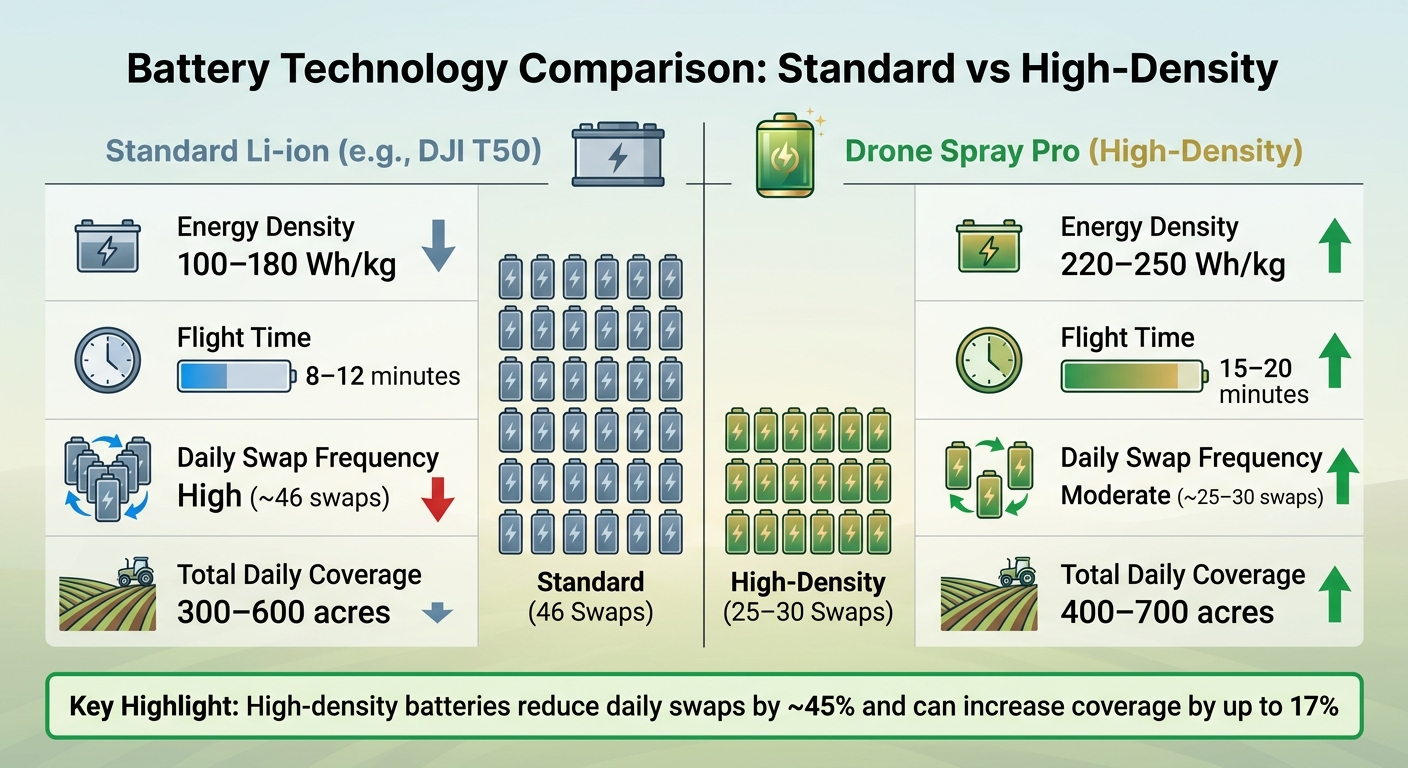
Agricultural Drone Battery Performance Comparison: Standard vs High-Density
Energy density plays a key role in determining your drone's daily efficiency and overall return on investment, especially when paired with battery health metrics.
Energy Density and Flight Time
Measured in watt-hours per kilogram (Wh/kg), energy density indicates how much power a battery can store relative to its weight. This directly impacts how long your drone can stay in the air on a single charge. For agricultural spray drones, higher energy density means longer flight times, fewer battery swaps, and more acres covered before needing to return for a recharge.
Currently, lithium-based batteries offer energy densities in the range of 150–250 Wh/kg [4]. For instance, the DJI Agras T50 delivers around 8 minutes of flight time per charge with these batteries [3]. While 8 minutes may seem brief, it allows the drone to cover 40 to 60 acres within an hour of operation [3]. Each battery swap takes about 3 minutes [3].
Improving energy density could significantly boost productivity. Longer flight times mean fewer interruptions for battery changes, which is especially valuable during intensive 10-hour spray days. Under current conditions, a DJI Agras T50 might require up to 46 battery swaps in a single day [3]. With higher-density batteries, that number could be cut nearly in half, saving both time and effort.
Energy Density Comparison Table
The table below highlights the differences between standard and high-density batteries in terms of flight time, swap frequency, and daily field coverage. Standard lithium-ion batteries, like those used in the T50, typically fall between 100–180 Wh/kg [4], leading to frequent battery swaps. On the other hand, high-density batteries, such as those offered by Drone Spray Pro, achieve 220–250 Wh/kg [4]. This results in extended flight times of 15–20 minutes and a marked reduction in swap frequency.
| Battery Technology | Energy Density (System) | Est. Flight Time | Daily Swap Frequency | Total Daily Coverage |
|---|---|---|---|---|
| Standard Li-ion (e.g., T50) | 100–180 Wh/kg [4] | 8–12 mins [3] | High (~46 swaps) [3] | 300–600 acres [3] |
| Drone Spray Pro (High-Density) | 220–250 Wh/kg [4] | 15–20 mins | Moderate (~25–30 swaps) | 400–700 acres |
To keep your DJI Agras T50 running efficiently, it's crucial to have 4 to 6 batteries on rotation with a rapid charging system [3]. This ensures the drone stays operational while other batteries are recharging, preventing downtime caused by mismatched charge and flight times. Opting for high-density batteries and advanced charging hubs can further enhance your drone's daily field coverage.
Temperature Management for Battery Life
Excessive heat can wreak havoc on agricultural drone batteries, cutting down their power, lifespan, and safety. Knowing how temperature impacts your batteries is key to protecting them and ensuring your equipment performs reliably.
Safe Operating Temperature Ranges
Most drone batteries are designed to function within a temperature range of 32°F to 104°F (0°C to 40°C). However, spraying operations often push these limits. When the air temperature exceeds 104°F (40°C), thermal throttling can kick in, reducing available power by as much as 35%, even when the battery appears fully charged [5].
"Ambient temperatures above 40°C create three critical failure modes in agricultural drones: Battery thermal throttling reduces available power by up to 35%, motor efficiency degradation increases current draw and heat generation, and GPS receiver drift from thermal expansion of antenna components." - DJI Agras T50 Guide [5]
The real insight comes from checking the battery's surface temperature after landing. A battery that feels warm - around 95–113°F (35–45°C) - is normal after a demanding flight. But if the temperature exceeds 131°F (55°C), the battery is under severe stress, which can drastically shorten its lifespan [6]. A helpful rule of thumb: if the battery is too hot to comfortably hold for more than 10 seconds after landing, take it out of service immediately [2].
In a July 2024 study, researchers tested six DJI Agras T50 drones in Arizona, where ground temperatures soared to 117–126°F (47–52°C). Over 200 flight hours per unit showed that the T50's white reflective shell helped internal components stay 14–22°F (8–12°C) cooler than darker models. This design reflected 34% more solar radiation, preventing overheating that often leads to power loss and signal issues [5].
Temperature management isn’t just about operating within safe ranges - it also plays a critical role in how you charge and cycle your batteries.
Cooling Cycles and Downtime Reduction
Never charge a battery immediately after a flight. Hot batteries already retain discharge heat, and combining that with charging heat can cause lasting damage, reducing their capacity over time [6]. Always let the battery cool below 100°F (38°C) before charging. This small adjustment can significantly extend battery life and save you from prematurely replacing costly packs.
To keep operations running smoothly on hot days, rotate a larger set of batteries instead of fast-charging the same ones repeatedly. Store batteries in shaded or climate-controlled spaces until about 10 minutes before use [5]. Some operators use cooler bags lined with insulating towels to keep batteries cool - just avoid direct contact with ice packs to prevent extreme temperature swings [7]. For heavy spray jobs, plan flights for early mornings or late afternoons to dodge peak heat. This approach can cut downtime by 10–15% while safeguarding your batteries [5].
Fast Charging and Downtime Reduction
Today's advanced systems can fully charge heavy-duty agricultural batteries in just 9 to 12 minutes [11]. This speed enables a "two-battery cycle" workflow - while one battery charges, the other is actively in use - allowing uninterrupted field operations and minimizing costly downtime [8].
Fast Charging Benefits
The key to fast charging lies in efficient thermal management. Air-cooled heat sinks push cool air across the battery during charging, ensuring temperatures remain stable and reducing the time spent on the ground [8]. Meanwhile, intelligent battery management systems constantly monitor each cell to prevent damage from excessive heat, current, or voltage during rapid charging cycles [8]. This combination of speed and safety not only reduces downtime but also boosts return on investment (ROI).
Using a high-capacity charger, such as the C10000, alongside an optimized inverter generator, can cut charging costs by up to 20%, saving approximately $0.17 to $0.21 per battery [8]. Additionally, intelligent battery stations with power-adaptive features adjust output to safeguard weaker circuits, ensuring a smooth transition between charging and flight. This setup maximizes field coverage and operational efficiency [9][11]. To complement these benefits, following proper storage practices is essential for maintaining battery performance and extending lifespan.
Storage and Charging Guidelines
Fast charging works best when paired with proper battery storage habits. For long-term performance, store batteries at a charge level of 40–60%, with 40–50% being the ideal range, to slow internal aging [2][10]. Avoid leaving batteries fully charged or completely discharged, as this accelerates wear and reduces lifespan. A healthy storage voltage typically falls between 3.7V and 3.85V per cell [10].
When using batteries, always land with a reserve charge instead of flying until the low-voltage cutoff. This practice significantly extends the battery's cycle life and supports a better ROI [10]. For cold-weather operations, insulated cases can help maintain proper temperatures, and batteries should be warmed up before use. Never charge batteries below 32°F (0°C) to avoid lithium plating, which can damage cells [10]. Rotating between multiple battery packs prevents overheating in any single pack, further extending the overall fleet's lifespan [2]. Lastly, inspect batteries for swelling, dents, or damaged leads before each use to ensure safety during high-current fast charging [10].
Conclusion
Getting the most out of agricultural drone operations hinges on closely monitoring and managing key battery metrics. Factors like State of Charge accuracy, Internal Resistance, and Cycle Life play a crucial role in determining how much productive work each battery can deliver before needing replacement. Neglecting battery maintenance can significantly increase per-flight costs, cutting into long-term profitability.
Temperature control is another critical factor. Operating in cold conditions can speed up battery wear and reduce flight times, potentially slashing ROI by a staggering 30% to 50% [1]. To counteract this, investing in thermal management systems - priced between $100 and $300 - can yield impressive returns, extending battery life from 300 to 450 cycles for a 3:1 return on investment [1]. Simple practices like avoiding charging below 32°F and storing batteries at a voltage range of 3.7V to 3.85V per cell can go a long way in maintaining both performance and profitability [10].
Fast charging is another game-changer, cutting recharge times to just 9–12 minutes [11]. Drone Spray Pro offers tools like the C10000 High-Speed Charger and the Talos T60X - Fly All Day Package. The latter includes a cooling station, intelligent charger, and three flight batteries, enabling seamless, continuous operations. These solutions are designed to help operators maximize uptime and, ultimately, ROI [11].
FAQs
How do I measure SOC accuracy in the field?
To check the accuracy of the State of Charge (SOC) in real-world conditions, rely on the drone’s battery monitoring system. This system keeps track of voltage, current, and capacity in real time. To ensure reliable readings, make sure the battery sensors are properly calibrated, examine the battery’s health frequently, and steer clear of deep discharges. Storing and charging the battery correctly also plays a key role in maintaining dependable SOC data, which supports safer flights, better planning, and efficient operations.
What IR numbers indicate a battery is wearing out?
When a battery's internal resistance (IR) increases beyond typical levels, it’s a clear sign of aging or wear. Higher IR directly impacts the battery’s performance and capacity, showing that it’s losing efficiency. Keeping an eye on IR is critical for assessing the battery’s condition and maintaining its performance over its lifespan.
How many batteries do I need to fly all day?
To keep your drone in the air all day, you'll need several batteries to swap out during operations. Most agricultural drones can fly for about 8–12 minutes on a single charge. A practical approach is to have at least 3–4 batteries on hand. This allows for continuous flight by giving you time to charge and cool down used batteries, ensuring smooth and efficient operations without unnecessary downtime.