Call or Text: +1 (208) 425-2990
Email: Sales@DroneSprayPro.com

DJI Agras Import Guide: U.S. Compliance Tips
Importing DJI Agras drones into the U.S. has become more complicated since December 2025 due to tighter FCC restrictions. These drones, essential for agricultural tasks like crop spraying, face new hurdles, including mandatory FCC authorization, CBP documentation, and compliance with forced labor laws. Here's what you need to know:
- FCC Rules: Only models authorized before December 2025 can legally enter the U.S. Newer drones are restricted unless listed under specific exemptions.
- CBP Requirements: Accurate documentation, including Harmonized System (HS) codes, FCC authorization, and battery safety reports, is mandatory.
- Forced Labor Compliance: Importers must prove their supply chain is free from forced labor, especially for goods sourced from China.
- FAA Registration: Drones over 55 lbs require paper registration and additional certifications for agricultural use, such as a Part 137 certificate.
Failure to meet these requirements can result in shipment delays, penalties, or forfeiture. Proper preparation ensures smooth importation and legal operation of DJI Agras drones in the U.S.
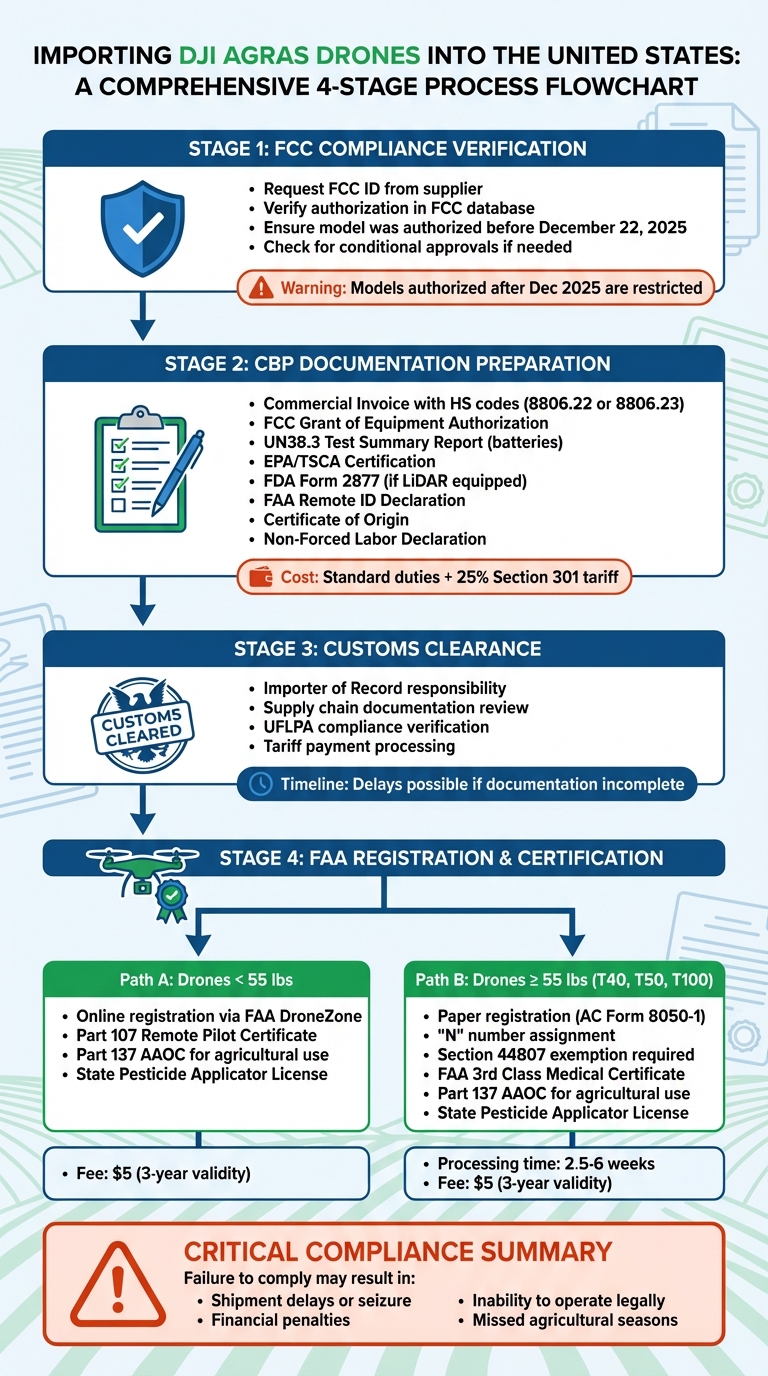
Complete DJI Agras Drone Import Process for U.S. Compliance
Here is the FCC Drone Ban Update
sbb-itb-3b7eef7
FCC Regulations and Drone Import Restrictions
Navigating the import process for drones in the U.S. begins with ensuring compliance with FCC regulations. The Federal Communications Commission (FCC) plays a key role in determining which drones can legally enter the U.S. market. On December 22, 2025, the FCC updated its Covered List to include all foreign-made drones and their critical components [5]. This update directly impacts the import of DJI Agras drones.
What Is the FCC Covered List?
The FCC Covered List is essentially a registry of communications equipment deemed to pose security risks to the United States [5]. The December 2025 update specifically targeted drones and their critical components, such as flight controllers, data transmission systems, navigation equipment, batteries, and motors. Consequently, any new DJI Agras models that did not receive FCC authorization before December 22, 2025 cannot secure the FCC authorization necessary for U.S. market entry. However, models like the DJI Agras T40, T50, T55, and T100 already hold valid FCC authorizations and can still be legally imported, sold, and operated in the U.S.
"Placement on the Covered List prohibits the FCC from issuing new equipment authorizations for covered hardware makers and equipment. In practice, this effectively pauses foreign manufacturers' ability to bring brand-new drone models to the U.S. market." - DroneDeploy [2]
However, the restriction is not retroactive. DJI Agras models that obtained FCC authorization before December 2025 can still be imported, sold, and operated legally. Additionally, a temporary exemption remains in place until January 1, 2027, for drones listed on the Blue UAS Cleared List or those classified as “domestic end products” under the Buy American Standard (48 CFR 25.101(a)).
| Critical Drone Components | Description/Examples |
|---|---|
| Flight Control Systems | Flight controllers and related software |
| Communications | Data transmission devices and communication links |
| Power Systems | Batteries and Battery Management Systems (BMS) |
| Propulsion | Motors and electronic speed controllers |
| Sensing & Navigation | Navigation systems, sensors, and cameras |
| Ground Control | Ground control stations and UAS controllers |
These restrictions highlight the importance of verifying FCC authorization before attempting to import drones.
How to Verify FCC Authorization for Your Drone
Before importing a DJI Agras drone, it’s crucial to confirm its FCC authorization. Start by requesting the FCC ID from your supplier. This unique identifier confirms compliance with U.S. import regulations [6].
Once you have the FCC ID, visit the FCC ID Search database provided by the FCC Office of Engineering and Technology. This tool lets you verify whether a Grant of Certification was issued for the model before the December 2025 cutoff. Additionally, check the FCC’s Supply Chain website for any "Conditional Approvals." For instance, on March 18, 2026, the FCC announced its first Conditional Approvals for four specific UAS systems (SiFly Q12, Mobilicom SkyHopper, ScoutDI Scout 137, and Verge X1), valid through December 31, 2026. This established a pathway for other foreign manufacturers to seek similar exemptions.
It’s also a good idea to confirm with your dealer that the drone model is cleared for sale in the U.S. If the equipment arrives at a U.S. port without proper FCC authorization, it cannot be imported. In such cases, you’ll need to return the equipment to its origin or move it to a bonded warehouse while seeking authorization [6].
"If the equipment is in port and I just learned about FCC requirements... The equipment cannot be imported into the United States. Options to remedy this situation are to return the equipment to the originating port, or obtain a proper equipment authorization." - Federal Communications Commission [6]
CBP Import Requirements and Compliance
After securing FCC authorization, the next step is dealing with U.S. Customs and Border Protection (CBP). Importing DJI Agras drones requires meticulous attention to documentation and adherence to forced labor regulations. A single missing document can leave your shipment stuck at the port indefinitely, so precision is key.
Required Documentation for Importing DJI Agras Drones
CBP demands a thorough set of documents before clearing your drone through customs. The commercial invoice must include accurate descriptions, such as "Unmanned Aircraft for Agricultural Spraying", along with the appropriate Harmonized System (HS) code. Since December 2021, the U.S. has implemented 11 new HTSUS codes for unmanned aircraft systems (UAS). DJI Agras drones fall under HS heading 8806, with the specific subheading depending on maximum takeoff weight. For example, 8806.22 covers drones with a max takeoff weight between 250 g and 7 kg, while heavier agricultural spray drones like the Agras series would fall under higher weight category codes[7].
You'll also need an FCC Grant of Equipment Authorization to confirm compliance with radio frequency standards under Title 47 CFR Part 15. Don’t just rely on supplier-provided PDFs - verify the FCC ID directly in the FCC database [8]. For battery safety, include a UN38.3 Test Summary Report showing the battery passed all eight critical tests (T1–T8), such as altitude simulation and vibration. Lithium batteries over 100Wh require Class 9 Dangerous Goods labeling, while those exceeding 300Wh are generally prohibited on passenger flights [8].
Other required documents include:
- EPA/TSCA Certification: Confirms compliance with the Toxic Substances Control Act.
- Form FDA 2877: Necessary if the drone uses LiDAR or laser-based obstacle avoidance systems.
- FAA Declaration of Compliance: Verifies adherence to Remote ID standards (Part 89) for legal operation in U.S. airspace.
- Certificate of Origin: Determines applicable duty rates.
Keep in mind that drones imported from China are subject to standard import duties plus Section 301 tariffs. As of 2025, additional reciprocal tariffs have been applied, and the combined duty on Chinese-made drones may be significantly higher than 25%. Check current tariff schedules before importing, as rates have changed multiple times [7][1].
"It is an importer’s responsibility to know how their goods are made, from raw materials to finished goods, by whom, where, and under what labor conditions."
- Jennifer Diaz, President, Diaz Trade Law [7]
This extensive documentation ensures compliance with both FCC and FAA regulations, while also meeting CBP’s requirements.
Forced Labor Compliance Rules
Compliance with forced labor regulations is another critical aspect. The Uyghur Forced Labor Prevention Act (UFLPA) assumes that goods made "wholly or in part" in China’s Xinjiang region involve forced labor and are therefore barred from entry into the U.S. [7]. As the Importer of Record, you’re responsible for exercising "reasonable care" to confirm that your supply chain is free from forced labor, covering everything from raw materials to finished products.
CBP has intensified its scrutiny of Chinese-made drones, and some DJI shipments have faced delays as compliance is reviewed. While DJI is not currently listed under the UFLPA Entity List, newer models have occasionally been held up at the border. DJI asserts that its manufacturing occurs in Shenzhen, China, or Malaysia, and states:
"DJI does not manufacture anything – in whole or in part – in Xinjiang. DJI has no manufacturing facilities in Xinjiang, nor do we source materials from the region" [3].
To address CBP’s concerns, provide clear evidence such as a Non‑Forced Labor Declaration or a detailed supply chain map. DJI claims its supply chain is audited by reputable U.S. retailers and that it holds ISO 45001 certification for occupational health and safety standards [3]. Maintain thorough records of manufacturing locations and raw material sources, as forced labor accounts for an estimated $150 billion in global trade annually, affecting over 40 million people worldwide [7].
For detained shipments, consulting customs attorneys or trade experts can make a significant difference. As one industry professional noted:
"Missing a single document can leave your valuable shipment stranded at Long Beach indefinitely, causing missed spraying seasons and financial loss."
FAA Registration and Agricultural Drone Operation Rules
Once your drone has cleared customs and FCC verification, the final steps involve FAA registration and obtaining the necessary certifications for operation. These steps are crucial for ensuring compliance with U.S. regulations.
How to Register DJI Agras Drones with the FAA
Before using your DJI Agras drone for agricultural purposes, it must be registered with the FAA. The registration process depends on the drone's weight:
- Drones under 55 lbs (including payload): Register online via the FAA DroneZone portal.
- Drones over 55 lbs: These require paper registration through the FAA Aircraft Registration Branch.
For example, the DJI Agras T40, T50, and T100 models all exceed 55 lbs, with maximum takeoff weights of approximately 198 lbs (90 kg) for the T40, 202 lbs (92 kg) for the T50, and 386 lbs (175 kg) for the T100 when configured for spraying[11]. To register these heavier drones, you'll need to submit the following by mail:
- Original AC Form 8050-1 (Aircraft Registration Application)
- A notarized Affidavit of Ownership
- A Bill of Sale
- A $5 check or money order payable to the Federal Aviation Administration
Processing times for paper registration can range from 2.5 to 6 weeks. Before submitting your application, locate your drone's Remote ID, typically found in the remote controller under "Device Management" (it usually starts with "1581F") [9].
Eligibility Requirements
Only U.S. citizens, legal permanent residents, or U.S.-based corporations (with at least 75% voting interest owned by U.S. citizens) can register drones [11]. If registering under an LLC, you must provide documentation proving compliance with U.S. citizenship requirements.
"Owner is NOT an acceptable title for the FAA. Enter a title [such as] Director, President, Vice President, CEO, COO, [or] Manager."
Once your registration is approved, the FAA will issue a registration number ("N" number for drones over 55 lbs). This number must be visibly displayed on the drone's frame or near the tank. The $5 registration fee covers three years [9]. Additionally, federal law requires you to carry your registration certificate and present it to law enforcement upon request [9].
With registration complete and your "N" number in place, the next step is ensuring compliance with FAA operational and safety rules.
FAA Rules for Agricultural Drone Operations
Registering your drone is just the beginning. To legally conduct crop spraying or any agricultural application, you must obtain a Part 137 Agricultural Aircraft Operator Certificate (AAOC) [10]. This certification is required for applying pesticides, fertilizers, or even disinfectants, as these are classified as "economic poisons" under Part 137.
Steps to Obtain an AAOC
- Submit FAA Form 8710-3 to UAS137Certificates@faa.gov.
- If your drone weighs over 55 lbs, secure a Section 44807 exemption and reference it in your AAOC application.
- Ensure the pilot holds a Part 107 Remote Pilot Certificate.
- For drones 55 lbs or heavier, the pilot must also obtain an FAA 3rd Class Medical Certificate [4].
| Requirement | Drones < 55 lbs | Drones ≥ 55 lbs |
|---|---|---|
| Registration Method | Online via FAA DroneZone | Paper Mail (AC Form 8050-1) |
| Identification | FAA Registration Number | "N" Number |
| Primary Regulation | 14 CFR Part 107 & Part 137 | 14 CFR Part 91 & Part 137 |
| Medical Certificate | Not required | FAA 3rd Class Medical |
| Registration Fee | $5.00 | $5.00 |
Additional Requirements
You must also obtain a State Pesticide Applicator License for the state where you intend to operate [4]. Each state has its own licensing process, so be sure to research and comply with local regulations.
The FAA has noted instances of noncompliance among exemption holders conducting agricultural operations. This highlights the importance of adhering to all certification requirements [10].
Finally, all registered drones must meet Remote Identification (Remote ID) standards, which allow the FAA and law enforcement to identify drones during flight [9]. For agricultural operations, ensure compliance with Part 107.36 exemptions for hazardous materials (for drones under 55 lbs) or Part 91 requirements for heavier models [10].
Step-by-Step Guide to Importing DJI Agras Drones
Sourcing DJI Agras Drones from Authorized Suppliers
The first step in importing DJI Agras drones is ensuring you source them from authorized suppliers. Start by verifying the supplier's FCC Grant of Equipment Authorization. Cross-check the FCC ID in the official database to confirm compliance. Don’t rely on "CE" markings alone, as U.S. Customs does not accept them. Additionally, confirm that the drone has an FAA-accepted Declaration of Compliance for Remote ID. For the lithium batteries - classified as Class 9 dangerous goods - obtain a UN38.3 Test Summary Report and a Safety Data Sheet (SDS). Partnering with authorized suppliers, such as Drone Spray Pro, can help ensure you receive all necessary documentation and minimize customs-related delays. Once supplier compliance is verified, you can proceed to prepare for shipping.
Proper Packaging and Shipping Documentation
With supplier compliance confirmed, turn your attention to accurate packaging and documentation. Use the correct HS codes on your commercial invoice. For example, 8806.21 applies to drones under 250 g, while 8806.22 covers drones between 250 g and 7 kg. Agricultural spray drones like the Agras series, which far exceed 7 kg, fall under higher weight category codes. Label the shipment as "Unmanned Aircraft for Agricultural Spraying" to reduce the likelihood of manual inspections. If the drone includes LiDAR or laser sensors, make sure to include FDA Form 2877 with its Accession Number and complete a Toxic Substances Control Act (TSCA) certification to confirm EPA compliance. Avoid mislabeling lithium batteries as "plastic parts", as this could lead to severe legal penalties. Always ensure all battery-related documentation is original and complete before shipping.
Clearing Customs and Final Delivery
Once your shipment is packaged and documented correctly, the next hurdle is clearing customs. As the Importer of Record, you are responsible for classifying goods accurately, determining their value, and meeting all legal requirements. Be aware of Section 301 tariffs on drones imported from China. As of 2025, combined tariff rates may significantly exceed 25% due to additional reciprocal tariffs. Verify current rates before importing. Additionally, under the Uyghur Forced Labor Prevention Act, you may need to provide supply chain tracing documentation or a Non-Forced Labor Declaration to clear your shipment.
"If an Importer of Record can demonstrate by clear and convincing evidence that the goods in question were not produced wholly or in part by forced labor the Commissioner of CBP may grant an exception to the presumption."
- Jennifer Diaz, President, Diaz Trade Law
To address potential forced labor concerns, maintain detailed records of manufacturing locations and supporting certifications. After clearing customs, complete the FAA registration process and set up the drone for operational use.
Conclusion
Importing DJI Agras drones involves several key steps: ensuring FCC compliance, obtaining proper CBP documentation (including accurate HTSUS classification), and adhering to forced labor standards. Additionally, you'll need to factor in Section 301 and reciprocal tariffs on drones manufactured in China, which may significantly exceed 25% under current trade policy and maintain transparent supply chain records.
"If you are the importer of record, it is your duty to exercise 'reasonable care' in meeting these obligations" [1].
Getting the valuation, classification, and documentation right is crucial to avoid penalties or even shipment seizures.
After clearing customs, the focus shifts to FAA requirements. Registering the drone and obtaining the necessary operational licenses are essential. For heavy drones like the DJI Agras T100, a Section 44807 exemption is mandatory. Pilots must also secure both Part 107 and Part 137 certifications to legally conduct crop-spraying operations [4]. These steps ensure compliance and set the stage for efficient drone use compared to traditional crop dusting.
For those navigating this process, Drone Spray Pro provides end-to-end support. From sourcing FCC-compliant equipment to assisting with FAA licensing and offering practical operational training, their team - composed of experienced farmers - delivers hands-on expertise to help you meet all U.S. requirements for agricultural drone operations.
FAQs
How do I know if my DJI Agras model can still be imported after December 2025?
DJI Agras models that received approval before the FCC's new regulations will still be allowed for import, sale, and operation in the U.S. beyond December 2025. These existing approvals will remain valid indefinitely under the current guidelines.
What paperwork should I have ready to avoid CBP delays or a detention?
If you're planning to import a DJI Agras drone, it's crucial to take a few steps to avoid delays or even detention by U.S. Customs and Border Protection (CBP). Here’s what you’ll need to have in order:
- Customs Documentation: Ensure all paperwork complies with U.S. import regulations. Missing or incorrect documentation can cause significant setbacks.
- Product Classification: Properly classify the drone under the Harmonized Tariff Schedule of the U.S. (HTSUS). This ensures accurate tariff assessments and avoids unnecessary complications.
- Regulatory Compliance Proof: Provide evidence that the drone meets federal regulations, including any necessary permits.
- FAA Registration: If the drone weighs more than 55 lbs, it must be registered with the Federal Aviation Administration (FAA).
Taking these steps ahead of time can make the import process much smoother.
What extra FAA steps do I need to legally spray crops with an Agras drone?
To legally use an Agras drone for crop spraying in the U.S., you must have a Part 107 Remote Pilot Certificate and an Agricultural Aircraft Operator Certificate (AAOC). If the drone weighs more than 55 pounds, you'll also need an FAA Section 44807 exemption. Beyond federal requirements, make sure to register your drone, adhere to safety guidelines, and secure any state-specific licenses, such as a pesticide applicator’s license. These measures ensure you stay compliant with FAA rules.
