Call or Text: +1 (208) 425-2990
Email: Sales@DroneSprayPro.com

Complete Ag Drone Tariff Guide: Everything You Need to Know, Not Just DJI
If you're buying an agricultural drone in 2026, tariffs and regulations are reshaping the market. Chinese-made drones currently face a 25% Section 301 tariff, plus a 10% Section 122 surcharge that may or may not apply depending on classification. The Section 122 surcharge is temporary and expires July 24, 2026 and the FCC has added DJI to its Covered List, blocking imports of new DJI models into the US. While prices haven't spiked dramatically yet, supply is tightening and further tariff increases are under active investigation. American and European-made alternatives like Ceres Air, Hylio, and ABZ Innovation face significantly lower tariff exposure and zero FCC restrictions.
Key highlights:
- New FCC rules (Dec 2025) ban approval of foreign-made drones and critical parts.
- Section 122 tariffs (Feb 2026) add a 10% global duty (15% announced but not yet implemented as of March 25th), except for Canada and Mexico.
- Supreme Court rulings (Feb 2026) struck down some tariffs, but others remain active.
To manage costs, consider pre-made drone packages, timing purchases strategically, and using tariff exemptions like the USMCA or "Blue UAS Cleared List." Accurate import cost calculations using HTS codes and sourcing from non-Chinese manufacturers can also help reduce expenses.
Navigating these tariffs is critical for keeping drone investments manageable and news has been changing frequently, making tariffs a moving target.
Ag drone leader responds to FCC ban on new foreign-made drones
sbb-itb-3b7eef7
U.S. Tariff Policies on Agricultural Drones
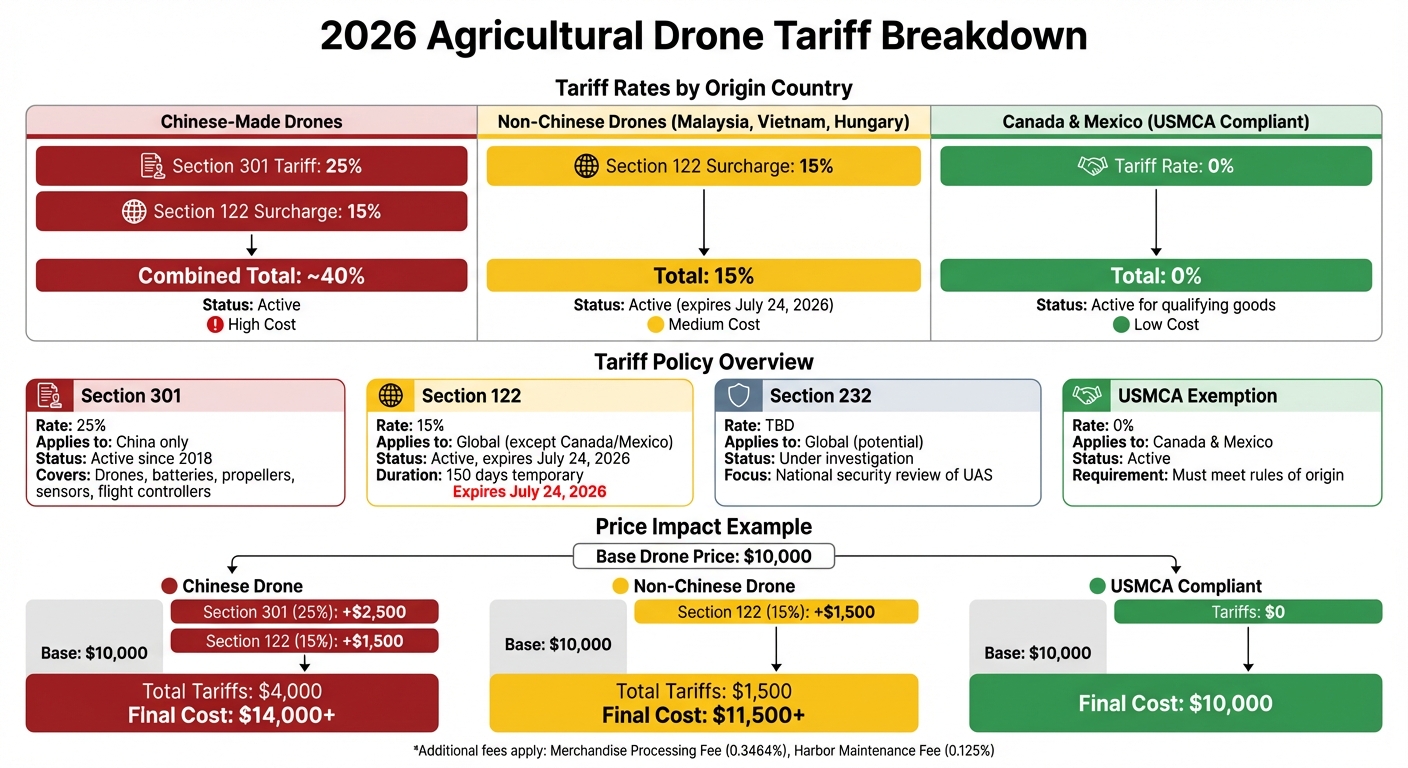
2026 Agricultural Drone Tariff Rates by Country and Policy
In February 2026, the Supreme Court invalidated the use of the International Emergency Economic Powers Act (IEEPA) for imposing tariffs. This decision struck down reciprocal tariffs that had reached 125% and a 10% fentanyl-related surcharge, both of which had driven Chinese drone prices to record highs in 2025. To maintain import duties, the administration turned to Section 122 of the Trade Act of 1974, ensuring tariffs continued to elevate drone costs. Below, we break down the key tariffs affecting Chinese imports, additional surcharges, and policies impacting drones from other countries - essential details for calculating the total cost of drones.
Section 301 Tariffs on Chinese Imports
Since 2018, a 25% Section 301 tariff has applied to Chinese-made drones and their components, including batteries, propellers, sensors, and flight controllers [8]. While other electronics like smartphones and laptops received exemptions in 2025, drones remained excluded due to national security concerns and the Department of Defense's 2024 ban on DJI products [2][3]. This means even replacement parts and accessories are subject to the 25% duty.
The American Soybean Association has voiced concerns about these restrictions, emphasizing the challenges they pose for farmers:
sudden restrictions on their use without available domestically manufactured alternatives risk adding new financial and operational burdens for farmers already facing tight margins and market uncertainty [9].
Section 122 Surcharges
On February 24, 2026, a new 10% duty under Section 122 was introduced to address balance-of-payments deficits. President Trump announced an increase to 15% via Truth Social on February 21, and Treasury Secretary Bessent reiterated this on March 4, but no formal executive order has been issued and CBP is currently collecting at the 10% rate [8]. Unlike Section 301 tariffs, which specifically target Chinese imports, Section 122 applies globally but exempts goods from Canada and Mexico that comply with the USMCA. The surcharge is temporary, set to expire on July 24, 2026, after 150 days [10]. These surcharges stack with existing tariffs, meaning Chinese drones could face a combined duty of about 35% (25% from Section 301 plus 10% from Section 122). Note that drone codes under HS heading 8806 were added to the Section 122 Annex II "Aircraft" scoped exemption list, but this exemption only applies when entered as civil aircraft components, which agricultural spray drones typically are not. Importers should consult a licensed customs broker for their specific classification.
Tariffs on Drones from Other Countries
For drones manufactured outside China, the tariff structure is generally less complex. Brands from countries like Malaysia, Vietnam, or Hungary are subject only to the 10% Section 122 surcharge (15% announced but not yet implemented)[8]. However, the Department of Commerce is currently investigating the national security implications of Unmanned Aircraft Systems (UAS) under Section 232. This review could lead to additional global tariffs, potentially impacting all drone imports. For now, non-Chinese drones are only subject to the 10% surcharge, but the outcome of the Section 232 investigation could change this.
| Tariff Policy | Rate | Origin Country | Status |
|---|---|---|---|
| Section 301 | 25% | China | Active |
| Section 122 | 10% (15% announced, not yet implemented) | Global (Excluding Canada/Mexico) | Active (expires July 24, 2026) |
| Section 232 | TBD | Global | Pending Investigation |
| USMCA Exemption | 0% | Canada, Mexico | Active for qualifying goods |
Next, we’ll look at ways to manage these tariff costs effectively.
How to Reduce Tariff Costs
With rising tariffs driving up drone prices, finding ways to cut these costs is crucial for farmers and agribusinesses. Below are practical strategies to help manage these expenses without disrupting operations.
Buy Pre-Made Drone Packages
Opting for complete drone packages can save money compared to buying individual components. These bundles typically include the drone, batteries, chargers, and other essential accessories. By purchasing everything together, you can minimize the overall impact of tariffs. For instance, Drone Spray Pro offers ready-to-fly systems tailored for agricultural needs, making it easier to comply with tariff regulations while ensuring you have all the necessary equipment from the start. This approach also helps avoid future price hikes on accessories like batteries and propellers, which are subject to the same high tariffs as drones [4][7].
Plan Your Purchase Timing
Timing your purchase wisely can lead to significant savings. Retailers like Amazon and B&H often maintain pre-tariff pricing longer than manufacturers' websites [4]. Additionally, keep an eye out for retroactive exemption periods. For example, goods shipped by April 5, 2025, qualified for certain duty exemptions [2]. Some operators are even stockpiling spare equipment to guard against potential tariff increases and supply chain disruptions [6]. If you're planning to use drones for commercial spray operations, remember that FAA certifications take six to seven months and require the drone's serial number to begin the process. Buying well ahead of the spray season is essential [14].
Find and Use Tariff Exemptions
Taking advantage of exemptions can further reduce costs. Temporary exemptions exist for drones listed on the Defense Contract Management Agency's "Blue UAS Cleared List" and for products classified as domestic end products under the Buy American Standard, which requires at least 65% U.S.-made components. These exemptions, established by the FCC as of January 7, 2026, can eliminate tariff burdens for qualifying models [13].
Certain foreign-made drones from companies like Parrot, Teledyne FLIR, Neros Technologies, Wingtra, Auterion, ModalAI, Zepher Flight Labs, and AeroVironment are also exempt from import bans through December 31, 2026 [9]. Additionally, drones from Canada and Mexico that meet USMCA standards are free from Section 122 surcharges. A Supreme Court ruling on February 20, 2026, declared some IEEPA-based tariffs unconstitutional, potentially allowing importers to claim refunds for previously paid duties [11]. On a state level, programs like Connecticut’s Farm Transition Grant offer matching funds of up to $50,000 to support agricultural investments [1].
Calculating Total Import Costs
Understanding the complete landed cost is crucial to avoid unexpected expenses. The price you see online often excludes tariffs, fees, and shipping, which can significantly inflate the total. Misclassifying goods can also lead to penalties, so accuracy is key.
How to Use HTS Codes for Drones
To calculate your drone's total import cost, start with the Harmonized Tariff Schedule (HTS). This system uses a 10-digit code to determine duty rates for imported goods. The first six digits align with the international Harmonized System, while the last four are specific to U.S. trade data [18][19]. Since 2022, drones have been assigned 11 distinct HTS classifications. For complex systems, consulting a licensed customs broker is recommended to avoid errors [12][15].
To identify your drone's HTS code, use the U.S. International Trade Commission's online search tool. Begin with Chapter 88 (Aircraft) and refine your search to the 10-digit level based on the drone's function and components. Be sure to review the Section and Chapter Notes for any specific inclusions or exclusions [18][20].
"It is an importers responsibility to know how their goods are made, from raw materials to finished goods, by whom, where, and under what labor conditions." – Jennifer Diaz, Diaz Trade Law [12]
Once you have the correct HTS code, you can calculate the associated duties and fees.
Calculate Your Landed Cost
The total import cost includes much more than the purchase price. Starting February 24, 2026, all imports will be subject to a 10% Section 122 global tariff [16]. Additionally, drones made in China face a 25% Section 301 surcharge on the base rate [12]. Other fees include the Merchandise Processing Fee (0.3464% of the cargo value) and the Harbor Maintenance Fee (0.125%) for ocean freight shipments [15].
For instance, importing a Chinese agricultural drone priced at $10,000 would result in at least $2,500 in Section 301 duties, plus potentially $1,000 in Section 122 surcharges (if applicable to your classification), excluding standard fees and shipping costs [16][12]. Don't forget to factor in international freight, insurance, and customs broker fees, especially for complex imports. Furthermore, the suspension of the Section 321 "de minimis" exemption on August 29, 2025, now subjects even small drone parts valued under $800 to full duties [17].
Next, we’ll look at ways to reduce these costs.
Ways to Lower Your Tariff Costs
One way to lower costs is by sourcing drones from countries with Free Trade Agreements (FTAs). For example, drones from Mexico or Canada that meet the USMCA "rules of origin" requirements may qualify for a 0% duty rate [16][17]. Use the "Special" sub-column in the HTS lookup to verify trade agreement eligibility [19][20].
For temporary imports, consider using a Temporary Importation under Bond (TIB) or an ATA Carnet to avoid permanent duties [17]. If you're uncertain about classification, you can request a legally binding written decision from CBP to ensure accuracy and avoid disputes down the line [18][20]. These strategies, combined with proper HTS code usage and landed cost calculations, can help reduce your overall import expenses.
Conclusion
Managing ag drone tariffs effectively is key to keeping costs under control. With Chinese-made drones facing combined tariffs of 25-35%, costs add up significantly. A $40,000 system could cost $54,000 or more after duties, fees, and shipping [3][5][2]. This makes precise classification and thoughtful sourcing more important than ever, as outlined earlier.
To navigate this complex terrain, it's essential to focus on accurate HTS code classification, meticulous landed cost calculations, and strategic sourcing. As Jennifer Diaz, a Customs and International Trade Attorney, emphasizes:
Exercising reasonable care in the import process is not just a best practice - it's a necessity to ensure compliance with U.S. Customs regulations [12].
Missteps in classification could result in significant penalties from U.S. Customs and Border Protection (CBP).
Pre-assembled drone packages offer a straightforward solution by bundling landed costs for airframes and necessary accessories, all of which are subject to varying tariffs [21]. Opting for complete packages from dealer inventories ensures fixed pricing for equipment that has already cleared customs, protecting buyers from the uncertainties of shifting tariff rates and evolving regulations [6][1]. These ready-made options align with the practical strategies explored earlier in this guide.
For example, Drone Spray Pro's ready-to-fly packages eliminate the hassle of calculating separate landed costs for components sourced from different countries. This approach also helps shield buyers from potential supply chain disruptions, offering a simpler and more reliable path forward.
FAQs
What tariff rate will my ag drone actually pay at the border?
It depends on where the drone is manufactured.
Chinese-made drones (DJI, XAG, EAVision): 25% Section 301 tariff, plus potentially 10% Section 122 surcharge (depending on classification). The Section 122 surcharge is temporary and expires July 24, 2026. Additional tariff increases are under investigation but not yet in effect. Note: DJI is also on the FCC Covered List, which blocks imports of new DJI models regardless of tariffs.
American-made drones (Hylio, Ceres Air): 0% tariff. Domestically manufactured, no import duties apply.
European-made drones (ABZ Innovation): Potentially 10% Section 122 only (depending on classification). No Section 301 exposure. FCC-exempt through 2026. The Section 122 surcharge expires July 24, 2026.
Tariff rates on Chinese goods are a moving target right now. The numbers above reflect what's confirmed and active as of March 2026. We may update this page as the situation changes, but if the date is far past, check more recent sources.
How can I tell if a drone qualifies for USMCA or other exemptions?
To figure out if a drone qualifies for USMCA or other tariff exemptions, start by reviewing the rules of origin and compliance requirements outlined in the USMCA guidelines. You'll need to confirm that the drone is manufactured in one of the USMCA member countries and that it meets the necessary production standards. Carefully verify that all criteria are satisfied to ensure eligibility for these exemptions.
What costs besides tariffs should I include in my landed cost?
When calculating the total landed cost of importing agricultural drones, don’t just stop at tariffs. You’ll also need to factor in freight charges, customs brokerage fees, compliance costs, and other related expenses. These additional costs can add up quickly and have a noticeable impact on the final price. Make sure to include all of these when planning your budget.
