Call or Text: +1 (208) 425-2990
Email: Sales@DroneSprayPro.com

Part 137 Documents for Ag Drone Approval
If you plan to spray by drone for hire in the U.S., you will usually need both Part 107 and a Part 137 certificate. And if your drone (like the DJI Agras T50) is over 55 lb, you will also need a Section 44807 exemption. Miss one document, use the wrong business name, or leave out your chemical-handling steps, and your FAA file can stall for 3 to 6 months.
Here’s the short version: I’d treat this as a document stack with 5 parts you need to line up before you apply and keep after approval:
- Application file: FAA Form 8710-3, business ID documents, and a physical address
- FAA support documents: Section 44807 file if the drone is over 55 lb, plus the Applicant Readiness Checklist
- Pilot records: Part 107 certificate, photo ID, and ALC-677 recurrent training every 24 calendar months
- Aircraft and manual records: registration, serial numbers, maintenance logs, and an operations manual with spill, loss-of-link, and disposal steps
- Post-approval logs: flight logs, spray records, incident reports, training currency, and manual revision history
A few points matter more than most:
- The legal name on your FAA forms must match your exemption and business records
- A P.O. Box is not enough for the main business address
- Each drone, such as the ABZ L30, should be listed on its own with the right registration and serial details
- Your manual should spell out how you handle chemicals, spills, and used containers
- State pesticide rules are separate from FAA approval, so you may need both sets of records
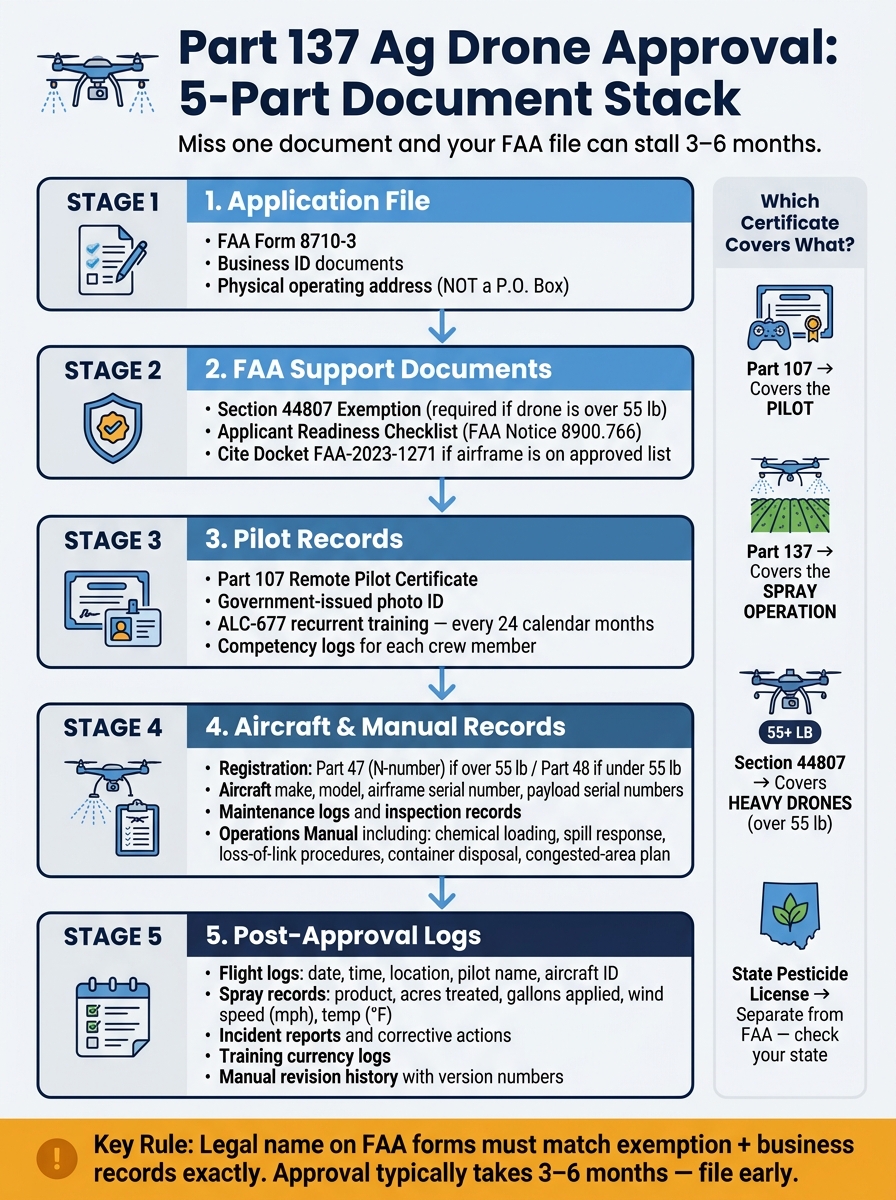
Part 137 Drone Approval: 5-Step Document Stack for Agricultural Spraying
Big Agricultural Drones and the Documents You Need to Get Your FAA Part 137 Exemption

sbb-itb-3b7eef7
Quick Comparison
| Item | When You Need It | What to Watch |
|---|---|---|
| Part 107 | For the pilot flying the drone | Pilot certificate and recurrent training must be current |
| Part 137 | For applying seed or chemicals by aircraft | Needed for spray work for hire |
| Section 44807 | If the drone is over 55 lb | Include exemption number and full file |
| Applicant Readiness Checklist | Before FAA certification moves ahead | Missing it can stop progress |
| State pesticide license | Based on state law and spray work | Separate from FAA approval |
In other words: Part 107 covers the pilot, Part 137 covers the application work, and 44807 covers heavy drones. If I were putting a file together, I’d first check names, addresses, aircraft IDs, exemption numbers, and manual procedures before sending anything to the FAA.
Core Application Documents for a Part 137 File
Build your Part 137 file around three main pieces: the application form, exemption support, and the FAA’s readiness paperwork.
FAA Application Form and Business Identification Documents
Start with FAA Form 8710-3. Pair it with your business ID documents and a physical operating address. Then send the full package by email to UAS137Certificates@faa.gov. Since June 2023, UAS-only Part 137 applications have gone through the centralized 137 UAS Operations Office (AFS-700), not local FSDOs. [1]
Your business identity documents need to match what appears on Form 8710-3. Use a physical business address, not a P.O. Box. If you formed an LLC, include the entity documents and make sure the business name stays the same across the full package. Even small name mismatches can slow things down. [1]
Exemption, Waiver, and Authorization References
If your drone weighs more than 55 lb, include a Section 44807 exemption in the Part 137 package. [1] That exemption also waives Section 107.36, which would otherwise bar carrying hazardous materials on a drone. Add the exact exemption number and attach the full exemption file with your submission. [1]
The FAA also keeps an approved agricultural UAS list under Docket FAA-2023-1271. If your airframe appears on that list, cite it in the package. [1]
Here’s the core submission checklist:
| Document | What to Include |
|---|---|
| FAA Form 8710-3 | Signed application with physical address |
| Section 44807 Exemption | Exemption number and full file |
| Applicant Readiness Checklist | Completed per FAA Notice 8900.766 |
Pre-Submission Review Checklist
Since January 24, 2024, the FAA has required applicants to complete a mandatory Applicant Readiness Checklist under FAA Notice 8900.766 before the file can enter Phase 3 of certification. [1] Fill it out before you submit. Without it, the FAA won’t move the file ahead.
Before you send the package, check a few details:
- The legal name on Form 8710-3 matches the exemption holder name exactly
- The address is a physical location
- The aircraft make, model, and N-number are listed
- The exemption number is clearly cited
- The operations manual includes chemical-handling and container-disposal procedures
Missing chemical-handling procedures often trigger an RFI, and missed deadlines can stop approval. [1] The process usually takes three to six months, so it pays to catch these issues up front. [1]
The next section covers the pilot, aircraft, and manual records the FAA will review after the core file is complete.
Pilot, Aircraft, and Manual Documents the FAA Will Review
Once the core application file is in, the FAA turns to three things: pilot records, aircraft records, and your operations manual. If any of those pieces are missing or thin, the review can stall.
Pilot Certificates, Photo ID, and Training Records
For each pilot, include a Part 107 Remote Pilot Certificate, a government photo ID, and the current FAA recurrent training record. To stay current, pilots need to complete Course ALC-677 on FAASafety.gov every 24 calendar months.[1]
You should also include competency records for each pilot and crew member. That means internal training logs plus any documented Part 137 knowledge or training records. The FAA checks these during certification, so it helps to have them clean and easy to follow.
Aircraft Registration, Serial Numbers, and Maintenance Records
List each drone separately. That lets the FAA match the registration, serial numbers, and spray setup to the right aircraft without guesswork.
Here’s how registration works:
- Drones over 55 lb register under 14 CFR Part 47 and get an N-number
- Drones under 55 lb go through the Part 48 process
Include the aircraft make and model, the airframe serial number, and the spray payload serial numbers. If the aircraft is over 55 lb, add the Section 44807 Exemption reference. You should also note any airframe listed in Docket FAA-2023-1271.
Your maintenance file should show how the aircraft is being kept in service. That usually includes the manufacturer's maintenance instructions, inspection logs, and records for any configuration changes that affect spray work.
| Document Category | What to Include |
|---|---|
| Registration | FAA Form 8050-1, N-number (Part 47) or Part 48 registration |
| Identification | Aircraft make, model, serial number; payload serial numbers |
| Authorization | Section 44807 Exemption number (UAS over 55 lb) |
| Maintenance | Manufacturer manuals, inspection logs, configuration change records |
Operations Manual, SOPs, and Emergency Procedures
The operations manual is the backbone of your Part 137 submission. It shows the FAA how your company plans to run agricultural spray missions from preflight through shutdown.
This is where your written preflight and post-flight checklists should live. Add your procedures for chemical loading, container disposal, and crew briefings too. The FAA also wants written steps for loss-of-link response and chemical spill response. If you plan to work within 300 meters of a congested area, include a Congested-Area Plan.
These procedures don’t just support the application. They also become the starting point for your recordkeeping after approval. That’s why it pays to keep them current and usable in day-to-day work, not just filed away for review.
Recordkeeping Documents to Maintain After Approval
Once you're approved, the paperwork doesn't stop. You need the same level of discipline in day-to-day work. After approval, the FAA and state agriculture departments can inspect your records.
Flight Logs and Spray Application Records
Keep a written record for every mission. Each entry should include the date, time, and location of the operation, the pilot's name, and the aircraft ID or N-number.
For spray missions, add the product applied, total acres treated, gallons applied, and weather details: wind speed (mph) and temperature (°F) when the label, FAA rules, or state law requires them.
State rules can add more fields. California and Texas, for example, may set their own recordkeeping rules for commercial pesticide applicators. Check your state's agriculture department rules before you lock in your log format.
| Record Category | Required Data Points |
|---|---|
| Flight Logs | Date, time, location, pilot name, aircraft ID/N-number |
| Spray Records | Product name, acres treated, gallons applied, wind speed (mph), temp (°F) |
| Active Compliance Files | Incident reports, corrective actions, Operations Manual version history, chemical-handling procedure updates |
| Maintenance | Serial numbers, repair descriptions, component replacements, inspection dates |
| Training Currency Logs | Part 107 recurrent training dates, competency logs, state pesticide applicator license renewals |
Maintenance, Incident, and Document Revision Files
Organize these files by aircraft and by date. That sounds simple, but it saves a lot of trouble when someone asks for a record and needs it fast.
Track every repair, replacement, and inspection by aircraft serial number. If something goes wrong in the field, write an incident report and record the corrective action taken. In plain English: note what happened, then note how you fixed it.
You should also log every update to a manual, SOP, or chemical-handling procedure with a date and version number. Version control helps show that crews are working from the current procedure.
Keep files current, indexed, and ready for inspection.
Master Checklist and Next Steps
Full Document Index by Category
Use this index to check your submission packet and your records after approval at a glance.
| Category | Key Documents | Source | Last Updated |
|---|---|---|---|
| Application Forms | Form 8710-3, FAA Form 8050-1, Applicant Readiness Checklist (FAA Notice 8900.766) | FAA | Pre-submission |
| Exemptions | Section 44807 Grant of Exemption, original petition | FAA | At renewal |
| Pilot Records | Part 107 Remote Pilot Certificate, government-issued photo ID, ALC-677 recurrent training certificate, competency records | FAA / Operator | At each recurrent cycle |
| Aircraft Records | FAA Registration Certificate (N-number), serial numbers, maintenance and repair logs | FAA / Operator | After each repair or inspection |
| Manuals & Procedures | Operations Manual, chemical-handling and container-disposal procedures, emergency/SOP documents, congested-area plan (if applicable) | Operator | Annually or upon change |
| Compliance Logs | Flight logs, spray application records, incident/accident reports, document revision history | Operator | Daily / per operation |
Key Points Before You Apply
Before you submit, check every name, address, and aircraft ID across the full packet. This is one of those small details that can cause a big headache later.
Match the legal name, address, and aircraft IDs across Form 8710-3, the exemption, and registration. Even one mismatch can delay approval.
Use a physical business address on every FAA form. For each aircraft, list the correct serial number and N-number, and make sure those numbers match in your registration, maintenance logs, and insurance policy.
The approval process usually takes three to six months, so file early.
Start flight and spray logs on day one. This is especially critical when operating heavy-lift systems like the ABZ Innovation L30.
FAQs
Do I need Part 137 if I only spray my own property?
Yes. You need Part 137 certification even if you spray only your own property.
Under FAA rules, agricultural aircraft operations that involve economic poisons, including pesticides, herbicides, and fertilizers, require a valid Agricultural Aircraft Operator Certificate. That rule applies whether you spray for other people or only on your own land.
What happens if my business name does not match across FAA documents?
If your business name doesn’t match across FAA documents, your Part 137 paperwork may get delayed or rejected. The FAA wants the name on FAA Form 8710-3 to match the exemption holder exactly.
Double-check that your business name is the same across your application, your Section 44807 exemption, and any related registration and compliance documents. That small detail can help you avoid an FAA Request for Information or a stalled process.
How often should I update my operations manual and training records?
Update these records on a regular basis to stay in line with FAA rules.
That means:
- update maintenance records whenever you complete repairs or inspections
- update flight logs after every flight
- update training and certification records as they change
You should also review and revise your operations manual when needed so it stays current with FAA guidance.
Your Part 107 Remote Pilot Certificate must be renewed every 24 calendar months by completing the FAA’s recurrent training course.
